“The sending of a letter constitutes a magic grasp upon the future.”
Iris Murdock, CBE, DBE. Irish-born, British philosopher & novelist
“In our letters, we are recollecting and conversing with the soul, through both our friends and ourselves.”
Thomas Moore Irish writer, social philosopher and in his lifetime, regarded as “Ireland’s national bard.”
“There is something special about holding a hand written letter. It carries the essence of the writer.” Jane Austen
I would suspect that the majority of readers who come across my blog do not write with a fountain pen. Not unusual and it’s okay. That’s just a factoid of our technology epoch. It’s been written that many are far more familiar with a screen, a QWERTY keyboard and now the exponential growth of AI. An observation, as well as a dirge, for the sentience and engagement of a communication method that some find impractical and inefficient.
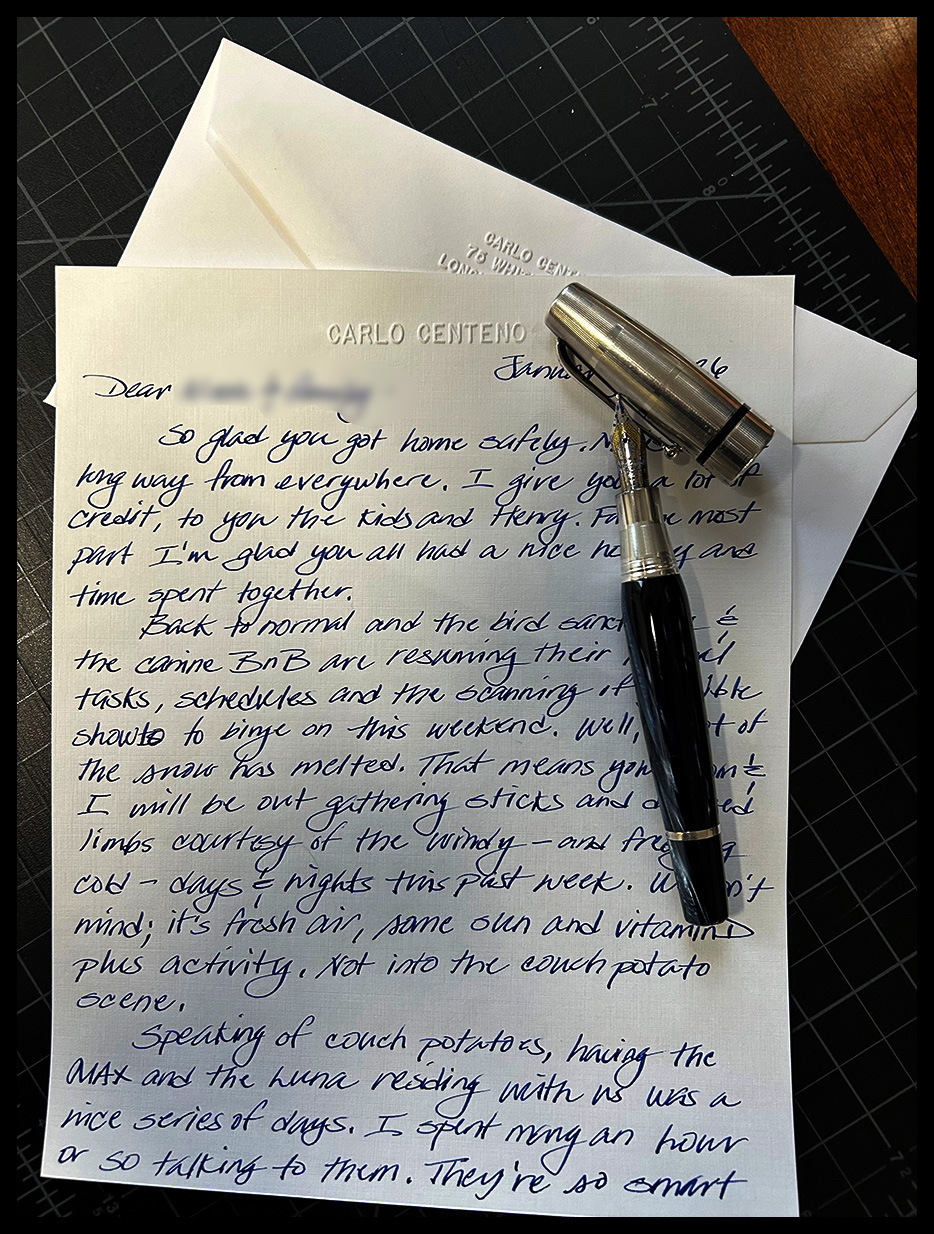
Yet on any given day or evening, I’m not far from paper and a pen filled with royal blue ink, ink drawn from a bottle and into a pen barrel via its nib and the piston residing in that barrel. Archaic, perhaps, yet some believe such things are unnecessary for our current state of living. What about the state of your life and the qualities that define its value…?
A frequent criticism is that using such a writing instrument is too slow, to use and get used to. Put another way, this is a communication method that requires your patience, your willingness to engage both mind and heart over a period of time. Handwriting is the articulation of thinking, learning, feeling and so much more.
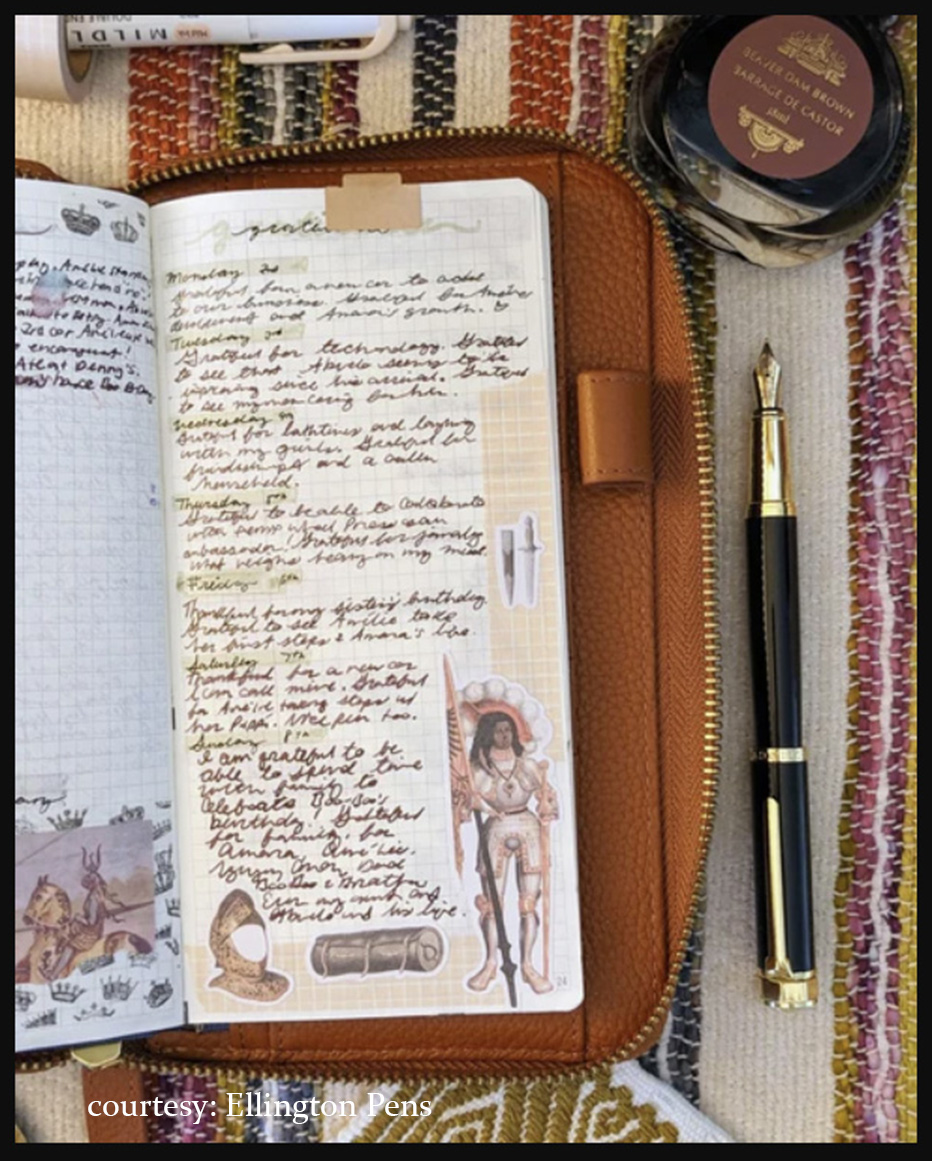
I would be remiss if I did not include some of the toils in finding the right paper and ink that adds to the fascination of such a timeless way of expression. These 2 items are just part of the discovery process, one which needs your attention as you gain familiarity and traction to fountain pens, inks, types of paper and of course, writing. With a nod to digital technology, researching pens, paper and ink is far easier now than it has ever been.

Writing with ink and paper is slow, certainly slower compared to the speed in which we talk; and even that is a lot slower than our brains when we’re processing just about anything we can think of. Writing slowly does not correlate to slow thinking. Such writing encompasses thoughtful pauses, an examination of those and adjacent thoughts, whether abstract or tangible, even working to make what was just put to paper more lucid for anyone–including myself–to grasp.

If you’ve come this far, you might have wondered about the “Permanence in Paper” notion in the essay’s title. Paper and the writing it holds can survive over a long period of time. But I wonder about some of those pages bound or bundled together for centuries. Egyptian manuscripts written on Papyrus are some of the oldest known individual texts in existence. Their scrolls go back c. 2500 BCE, whereas paper in its earliest form appeared in China c. 105 CE. [Note: BCE stands for Before Common Era and CE represents Common Era. These are the secular versions of Before Christ (BC) and After Christ/Anno Domini].
I think of times in history when handwritten correspondence was the perhaps the most confident way to connect. I visualize piles of envelopes each with a letter, a notice or alert, even a photograph among other possibilities. There were many, many things in those letters, rote and topical. There was the weight of loss and longing, of anticipation and impatience, of a happiness that seems forever in arriving, or the gravity of profound grief relentless in its hold of sadness, regret and helplessness.
Books have been written describing letters that have been exchanged. John and Abigail Smith Adams regularly wrote to each other. They were well ahead of their time as they were reciprocal to each other for support and encouragement and more. Think of this: more than once, Mr. Adams stated in his letters that Ms. Adams was his “dearest partner” and a “stateswoman” worthy to be among the most astute of advisors and confidantes.
Queen Elizabeth 1 wrote upwards of “3,000 plus letters to her oldest daughter.” President Lincoln’s “letter to Widow Bixby” is as empathetic and demonstrative of any condolence letter addressing a mother’s loss. The King of Sweden, Gustav Vasa [1523-1560] wrote at least 1,000 letters according to records; the quantity filled 29 books.
Then there are the epistolary writers who crafted letter writing from letters available to the public. Their constructs of referring to letters within a story or a novel carried some significance to the protagonists, society, an ideal, a scandal and so on. Authors Mary Shelley [Frankenstein] and Bram Stoker [Dracula] were epistolary writers. They used letters as a vehicle to convey everything from discovery to fear, to hope and love. And to think that their stories with these references of hand written letters have to this day, remain relevant and thought provoking.
For those who already do as I do with pen and paper, well they know a few positives associated with this old-school way of communicating: for starters, no special apps or electronics are required.
Return to terra firma. A few pointers
- Practically speaking, if this is your first foray, or re-entry to FP writing after a long sabbatical, you do not need a costly [above $25. USD] pen. You can obtain a fountain pen at a lower cost, but you get what you pay for. To start, select a universally adequate Medium nib. Nibs are made with steel or gold. Steel is more durable and gold has a feel all its own. The pen should come with a converter with the option of using universal ink cartridges. Color ink? That’s up to you.
- Speaking of ink, the easiest brand [at least around here] anyway is a ubiquitous bottle of Parker “Quink” in black, blue-black or royal blue. I believe all but the black is water & spot-cleaner soluble in combination. Parker offers cartridges as well, useful when traveling and potentially not as messy as carrying bottled ink. The Parker cartridges are made for use in Parker pens, however, you can also use universal ink cartridges, which are shorter in length and just as functional as any other.
- Paper. For initial practice, copy paper works, but it’s not ideal. You may experience blotching [when the paper sucks ink out of the pen creating spots]. And/or feathering, which is when the lines that make up your letters show tiny “feathers” coming from the main line that defines your letters. Ultimately, this will take some trial and error. Paperworks has a special sale of letter sized paper that may do the trick. Look for samplers that offer sheets of different weight papers. I cut these sheets in half and have a faux-Monarch size sheet I use for letters.
- Etsy has a number of papers as well. Names such as Clairefontaine and Tomeo [fantastic quality from Japan] are just 2 of other manufacturers that offer incredible papers. I do recommend you stay with smooth finished sheets versus sheets that have texture. Trust me on that one suggestion. A smooth surface is more forgiving than one that has texture. Goulet Pens has a complete section/tab on everything that has to do with fountain pens, inks, nibs, paper et al.
- You can also create your own personalized cards, letters and envelopes using an embossing stamp. I use one for my return address on the flap of the envelope and the second I use to emboss my name at the “header” area at the top of my letter.
Here’s another resource that you may find useful in your journey:
https://epica.com/blogs/articles-by-epica/putting-pen-to-paper
Final thoughts
Establish a schedule to write. Get yourself a journal and consider writing anything that comes to mind. A letter to your adolescent self or your current and future selves; notes about the _[skill]_in you that you want to improve. Essentially marry your thoughts to the fine motor skills that are important to clear writing. Legible writing is one thing, while illegible writing is but stepping stone that can lead you to letters, words, sentences and more with a character that’s yours and yours alone. Like learning an instrument, to be good at it, you need to have a plan, and you need to set aside time to make it work.
When you’re all in, the writing activity goes beyond movements of your wrist. Remember it’s your writing arm that carries the energy required to move synchronously across the paper & table top. Using your entire arm is necessary because it encourages good coordination and a focus. Another benefit is the wrist won’t do all the work, which means less repetitive stress to all those small tendons and cartilage, etc.
Left handers can fountain pen their way on & across paper. Take a look at scriveiner.com which contains a good amount of helpful details on what to look for.
Finally, I leave you with perhaps the wisest sentence in this top-heavy tome of questionable relevance:
“If people cannot write well, they cannot think well, and if they cannot think well, others will do their thinking for them”. George Orwell
 Carlo Centeno