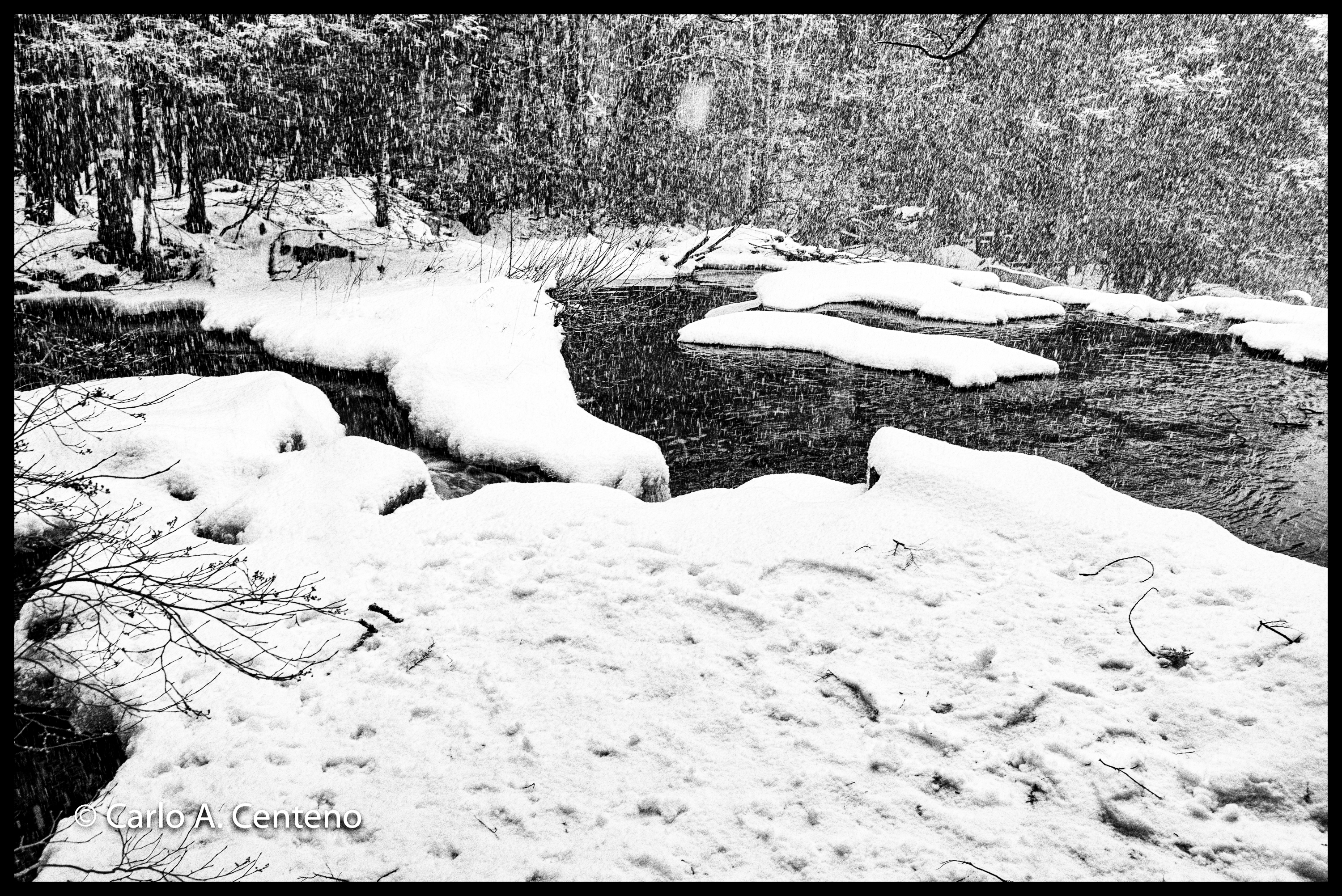
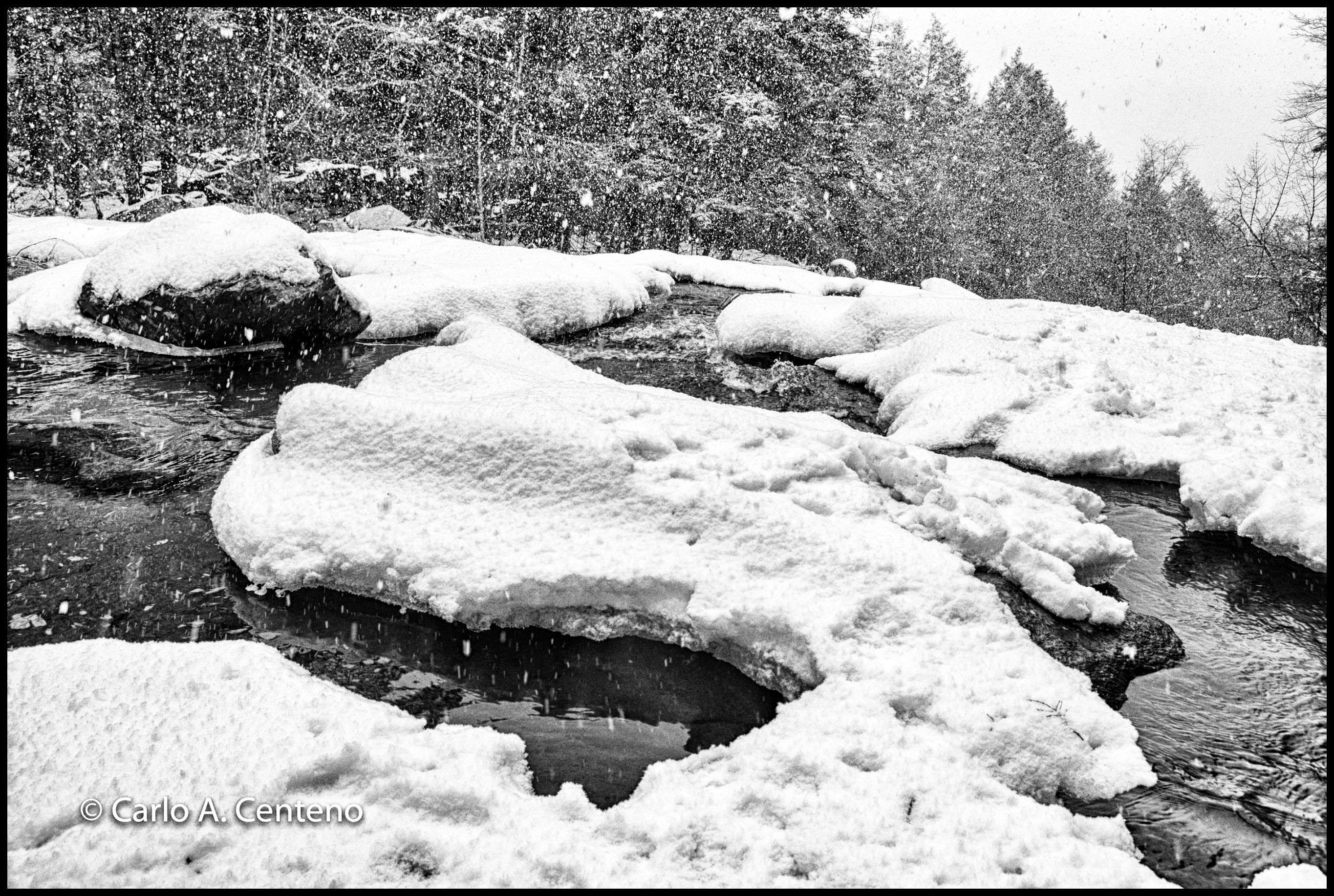
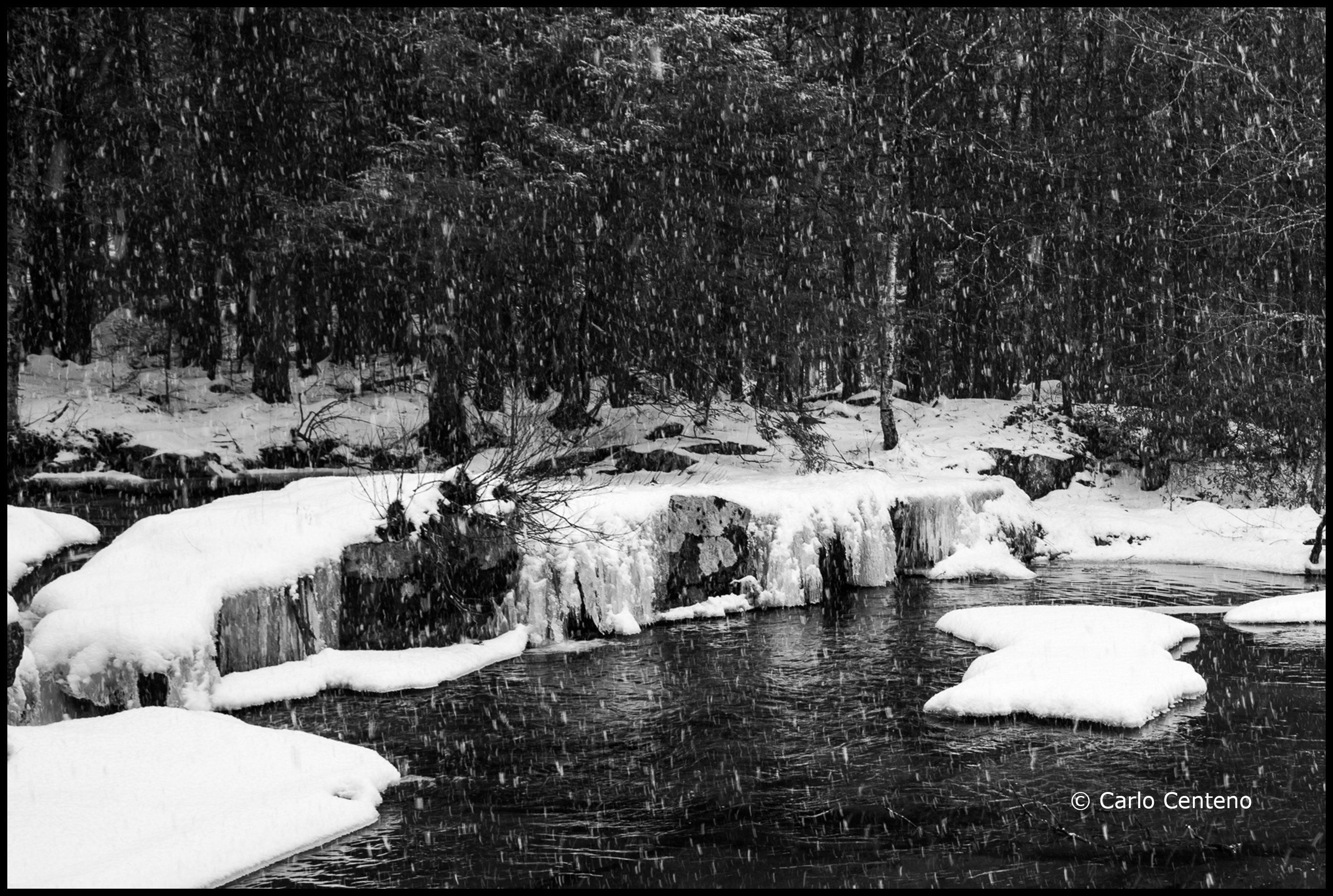
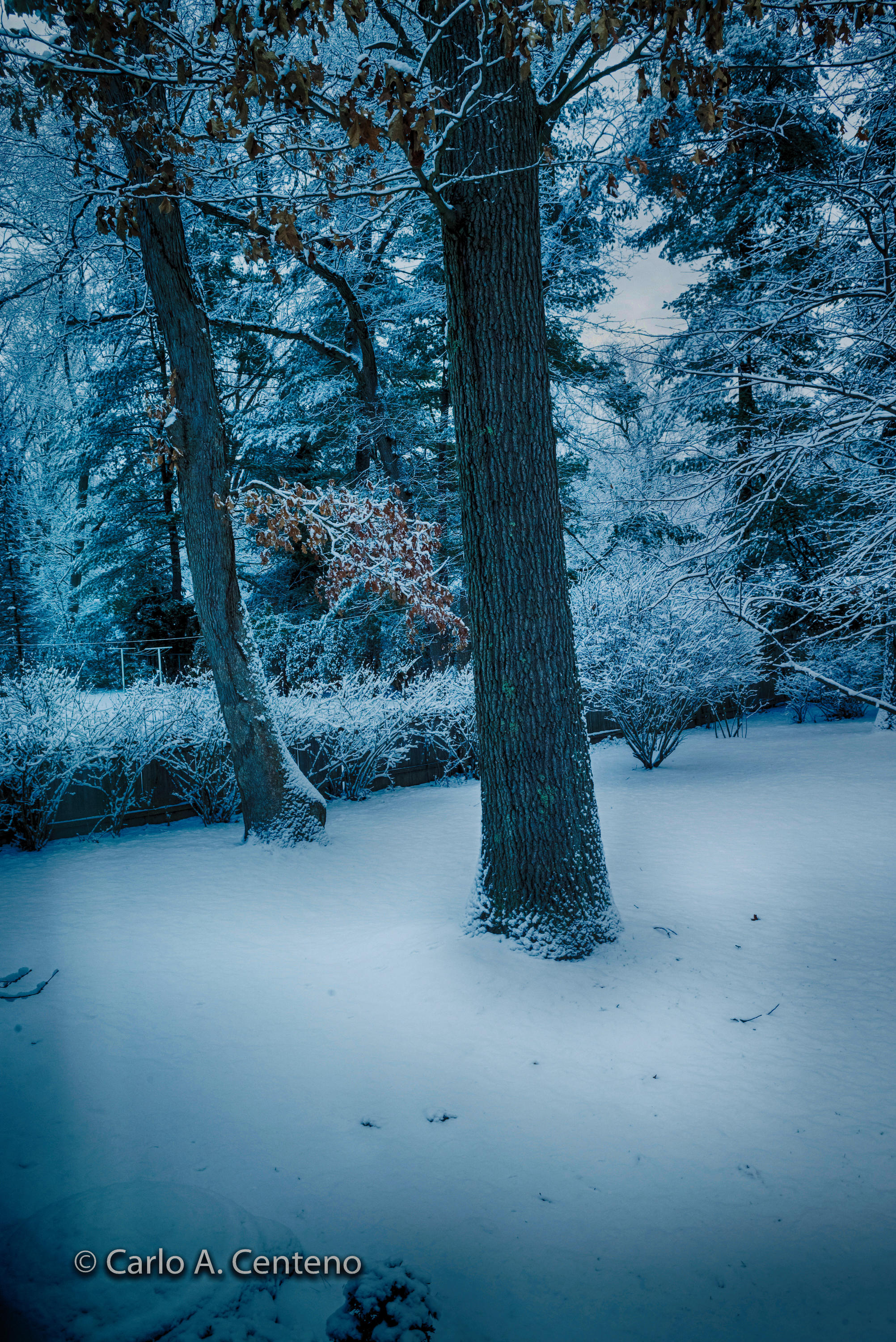
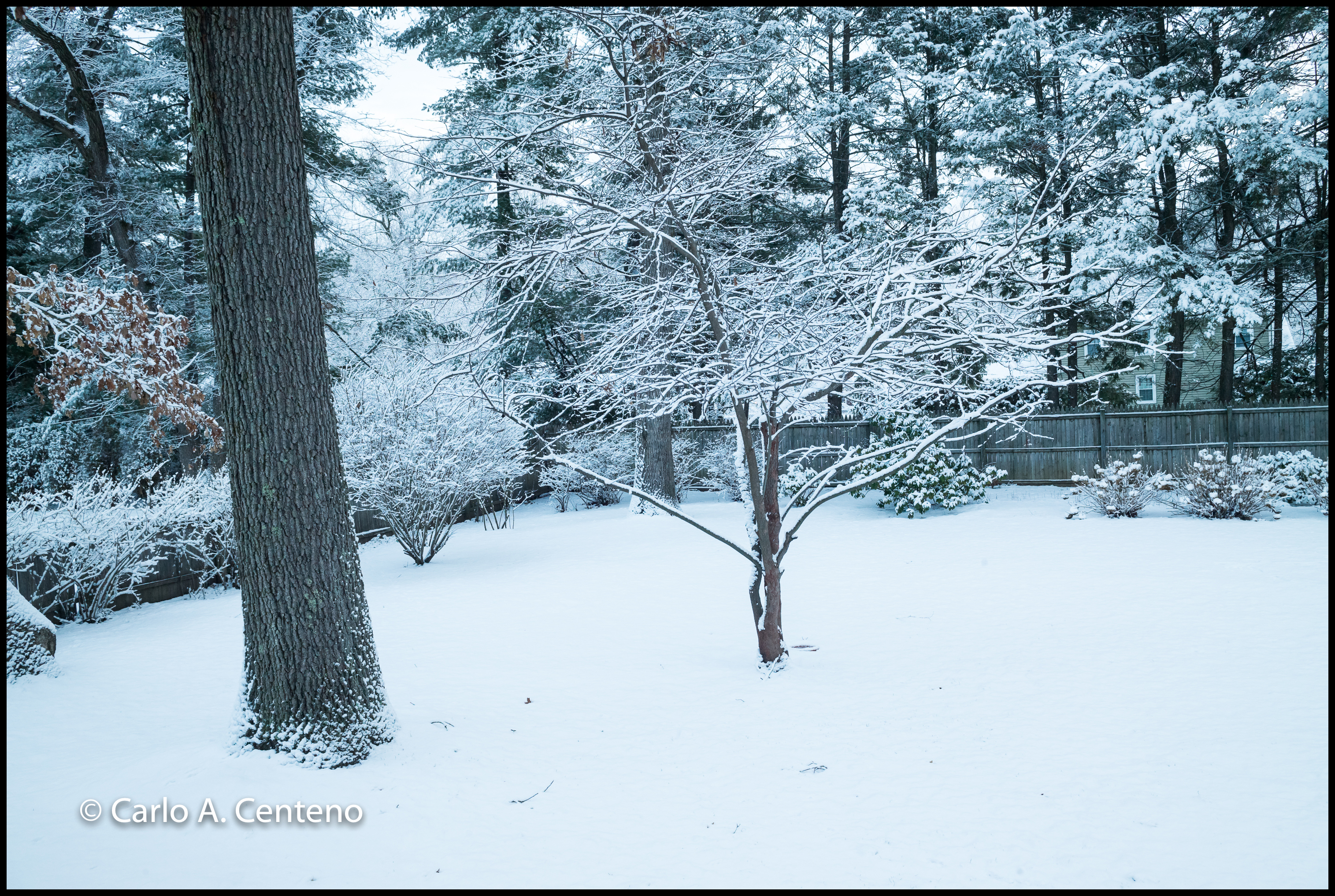
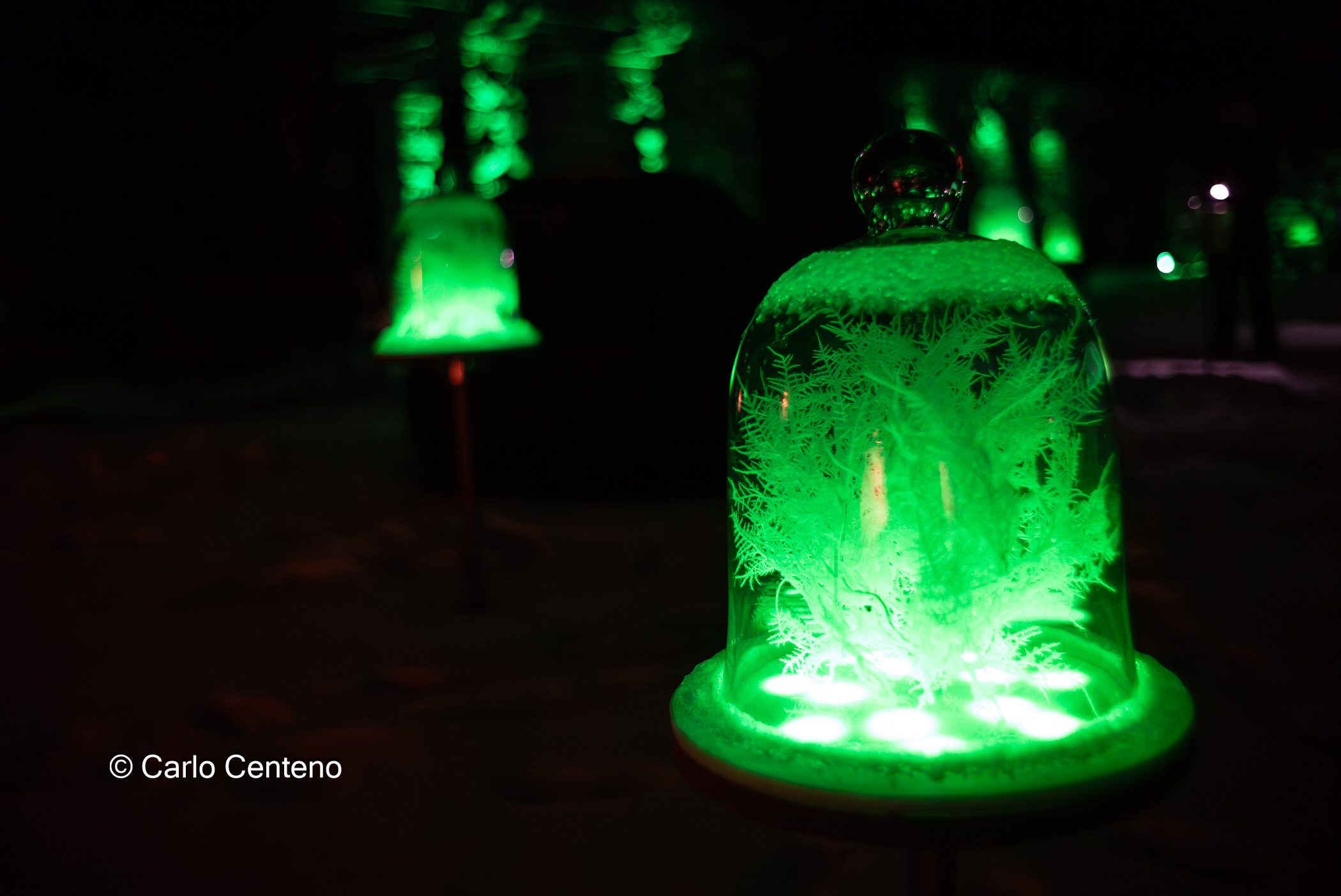
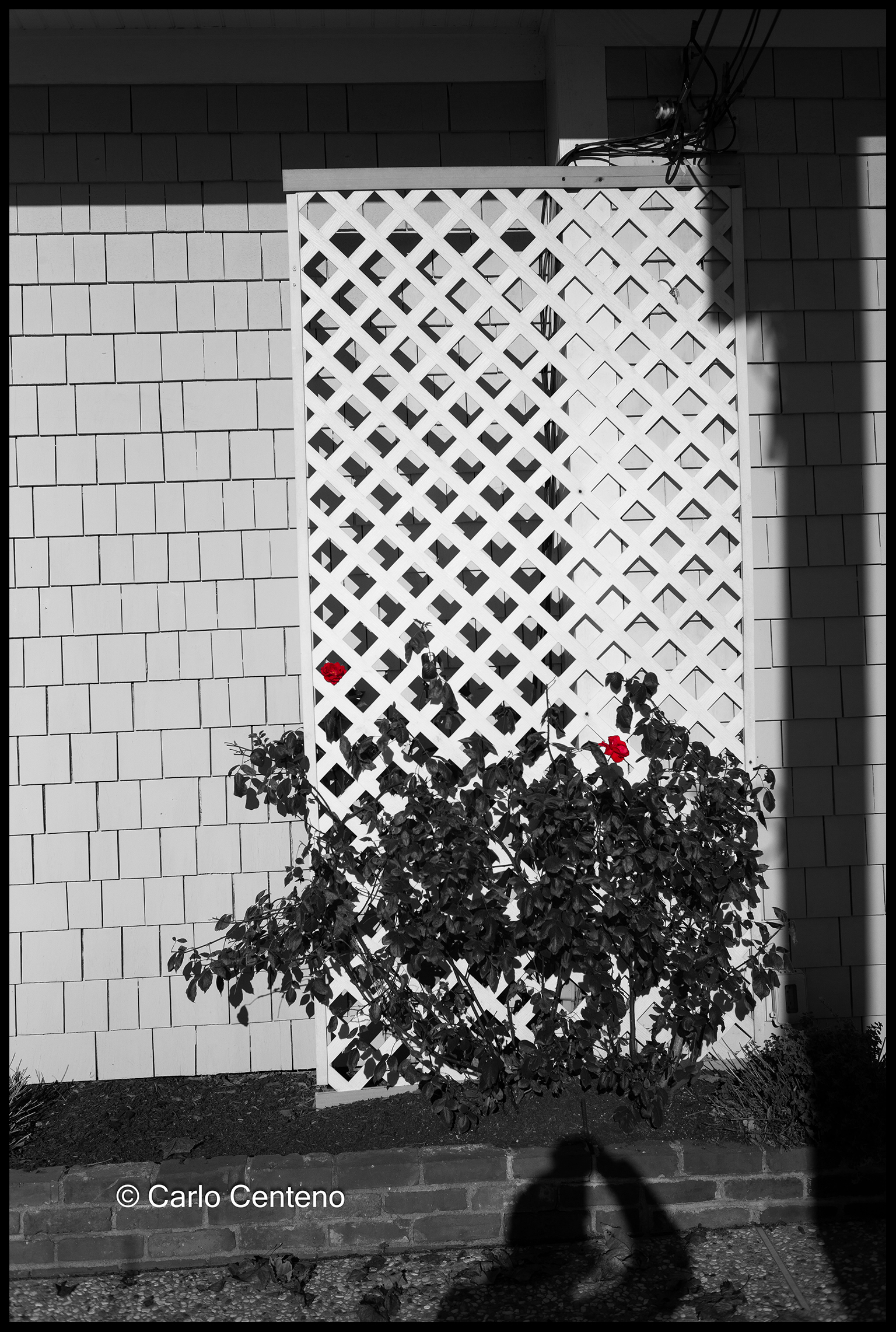
WinterLight-2

I’ll admit that it can take a lot out of you when winter conditions pin indicators below the norm [temperature, wind chill], or above the line [accumulation and severity of snow/freezing rain/sleet]. By February, a good number of folks are pining for—some hoping through a telekinetic event—the arrival of spring.
Yet in spite of our incongruous sentiments about winter, its been said that residents of Scandinavian countries can make the best of it.
Perhaps their overall acceptance of this perennial cold, snow and short days has something to do with the their countries having “the happiest people in the world.” Is there an attitude, a perception that we’re altogether missing? Warmer clothing compared to ours?

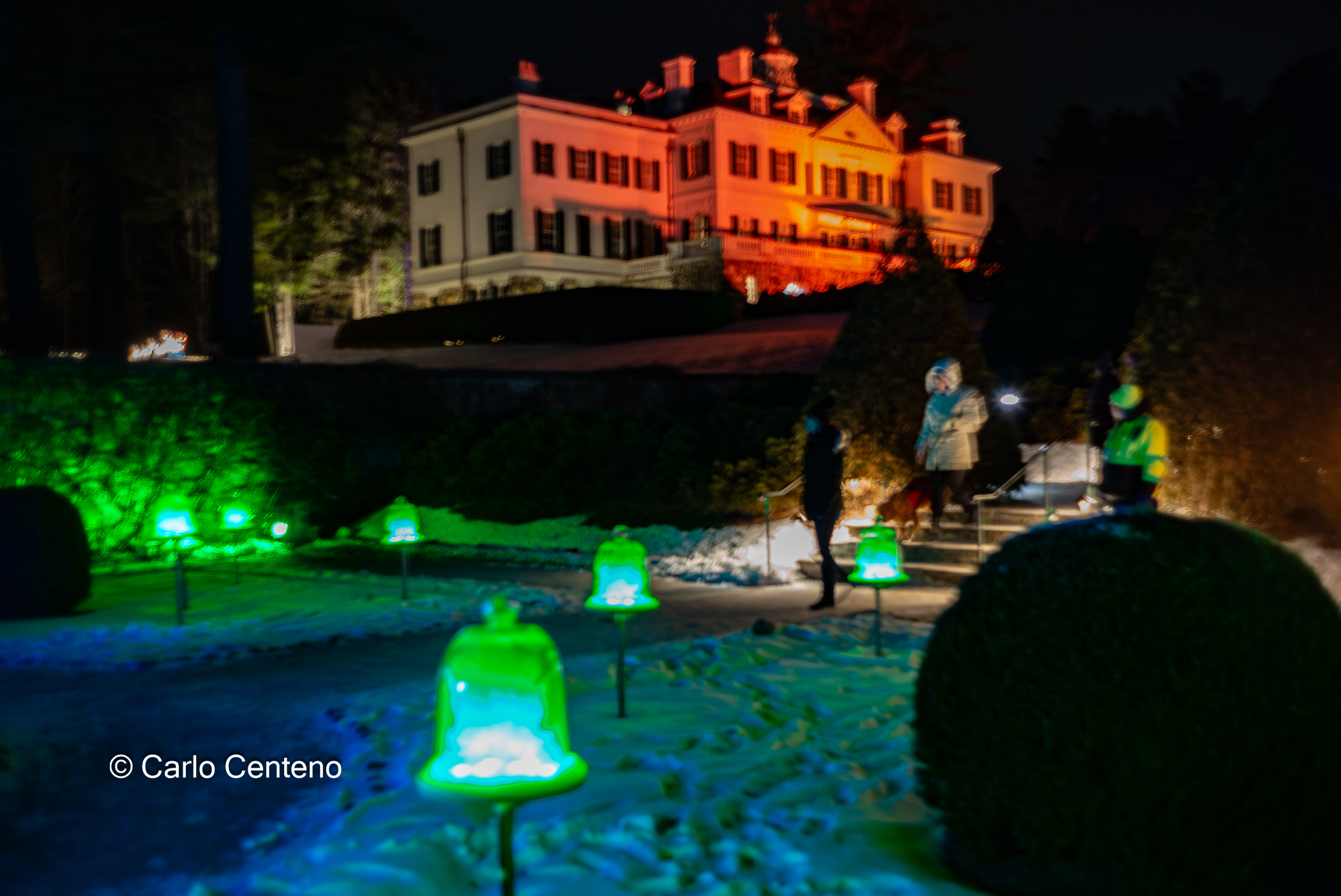
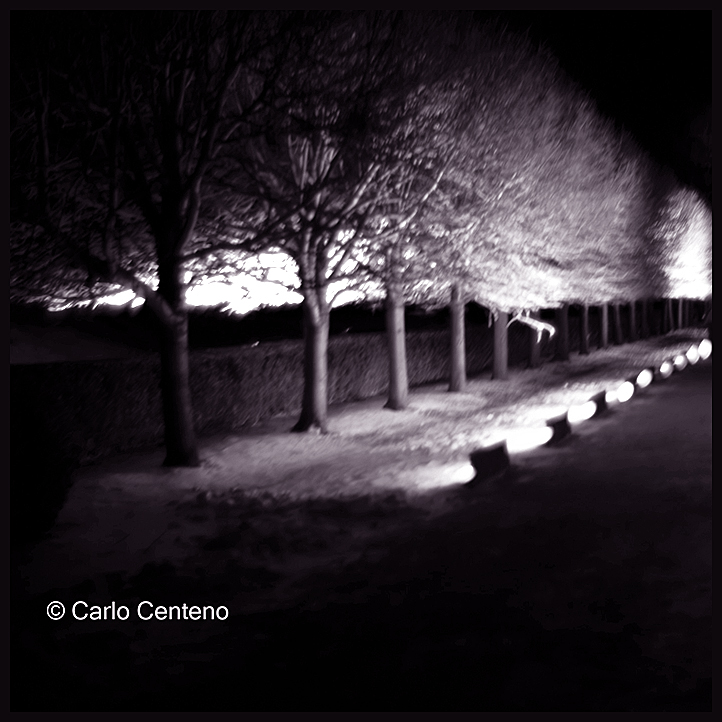
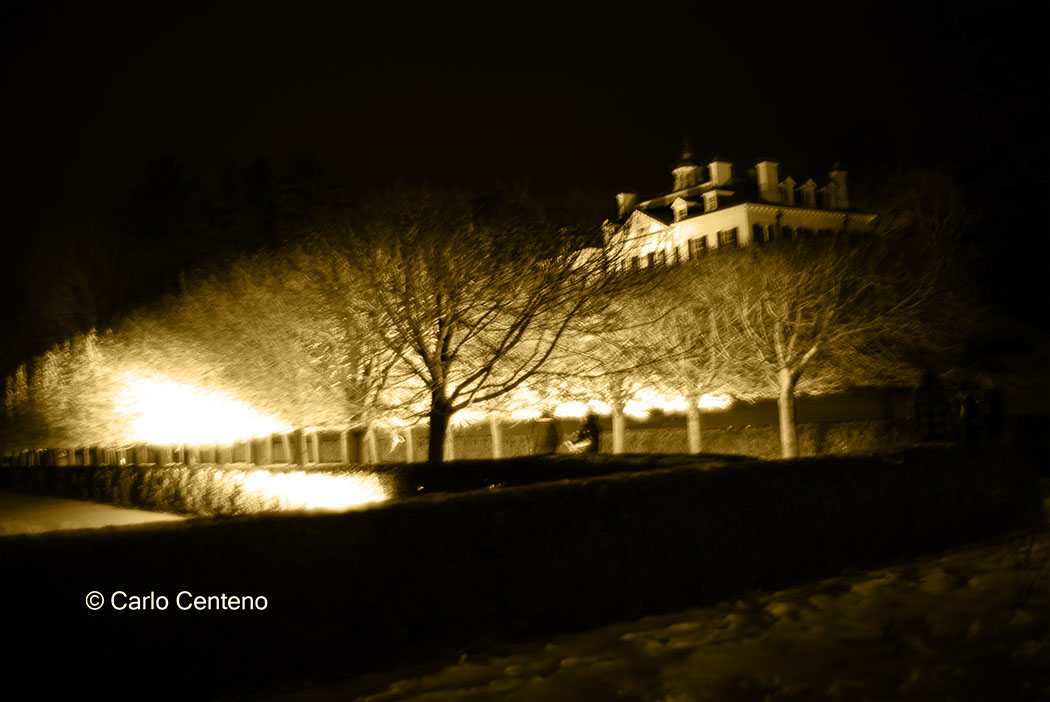
We’ve [me and my wife, MJ] made treks to the Berkshires all year long with additional stops during winter. Some of these stops included special outdoor exhibits of which 2 come to mind: The Mount, Edith Wharton’s home, and also at Naumkeag Estate. The photos posted here are from Nightwood, and it was a wonderful stroll along the garden pathways and woods at The Mount.

Appropriate winter clothing makes a big difference; it does get colder in the Berkshires. Key details: wool sweaters, base layers, even hand warmers.
Along a mile-long path cutting through the woods and gardens, the exhibits appear like waypoints on a map. Each installation carries its own interpretation of light, while an original music composition aurally ties everything together.

My interpretation of The Mount exhibit centered around the intensity of each installation, vis-a-vis the light itself. Using B&W images had provided [for me] a key, old-school tenet of imagery: simplicity allows interaction between the visitor, and the subject at hand. Put another way, monochromatic images transcend continuity. Color images offer validation to what we see because we readily see color. Yet color can be distracting. Not a slight, but just a matter of fact.

For me, I’m drawn to B&W images because of its tonal consistency. Black & white does not have the influence of color, and yet allows me to see the entire image and all its nuances.

I, along with others like color images , but there are times when color feels more like a distraction. A single color that’s part of a smaller detail is enough to pull you away from the whole and down into a rabbit’s hole. Still, B&W does have a way of binding together the elements that make up the photograph, all within the inimitable, ever valid black & white palette.

Winter Light

[Dylan Thomas, poet; Do not go gentle into that good night.]

Do not go gentle into that good night,
Old age should burn and rave at close of day;
Rage, rage against the dying of the light.

Though wise men at their end know dark is right,
Because their words had forked no lightning they
Do not go gentle into that good night.

Grave men, near death, who see with blinding sight
Blind eyes could blaze like meteors and be gay,
Rage, rage against the dying of the light.

And you, my father, there on the sad height,
Curse, bless, me now with your fierce tears, I pray.
Do not go gentle into that good night.
Rage, rage against the dying of the light.

Life Lessons

It’s been said that everything you needed to learn and know in order to get through a day was taught in kindergarten. That was the early-in-life primer, essentially a course in fundamentals: polite behavior, expressions of gratitude, common courtesy and common sense in all things you say and act upon.
Some life lessons around loyalty, unconditional love, patience, trust, kindness–among others–were influenced by my dog, Humphrey. Naturally, various experiences with family, teachers/professors and good friends added to that mix as well, as well it should.

Humphrey

Humphrey was a miniature cockapoo, but there was nothing small in his character or demeanor. Simply put, he acted like he was the biggest, baddest, dog east of the Mississippi. He possessed a radar that had a way of measuring and reading the nature of most grown ups, and of course other four-legged creatures [read: neighborhood dogs he didn’t quite like]. I’ve heard it said that the size of the dog doesn’t matter as much as the size of its heart. And that little guy had a huge heart.
Children were another story. He was comfortable around them. Humphrey was just as curious about kids, as the kids were with this little guy. Throughout his life, many thought Humphrey to be a puppy. In a sense he was that in many ways.

Our winter dress code.

It makes sense to me that the weight and burden of grief that comes from the loss of a pet correlates to the amount and type of affection you gave the pet, and vice versa. Reciprocity at its finest. Quite frankly, that equation is the same for family, significant others and close friends. When you truly care about someone or something, you give it your all, certainly your heart and soul as a minimum.
MJ and I support each other in all of this. She did, indeed, have a big part in Humphrey’s life, as did our kids and grandkids. Those connections or bonds don’t disappear at death. Not surprisingly, we had thought about ways to extend Humphrey’s life, perhaps just a bit more care or special intervention would’ve helped, but time waits for no one.
Second thoughts arose wondering if any intervention for Humphrey could still help him. I think part of understanding what love is revolves around one’s willingness to let go. We’d like to think that as the end drew closer, that that pup knew he added so much to our days, and vice versa. Life lessons arrive from many points. From the smallest of vignettes to those large and complex, there’s something one can glean from experience and interaction.

Two happy, ol’ dogs…

Not surprisingly, other events or milestones reach out and overwhelm us, including one in particular. About a week after Humphrey died, one of our daughters and her husband added to the number of grandchildren. Their second child–and our fifth grandchild–was a welcome sight!

Welcome, dear grandson…!

He was the salve to our sadness. The sounds and expressions of loss and affirmation differ. Death and grief are shadowed by life, not the other way around. That new baby dampened down some of the grief we’ve been carrying. The creation and arrival of a new life, affirms the reality that dying and being born are conditions each of us cannot deny. With one, comes the other.

Fate added another exclamation point to all of this. Just before the end of March, MJ’s sister suddenly passed away from heart failure made more complex by cancer. And just like that, death set us back yet again. Nostalgia, sadness, regret and second guessing returned in force. No sooner than when the new baby arrived home, MJ and I were thinking about an obituary and a funeral to attend in short order.

In all of this, I’m reminded of what MJ’s mom said about the passing away of loved ones: remember them on their birthdays, not just on the day they died. That notion has stuck by us for quite awhile now. With birthdays come celebrations, the gathering of family and friends, and an opportunity to reconnect with good times and the people who are and were a part of that. To auld lang syne, to “times that have gone by.” We can think of any number of experiences that raised a smile, a laugh, a few tears, but don’t mistake this as longing or living in the past. It’s really a time to be in the moment, a key one at that, to share recollections with those in attendance and in doing so, our connections to each other are again [or for the first time!] affirmed.

My take on all that’s happened is that our willingness to interact with each other can never be replaced with the efficiency of Facetime, Zoom Meetings, teleconferencing and any other present-day digital communication. The attributes of efficiency cannot separate us from emotions and empathy. There are lessons woven into experiences that can be shared, indeed as some should anyway. It’s what makes each of us a wholly unique, sentient being.

The peaks and valleys this past March, made clear that we need to nurture our connections to family and friends, to dogs and cats and pets, and to others outside our zones of comfort. Good or bad, joyful or sad, the confluence of your feelings shared with others enhances many of life’s lessons…

Photographic Somnabulism: second stanza

Give credit where credit is due. The fine-art book, Somnabulist created by photographer Ralph Gibson in 1970, was where I first saw the word, somnabulist. His fascination with discovery and the realm of things abstract made for different if not interesting images. My take was when reality is cojoined with one’s dreams, it’s a means to an end: achieving success, finding calm, reducing stress, maintaining good health, nurturing family and friends and so forth. The following images are dreamscapes of sorts. They’re a far cry from Mr. Gibson’s B&W prints.
As in life—that is in being “awake”—light, shadow, colors and the dark all have a role in both dreams and living. One is allegorical, the other experiential. Or even both?

WIT: Words, Ideas and Thinkers.

The inaugural 3-day, WIT Festival recently finished here in the Berkshires. Authors, journalists, novelists and playwrights gathered to engage participants in this year’s theme, Reimagining America. This was an opportunity to broaden one’s understanding of critical issues and concerns coursing through our current–and varied– socioeconomic and political points-of-view.
The festival is the brainchild of The Authors Guild Foundation, the largest organization of its kind in the USA that “educates, supports and protects American writers across the country.” It’s been noted that the Authors Guild Foundation is “the sole group of its kind dedicated to empowering all U.S. authors.”

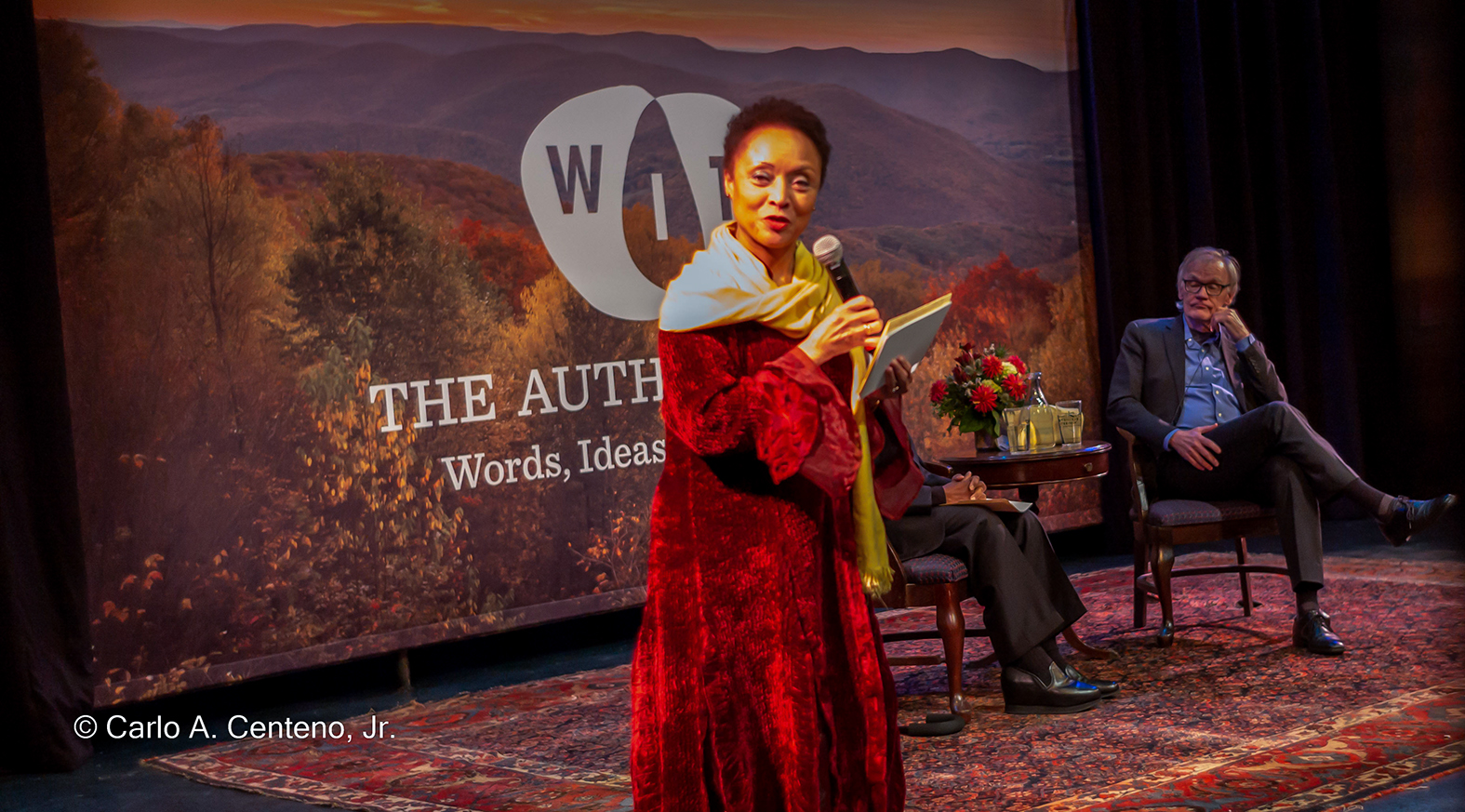
Ms. Lynn Boulger, executive director of the Authors Guild Foundation, welcoming authors, attendees, patrons and friends.

Berkshire County lies in western Massachusetts. Its rectangular shape stretches north-south with New York state at its west border, Connecticut to the south, Vermont to the north and to the east it borders with Hampden, Hampshire and Franklin counties. For many, the Berkshires is more than a destination: it’s a way of life.

Dan Brown, author of best-selling novels The Da Vinci Code and Angels & Demons.

Presentations/discussions took place at Shakespeare & Company in Lenox. For the most part, the 3-day festival sold out, however a roster of those wanting to attend were placed on a list just in case of cancellations. I did not hear of any registrants calling to back out.

Ms. Nikki Maniscalco, associate development manager, The Authors Guild Foundation.

I think the salient detail I took away was in finding a connection with the speakers. Whether through their anecdotes and experiences or with discussions that were enlightening or instructive, discovering these connections became visceral. The connections answer to or affirm my own perceptions, creative risks and even the most profound sentiments I keep close to the proverbial vest. As effective podcasts can be, for me there’s a lot more to glean from such happenings when they’re done in person. There’s an intimacy about gatherings as you hear, see and feel more than just commentary. And in that collective presence, you may pick up emotions inferred or otherwise demonstrated in tone, expressions and body language.

Ms. Janet Dewart Bell, PhD–author, social justice advocate, executive coach & more!

One cannot dodge a glance or ignore a gesture, or miss a light-hearted remark to loosen up a room. As good as podcasts are—and they have an important place in communications and education—being there does make a difference.

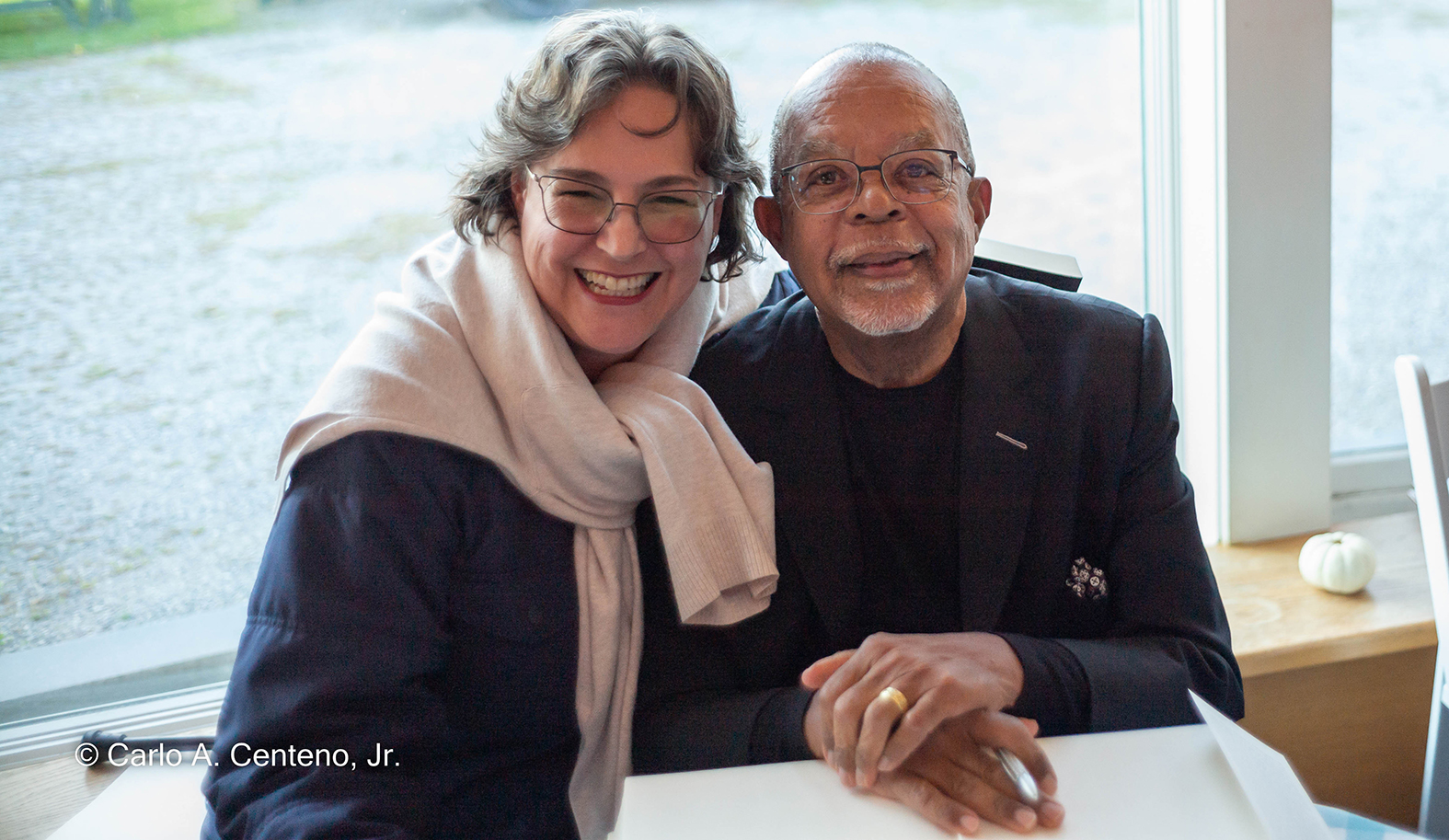
Henry Louis Gates, Jr.
David W. Blight–Pulitzer Prize-winning author.

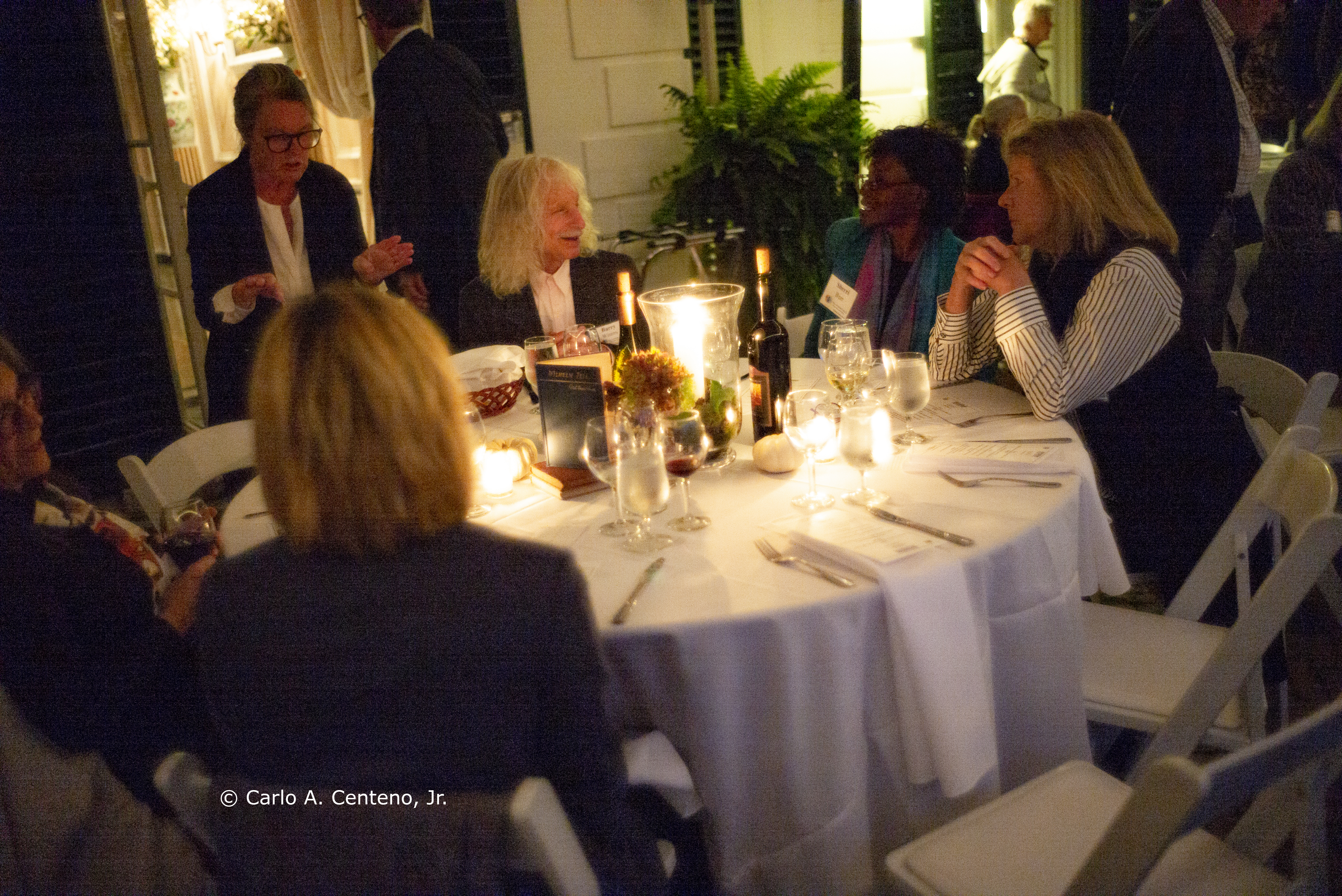
The dinner, served at The Mount: Home of Edith Wharton, was cleverly engaging. Instead of table numbers, the names of authors took their place. Your seat was placed at a designated table which bears the name of the author at the bottom of your name tag [Jean Cocteau] Your actual seat is marked by a small piece of paper with your name handwritten on it.

Each table had a visiting author/writer or playwrite to serve as a moderator. Our discussion started with introductions which quickly morphed into an eclectic blend of reality’s “top stories.” It didn’t take long to connect the dots. To hear one’s writing experience through the years did have a common denominator: persistence. No doubt I’d wager that most of the writers in the room have had to deal with many types of rejection. The cacophony of conversations, the tinkling of flatware against plates and the the intermittent sound of laughter made it clear that many, if not all, enjoyed being in this festival.

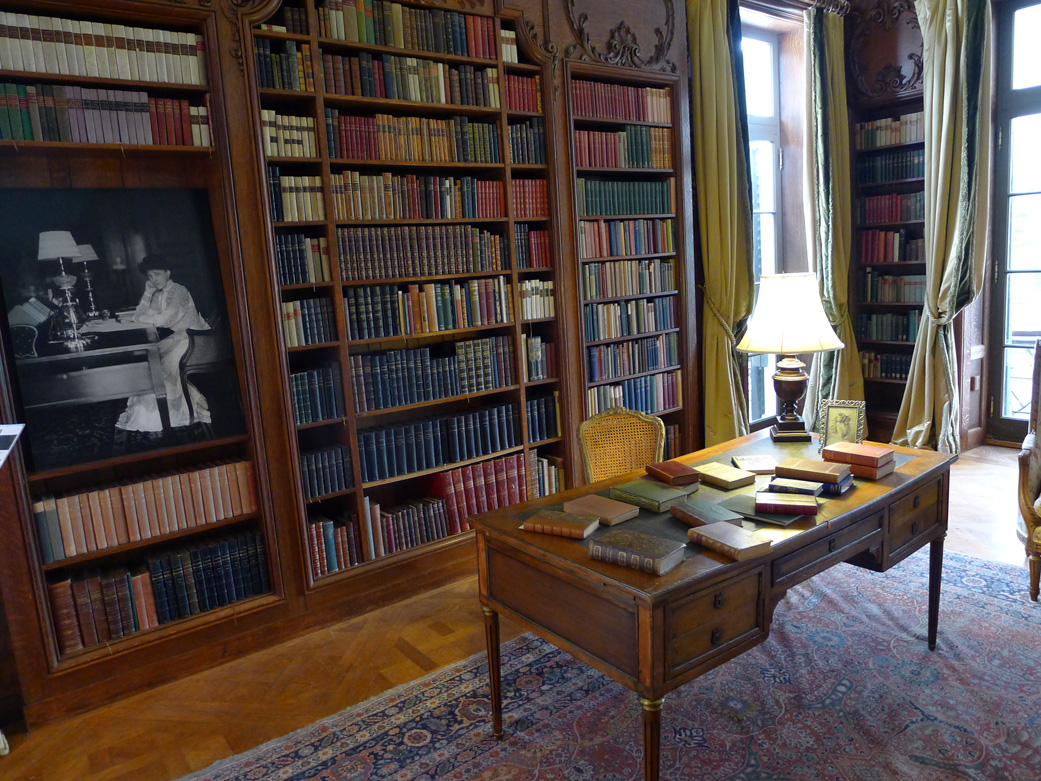
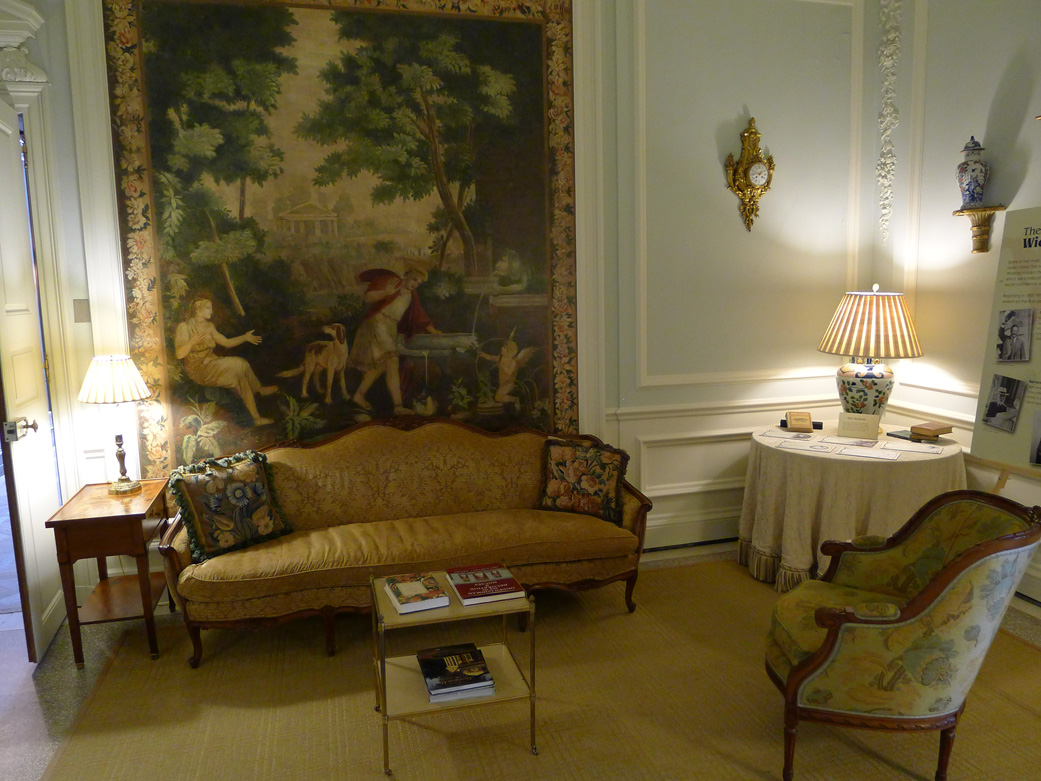
If you happen to visit the area, make a point of stopping at The Mount. Bear in mind that Ms. Wharton lived in that home. I marveled at the scale of its history, its art, design and much, much more .

All in all, I appreciated even more, the permanence and accessibility of books. They are tangible, finite in its content and physical features, yet infinitely capable of challenging your imagination and expectations. Such is the attractive symbiosis of humankind and the inanimate. Both are needed to create and sustain history, the arts, the sciences, and the stories that take shape into something palpable.
A lot of my creative and professional work involves digital technologies. The past 2-years have made that more than obvious. Zoom meetings, laptops & desktops, flash drives and the always-on platforms in social media. We can access a myriad of things electronically, online of course, and the ease of that can make astringent our feeling and thinking from engaging in life that’s face-to-face. Books tend to provide the opposite for me. The pages in a novel can transport me to wherever. The sensory experience of turning and feeling pages are the toner that can spark my imagination and involvement in life. Recall Emily Dickinson’s poem, There is No Frigate Like a Book. To me it’s the leitmotif, that binds our imagination through the settings created by writers and authors. And I don’t need an app or device to open books.

As mentioned earlier, the Berkshires is more than a destination; for many, it’s a way of life.

There is no Frigate Like a Book
There is no Frigate like a Book
To take us Lands away,
Nor any Coursers like a Page
Of prancing Poetry –
This Traverse may the poorest take
Without oppress of Toll –
How frugal is the Chariot
That bears a Human soul.
Emily Dickinson

Cold Light

I am an odd person out. I’m certain I shared this in a previous post, namely that winter, the shorter days, the snow and the cold don’t bother me the way I know it really bothers a lot of other people. However, when freezing rain, relentless winds from the north and sleet show up, doubts perk up about my relationship with winter.
My enjoyment of this season is greatly enhanced by a few other small details: no biting insects, most nasty smells are frozen in place, it’s easier to layer up to stay warm versus shedding attire to get cool. Fireplaces are invaluable for the way they comfort our weary minds and bodies.
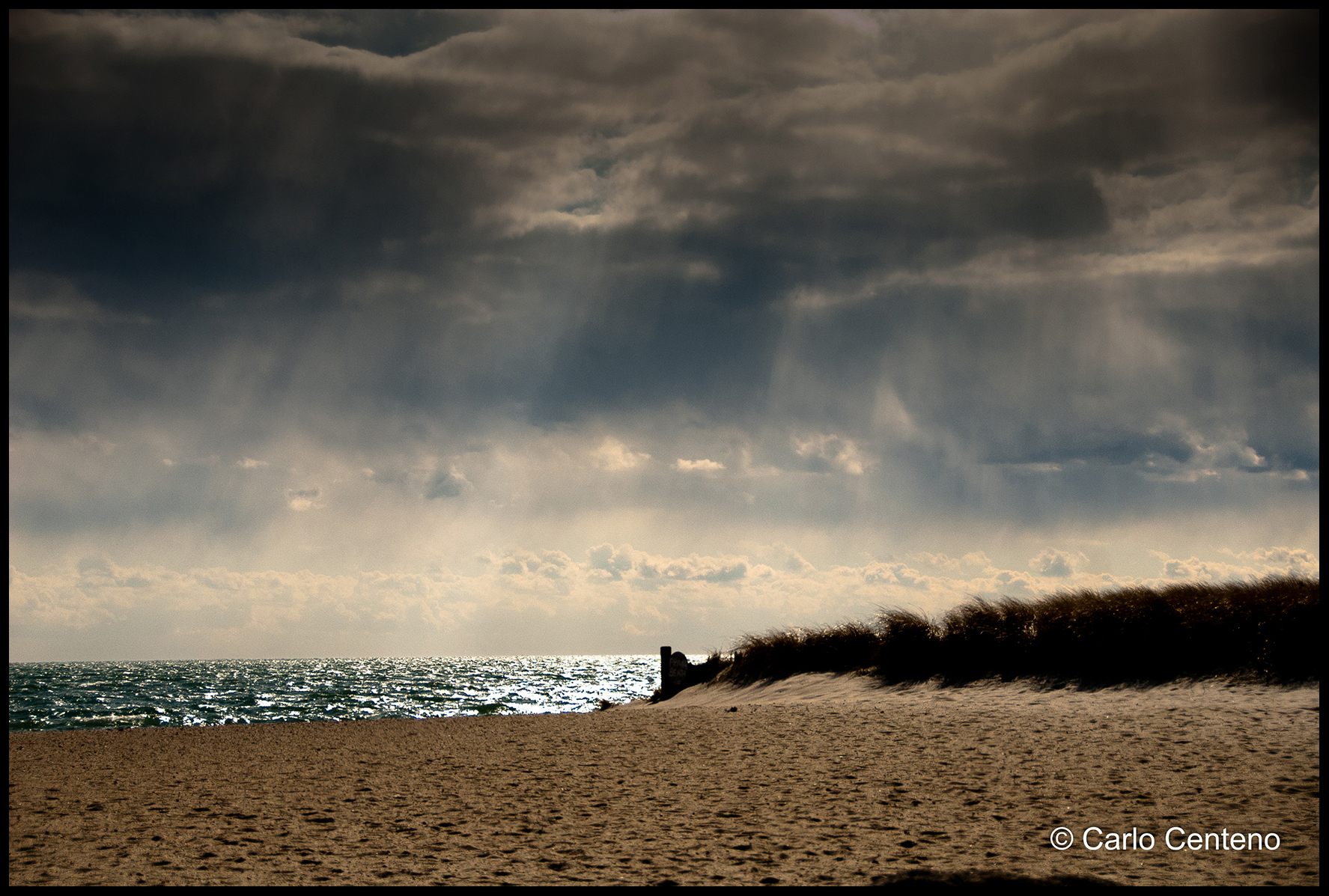
And then there’s the light. By late October, shorter days manifest that longing for days that end at 9:30 in the evening, versus 4:15 in the afternoon. But for me on any given day, winter light can be nothing short of amazing [well, to my eyes anyway].

For those enamored with snow, it doesn’t matter how you enjoy it, just as long as you get out to enjoy it. Snowshoes. Boards. Skis [alpine and cross country]. Insulated tie-up boots [aka “moon boots”]. Building snow forts, a snowman/woman/sculpture. Tubes, sleds, and toboggans. They all generate smiles at one time or another.

Even the most ardent worshipper of other seasons can understand why winter can be a favorite. There’s a sense of solitude, even in the busiest of urban environments. Indeed most folks are rushing—as it’s often said—to get out of the cold, to get inside to warm up. And yet there are those who look to get out to be invigorated by the cold air. When it’s cold, it’s only natural that you move to stay warm: motion generates heat and heat consumes calories and the consumption of calories means soothing cups of hot coffee, hot chocolate, hot soup, hot tea among other choices awaiting your selection. Admittedly, it is bliss having such hot consumables balance out the chill at the end of a day. The yin-yang of warm & cold becomes apparent.

A cold drink can bookend a hot summer day just as a hot toddy can on a cold winter day. This radiating cocktail of hot water, lemon, honey and a bit of whiskey is also hydrating, indeed soothing since it’s a drink perfect for sipping.

Cold light, winter light, is especially sharp when it reaches across a landscape as far as you can see. The shadows are longer and details stand out like bas-relief etched into tree trunks. On ski trails, the tendrils left by carving skis add to that dimension of depth, or even height, as if lengths of dark thread randomly lie atop the snow.

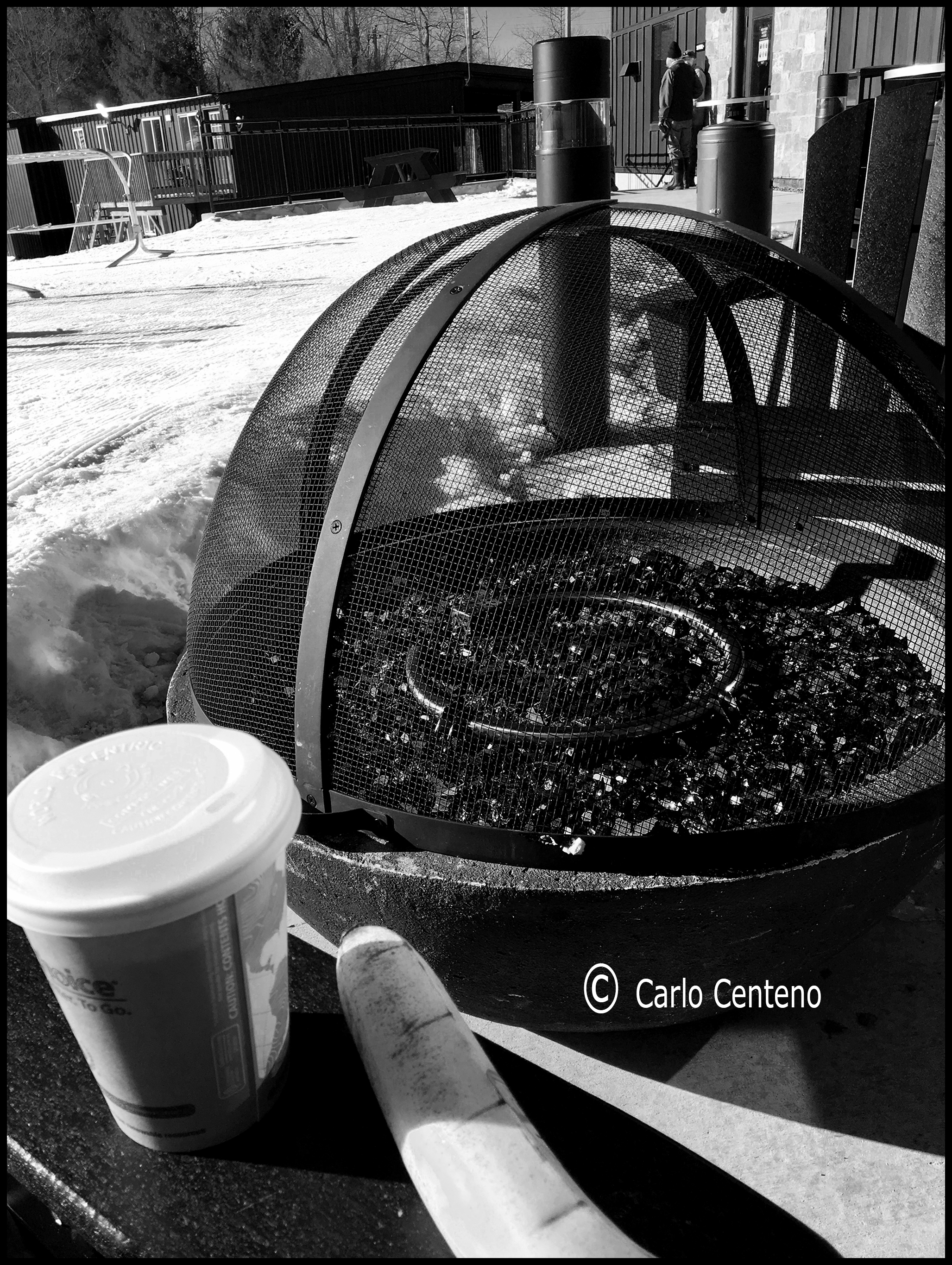
Winter’s light—especially later in the day—can feel cathartic and the sun’s warmth enhances this catharsis. A cup of hot chocolate, a banana, a comfy, large Maine Adirondack chair and a pit fire are all good company.

Cleansing Breaths

A benefit of changing seasons is precisely that: change. Here in New England, the 4 seasons do more than adjust amounts of daylight, colors of sunrise and sunset, the appearance/disappearance of flora, the transitions of both diurnal and nocturnal activities, owing in part to the amount of daylight/nightlight available for particular pursuits from tennis to star gazing. The change in seasons are as much physical as they are metaphysical, philosophical and experiential. The seasons are what you make them to be.

25th Floor–Just after a rainstorm

Often my cleansing breaths are interpreted as sighs of disappointment, or relief, a reaction to someone or something that gives purchase to both feelings. Since the arrival of Covid, I’ve made a conscious effort to use more cleansing breaths. I’m reminding myself there are far worse things to be disappointed with, and using some calming behaviors can make a difference.

25th Floor–North

The benefits of regularly using cleansing breaths has a way of taking edges off of things [vis a vis, the stress produced by today’s level of uncertainty]. Deep breaths and exhales do have physical and mental benefits. Gentle stretches [another cleansing breath, please] coupled with a proactive mindset that focuses on out with the bad, and in with the good has a lasting effect on our overall demeanor.

Ground Floor–Cape Cod

By extension, whenever I see a changing sky—especially one with clouds or on windy days—I attribute these shifts of clouds and air to cleansing breaths. However these are done by Mother Nature on behalf of our troubled planet. Earth is having a hard time rejuvenating much of what humankind has taken for granted, even wasted or destroyed.

Colorado

Whenever I’m out and about, feeling that need for solitude and distraction-free thinking, I load up on cleansing breaths and allow myself the chance to attain “groundedness” a term, I believe, coined by Stephen Hayes, Ph.D., professor of psychology at the University of Nevada. To avoid any confusion, I’ll merely say that attaining a semblance of groundedness means accepting and facing the here and now [however uncomfortable], and to make a commitment or shift of working on things that can mentally/emotionally help you.

Boulder, CO at sunset

The simplest example I can think of is this feeling or acceptance that one’s worklife/career is a dead end and wouldn’t be a dead end if the company your worked for was “better.” There are a myriad of other reasons to choose from. Instead of losing yourself and using up energy on this discontent, nurture a way to make yourself stand out. This isn’t about writing the great American novel or closing on a stupendous sale; it’s more in the line of working from your known strengths to optimize your “here-and-now” going forward.

Nantucket Island, Massachusetts

Now, before you do anything else, take that cleansing breath….

Catskills

There are several places I always look forward to visiting. The Catskills is one of those places. Marketers have positioned it a number of ways, two which I can refer to: the first being that author Mr. Washington Irving created a mystical dimension about these mountains and valleys as demonstrated in two of his works, Rip Van Winkle and The Legend of Sleeping Hollow. The second is that these same mountains are the birth place of American fly-fishing, this, toward the end of the 19th century.

The eponymous short story tells the tale of Rip Van Winkle, who after accepting a drink or drinks from other Dutchmen, went into a deep slumber. A twenty year slumber at that. And to think that suspended animation had yet to be imagined. Like Irving’s other short story, The Legend of Sleeping Hollow, there’s no denying the intrigue and fascination with the dark arts as it were, an ethereal construct of feeling displaced, out of touch and powerless. The spells, debauchery and intrigue hold the reader captive, and the Catskills is both crucible and container to the kind of narrative that keeps young and old awake at night.

Along the roadways that weave up and down and around these mountains you’ll see places with names like The Washington Irving Inn, Sleepy Hollow Mercantile, Rip Van Winkle Golf, etc. etc. From eateries to where locals meet and catch up on recent news, to bed and breakfast attractions, there are many hints at Catskills history and folklore.

As for the fly-fishing, there’s enough rivers and streams to keep you occupied. Certainly there’s enough real estate to get you lost as well or put another way, give you solitude and quiet like no other in the northeast. I’m told that Mr. Theodore Gordon is the one credited for starting American fly-fishing in the 1890s. This feeling of where fly-fishing started in the USA is supported by a smattering of fly shops and other related businesses, several found close to the rivers. For many die-hard enthusiasts, these are sirens that are as strong as the waters and fish that beckon us to get our fly lines in the water.

Covid has altered some of our pursuits, but it hasn’t put a dent on my love or time in the outdoors. Factor in the openness and scale of outside and one can understand the fascination, the desire to get up and out of the house/office and do something for yourself or for perhaps someone else. It’s rare to see another person here in the Catskills or in other wooded areas I’ve been in. Social distancing is a non-issue. In our uncertain world, being wrapped in the outdoors is invigorating and yes, even fulfilling.

Social Distance 2.0

Not again. I can’t imagine the number of times I have thought of that remark let alone the times I’ve said it. I’ve been fortunate on many fronts and I’m more than grateful. The past 13-14 months or so, has been a journey of minor inconveniences compared to what others had to suffer through. I have no reason to complain. Then again with the Delta Variant on a rampage, I can’t help but wonder yet hope that common sense will prevail….

Two renaissance men: my son-in-law and his father.

I have a handful of avocations, each having one thing in common: I am comfortable when it’s me and myself involved. That sounds a bit self-absorbed, but it simply means I’m fine being alone. Being alone and lonely are two different things, obviously. Having alone time is important for one’s rejuvenation, at least for me.
Photography, journaling, letter writing, playing the piano and fly-fishing are welcome pursuits for me. Granted the first and last distractions can be shared and done with others. On several occasions my wife, daughters and other family members have kept me company on nearby waters. Our fly rods might look like conductor batons in a free-for-all, an ensemble of asynchronous metronomes, where each length of graphite is tuned to the individual holder.

On those days when I’m out with a camera, my wife keeps me company. In the city, she waits for me to catch up when I stop to take a photo. After awhile though, the distance and the time it takes to catch up get a tad longer. On jaunts through the woods, the converse is true: our pace is calmer, slower than the one we use in the urban environment. Time takes its time [read: less frenetic] in natural spaces; and for me that’s how it should be.

To see something in the wild is often fleeting: the songbird you hear only to take flight once you actually see it; the whitetail deer that suddenly, inexplicably pops out from the background in what feels like a whisper’s distance, only to bound away just as you look to acknowledge its presence.

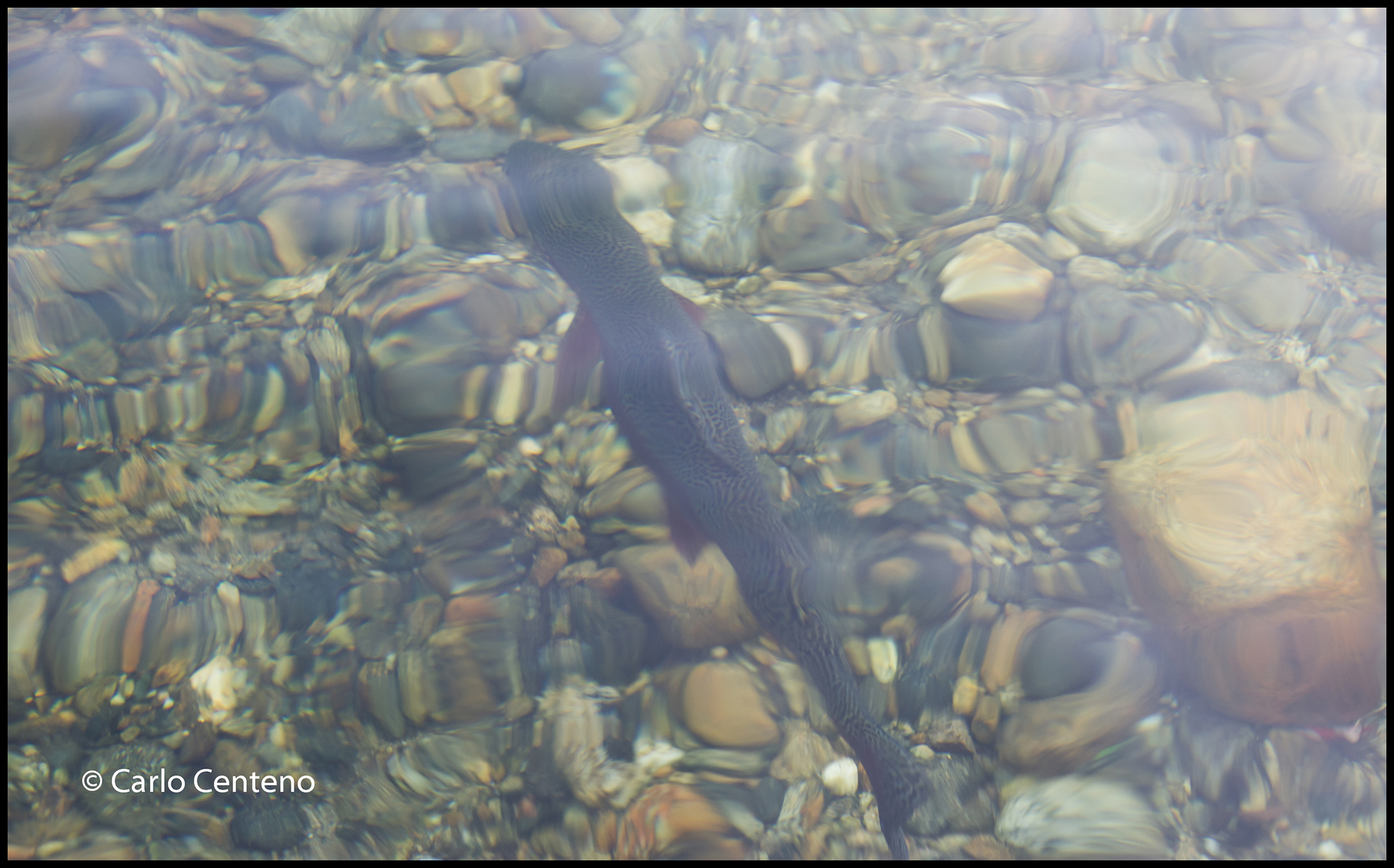
And then I’m handed a “pause” button. Fly-fishing can put a slight pause in what you’re looking at before the moment disappears. Having a landing net is an appreciation multiplier. It allows an opportunity to add a few seconds to really appreciate what you’re seeing. The Eastern Brook Trout is a jewel among fish. I never tire of catching this wild* freshwater creature that can only live in a healthy river or stream. Healthy, as in cold, clear and running. The existence of wild trout means the habitat we’re visiting is good for the fish and everything else that’s dependent on the river and surrounding area.

Ours is a symbiotic relationship with the natural world. Unfortunately, that relationship is out of balance and all things wild and natural are being short-changed by humankind’s behaviors. I find the safest social distance in the outdoors and the time there prompts me to examine the symbiotic and personal relationships I hold dear.

*wild versus native: a wild trout is one that’s been born in the very water it lives in. Wild trout/fish reproduce naturally in their habitat and sustain their populations. A native fish are those that have lived and thrived in areas that have had no or very little human interaction. A stocked fish is from a hatchery that’s typically managed by the state’s wildlife management. Regardless, please make an effort to carefully release these fish [a fly-fishing practice called catch-and-release]. It’s good for the neighborhoods we visit.

The Pen is More Personal…

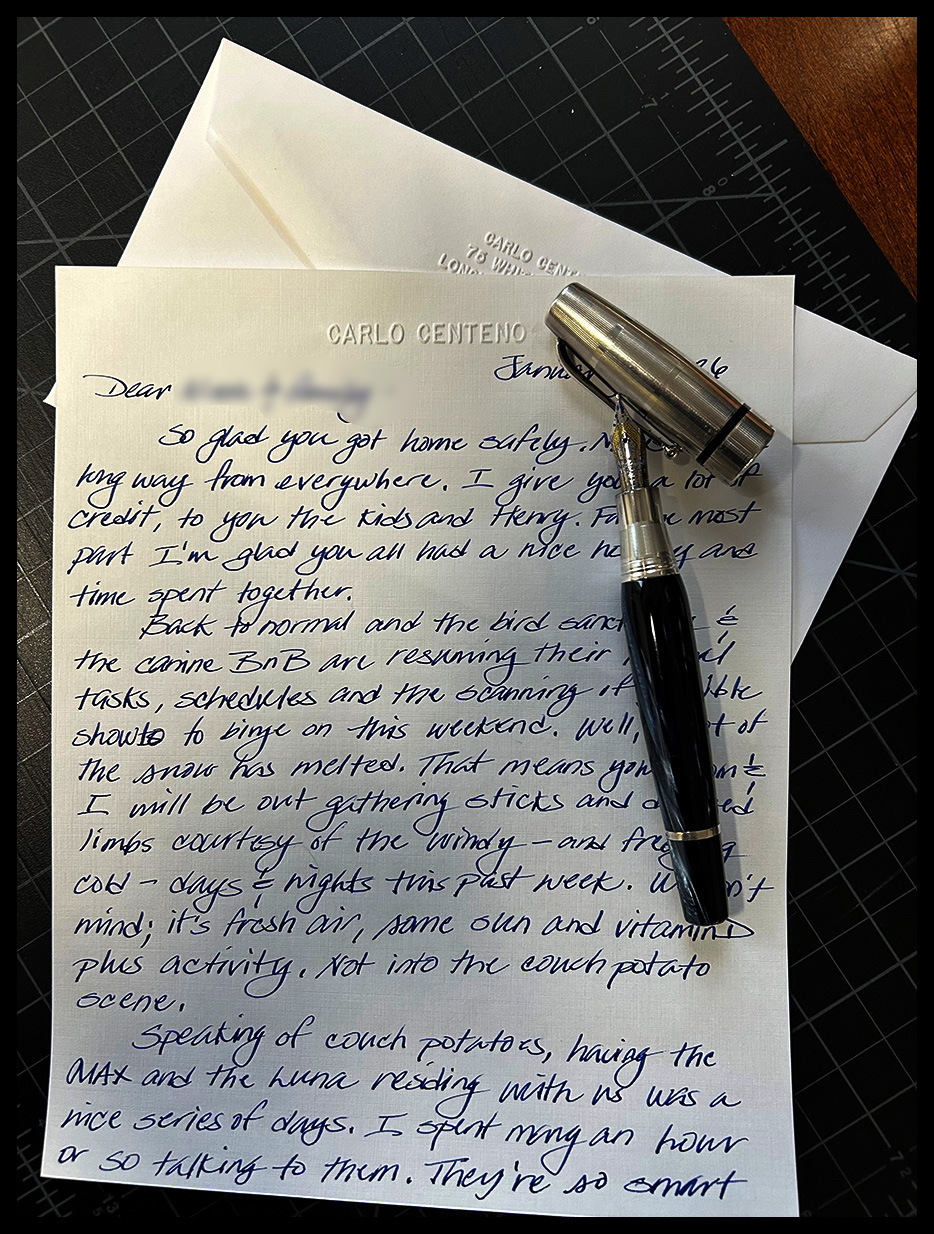
A few of us have been [hand] writing for as long as we can remember. More specifically, letters, postcards and greeting cards. Conceit aside, I’m one of those anachronisms [I use fountain pens & bottled ink] and I enjoy writing in all its archaic forms.

Because of the pandemic, there’s a renewed interest in writing, whether a letter, in a journal, even on a page or two of plain paper. I find it all encouraging as voiced in this recent article in The Critic. Writing a letter isn’t what it used to be, but a few of us still find satisfaction in such a personal construct of thought and emotion. A part of me is contained therein. Some days, the pen skims across the paper and other times, it’s hard to get out the first sentence or two.

Decades from now, no one will need an app to read its content. Sentimental as it is, perhaps some of my family and friends will keep them in a shoe box of sorts. Each envelope containing a capsule of time and place.

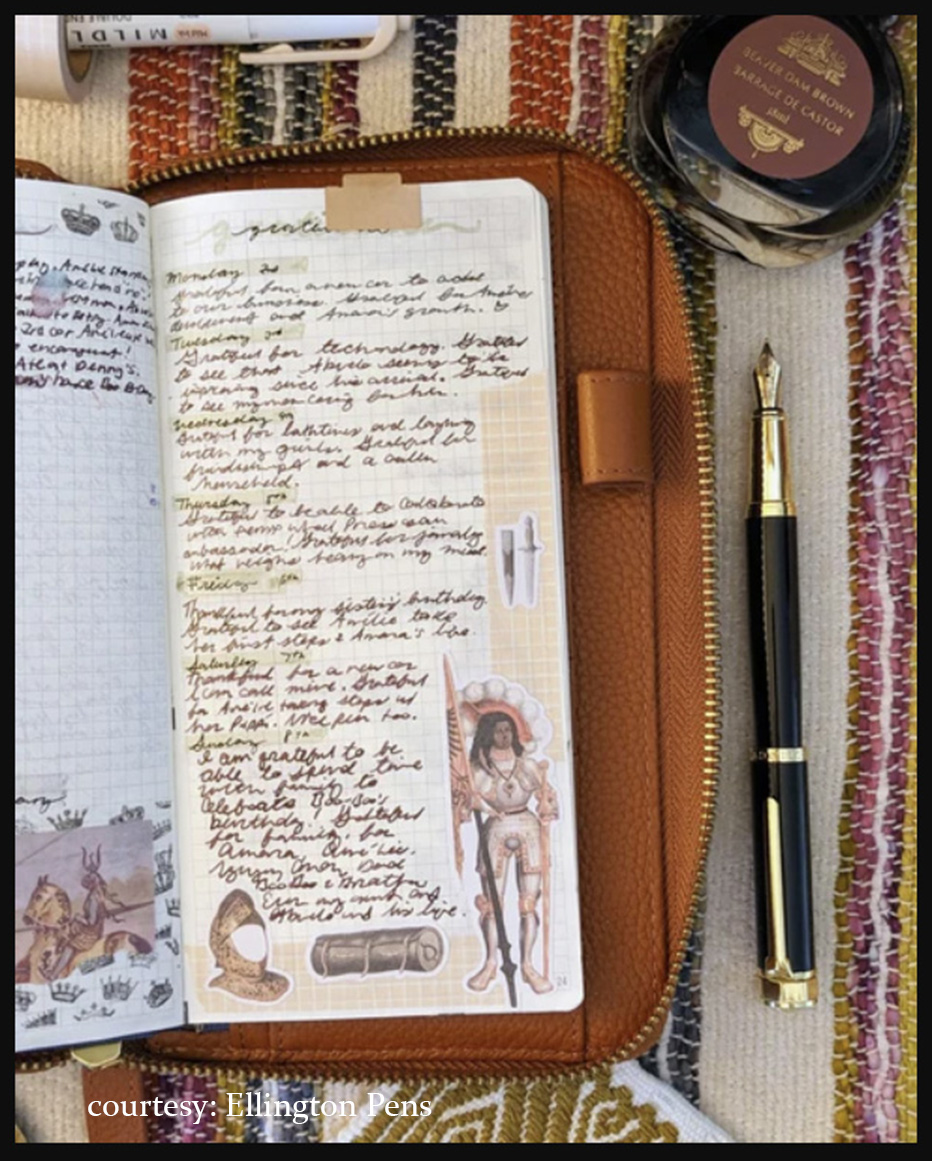
A journal can capture and hold—albeit brief—a particular sentiment, an observation, an epiphany perhaps more. And like letters, there is an enduring permanence to what’s put into and left on the paper. In a recent [April 13, 2021] issue of the Wall Street Journal, staff writer Ellen Byron wrote, “How Journaling Can Help You Live Your Best Life.” The Byron article reads more like a primer on the hows and whys of writing and using a journal.

Journal writing is cathartic and offers a number of ways to express practically anything. I write to an alter-ego, directly to myself and at times even address myself in the third person. When I move myself from the “I” to “he,” the dynamic changes. Writing in the third person creates a buffer of sorts, a moat if you will which separates the person in the moment from the person that offers perspective.

A large part of the catharsis revolves around time slowing to a less frenetic cadence. The efficiency or speed of the digital realm fosters an expectation of click-it-now, get-it-now. Letters and journals are the antithesis of such expectations.

Go ahead. Take a pen and some paper and write something, anything, that comes to mind. What matters is you’ve made a decision to place part of yourself right in front of you.

The Birdman

By all appearances, he patiently cares for his pigeons. While I cannot verify if he’s out regardless of weather, my sense is he’s devoted and committed to his feathered friends. I have this feeling he’s been at this for a long time. The 3 or 4 times I’ve seen him on the roof is a study in stoicism, or maybe a purposeful, self-administered state of calm and reflection which is part of his daily schedule. Click HERE to learn more about the hows and whys of raising pigeons.

On a cold March afternoon, I was surprised to see a large flock of birds flying closely together, first in one direction, then back toward the direction they came from. When they hovered and eventually landed, I noticed someone walking on a flat roof top, nothing more than his head and shoulders visible from the street below.

Having access to the roof of an apartment across the street, I made my way up and discovered the gentleman sitting on a bench, his back against a column of white-painted brick. His focus was on a rather large screened-in coop housing perhaps a hundred or more pigeons. Having nothing to compare this to, seeing it was impressive.

I only know of 3 reasons why someone would raise pigeons: some enthusiasts race them, another group trains them to return home to their roost and others rear them for special occasions. During some festivals, you might see a flock released from a specific area often during a program within that festival. Or you may witness a blur of white-feathered pigeons take flight moments after an officiant proclaims the union of two lovebirds [indeed, pun is intended].

It’s unwise to assume. Assumptions often miss their mark, but in this case, I believe the birds and their caretaker have a strong connection. It’s a reciprocal relationship.

For his efforts, the pigeons have shelter, food and water. He in turn relishes his role and acquires satisfaction knowing his handiwork allows him a unique form of social interaction.

The Erosion of Social Bridges

There are positive attributes to like-mindedness. It’s a way to find common ground and interests in practically all relationships be it personal, professional, philosophical and spiritual.

We understand that having similar interests can help solidify these relationships. We also know that different pursuits can develop into new perspectives, and these perspectives can present alternative ways of thought and action, perhaps some you haven’t thought of yet.

Unfortunately, the bridges which can connect the like-minded and those diverse in thought and action, are in danger. There is a level of social deconstruction affecting not only the infrastructure of social interactions and preferences, but our individual feelings of well-being [health] and significance [purpose].

Some may like it more than others, but various apps connect us both professionally and personally.

The relevance surrounding social engagement has been noted across many communication channels–magazine articles, academic papers, broadcast news, and more. The absence of in person, face-to-face interactions with colleagues, friends, family, business connections, neighbors, et al, has created varying levels of social isolation.

Some may miss the informal chatter when shuffling the hallways to and from meetings. There’s the interaction during lunch periods and conversations at the water cooler and copy room. I certainly miss some of the gatherings and conversations, either formal or informal. The taken-for-granted expressions of “good morning…good to see you…how’s your kid doing…you’re looking well, feeling better I hope….” and so on, chips away at our own self-perception and emotions borne by experiences. And this includes uncomfortable expressions and experiences as well. The good and not-so-good are inevitable in everyone’s life.

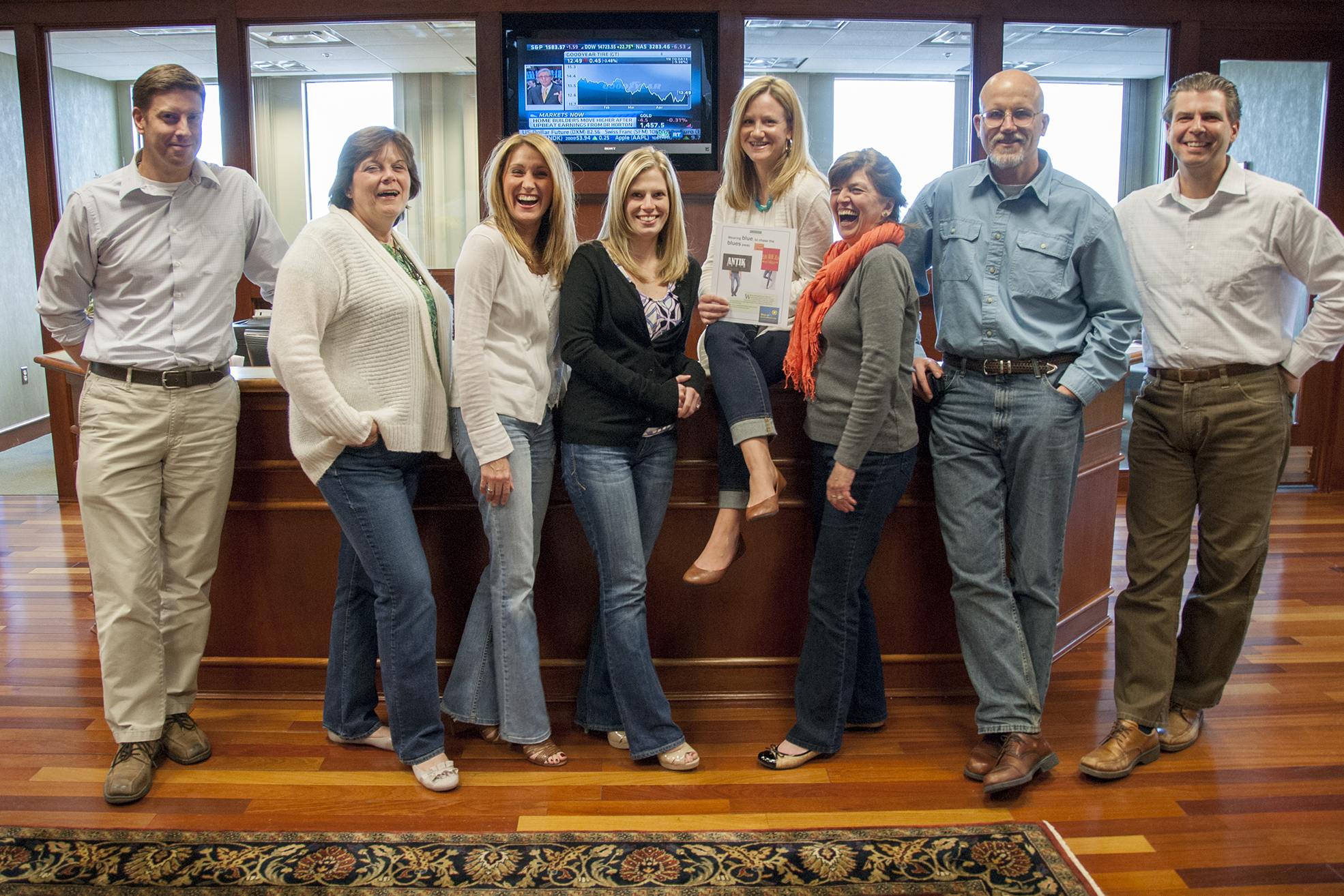
Before the pandemic, on two or more days during the workweek, a small group of us banter about life, kids, work pressures and current events. The time together in the lunchroom is not just small talk or attempts to fill in the question, “So, what’s new with you?” The time, albeit brief, permits a reciprocal exchange of ideas and feelings, or concerns and burdens, and even lighter moments, which on the whole, provide a brief respite from work. I miss deciphering the “Jumble” word game found in newspapers. Just about everyone at the table has had a go at the jumbled letters. Not surprisingly, others who saunter by have also added their own guesses.

Circa 2013. Interaction: Want to wear blue jeans on a Friday? Contribute to a charity.

Everyone has preferences though our personal constructs, expectations and beliefs can be as different and varied as the objects on our planet. And that’s what nurtures our face-to-face, in person interactions. We know there are differences, but I like to think that deep down, a lot of what matters between us are all too familiar.

Digital communications–Facetime, Instagram, zoom meetings, text messages and so forth have their place and their legions of supporters. Personally, I miss nuances of expression, of feeling connected and relevant in life whenever people are not physically present. Perhaps I’m just old fashioned but for me, being face-to-face validates our humanity.

Snow Dome

On MLK day at Glendale Falls

I was in a different bubble yesterday, away from the angst, the uncertainties, the frustration and disappointment of recent times. It was wonderfully quiet save the waterfall cascading over an edge some 20-yards away. That rushing sound had a soft, roundness to it, a barrier or suppressor of sorts that kept disheartening sentiments at bay.

I was in a snow dome.

With 4-inches already on the ground, a sudden burst of flakes quietly fell, quickly dusting tree limbs as well as foot prints left by other visitors: someone in a Sorel, perhaps a size 10 1/2 which lay opposite the basket imprints from a hiking staff. Only one set of human footprints was there, the other prints from a deer, a squirrel, a group of birds and others I wasn’t sure of or missed altogether.
This kind of place—where the simplest of what is before and around you—covers the burrs of unhealthy tensions and feelings. Indeed, a blanket comes to mind when snow covers a landscape. On some days—for me anyway—it’s more like a comforter. A comforter does not align with what snow feels like. Visually however, is a different matter. There is loft, an expanse of uniformity and balance that can remind one of a comforter. The solitude, the absence of man-made noise, reinforces that sense of comfort. Within my snow dome comes a particular calm that allows me to think and feel purposefully and openly. I consider possibilities beyond the familiar and rote. I dwell beyond the probable, but lie in the realm of things that are possible. As Martin Luther King, Jr. noted:
“Put yourself in a state of mind where you say to yourself, ‘here is an opportunity for me to celebrate like never before by my own power, my own ability to get myself to do what is necessary.'”

The saying, “this quiet, this silence is deafening…” runs contrary to my time in this snow dome. I feel reassured, positive, even happy. Embraced by such stillness, you can hear yourself think. You can engage all your senses with minimal distraction. You come face-to-face with who you are and in spite of yourself, you can choose to dwell in what should have happened—and thus remain predictably the same as always—or take a contrarian step, one that could make a difference. I’ll let Martin Luther King, Jr. have the last word. He has captured an enduring leitmotif of the human condition:

“The soft-minded man always fears change. He feels security in the status quo and has an almost morbid fear of the new. For him, the greatest pain is the pain of something new.”

Beginnings

“Happy New Beginnings!” doesn’t have the same cache as the tried and true, Happy New Year! Yet in many ways the first greeting has some weight behind it. There’s a strong inference to starting over, partially or completely. Everyone has a different take on “starting over.”

The action of a rising and setting sun, is starting over; the former begins a new day, the latter a new night. Starting over can literally be that: it’s an attempt to put in place what’s transpired with a second [or third, fourth, etc.] attempt to make something work.

This business of New Year’s resolutions—depending on whom you ask and why—is often predestined for failure. This is especially true with the “new and improved” ways to diet, to lose weight, to increase your brain power, your stamina and so on. For many it’s deja vu, a familiar redux from the year prior with the same if not similar results and attendant disappointments. Many successes become commercialized, specifically when a product is recognized as “effective.” On the one hand, you have the wannabes, individuals who for one reason or another did not accomplish their goal and likely through no fault of their own. So, the achievers draw the attention and accolades. No surprises there. Their testimonials reinforces product or program efficacy. Quite frankly, it’s marketing.

My notion behind beginnings [aren’t most beginnings new, BTW?] is that sometimes, we make a list that’s unreasonable: too many to pursue. It’s a big enough challenge to succeed with one, so why burden your good intentions with one or two, or even three. More than one is often simply one too many. Think about it.

There is a bigger challenge in starting over, in a willingness to start over with perhaps new or different tactics and strategies. Make goals more realistic. For me, to say I’ll master conversational french in 2021 is a real dream. I must’ve drank way too much wine on December 31st. And while I can read and write a good amount of francais, it’s quite another to hold a meaningful conversation [assuming I have someone I can converse with]. Indeed, make your goals lofty, but ensure beginnings are grounded.

My own journey contains many beginnings across many facets of life. For the most part, much of them are still a work in progress. Ultimately, something’s got to give. Endings contain their own nuances, good or bad, sad or happy. However, beginnings should always contain hope.

I see through a glass darkly…

It’s been noted in different ways, but anything that could be said about 2020 has already been said. There are new normals and our previous ways of living and working have undergone something more than a reboot. I wonder about the sustainability of our modifications to the changes we’ve been subjected to. At present, 2 things loom large for me in our modern ethos: the scale of loss [life, careers, homes, e.g.] and the contraction of education systems for students, Kindergarten through college.

The burden shouldered by first responders, caregivers, allied professionals, physicians, peace officers, firefighters, et al, is without precedent. Supporting them goes without saying. The COVID-19 story continues to unfold, though I hope the developing narrative produces more positive than negative outcomes. And yet I am still looking through a glass darkly.

Many conventions, routines and well-defined standards have been poured over with uncertainty. That change takes place, is to be expected, but the fog of what happens or what should happen clouds our view near and far. Supposition greets us through this dark glass of modern life. There’s the world before the new coronovirus, and the one hereafter.

All of this thinking takes me back to much younger days, days of academe, of discussion, of expository writing. This dark window we’re peering through—including windows like broadcast and online news, social media, Twitter, FB, e.g.—does shape our perceptions and expectations. Many are unclear, even misshapen or unrecognizable, perhaps even hinting at what was once familiar. Plato’s Allegory of the Cave posits we should question our assumptions. Thinking across and through assumptions helps nurture self-reliance and problem solving. I like to think of it in more practical terms: use your knowledge, experience and current life stage to shape your own conclusions versus being told what they should be.

None of this is new. Some of you probably realize that this post of mine references scripture.


Now, we see only an indistinct image in a mirror, but then we will be face to face.
Now what I know is incomplete, but then I will know fully, even as I have been fully known.
1 Corinthians 13:12

Eastern Standard Time

For a few days toward the end of October, there was some fuss about turning back our clocks one hour. The running complaint focused on days getting shorter even though we “gain” an hour of time. Early darkness just made things, well, darker, physically and qualitatively; it gets darker outside and for some, darker within one’s psyche.

I suppose I’m the odd person out; I shouldn’t “suppose” as I am an odd person with such things. Sunsets that announce evenings arriving earlier is not a big deal for me. Like some form of line dancing flitting across the horizon, once again daylight and night trade places, and time marches on without losing a single beat.

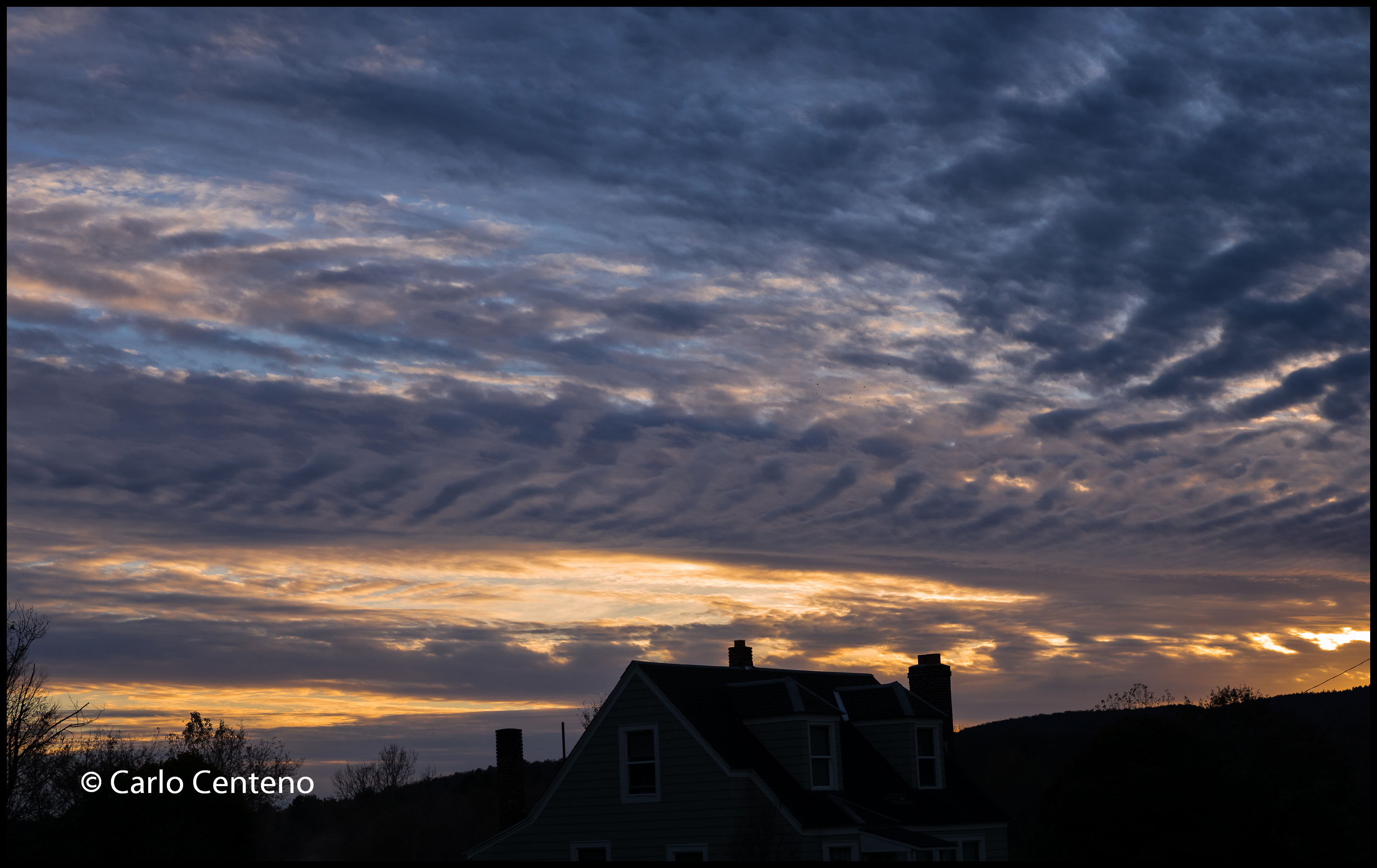
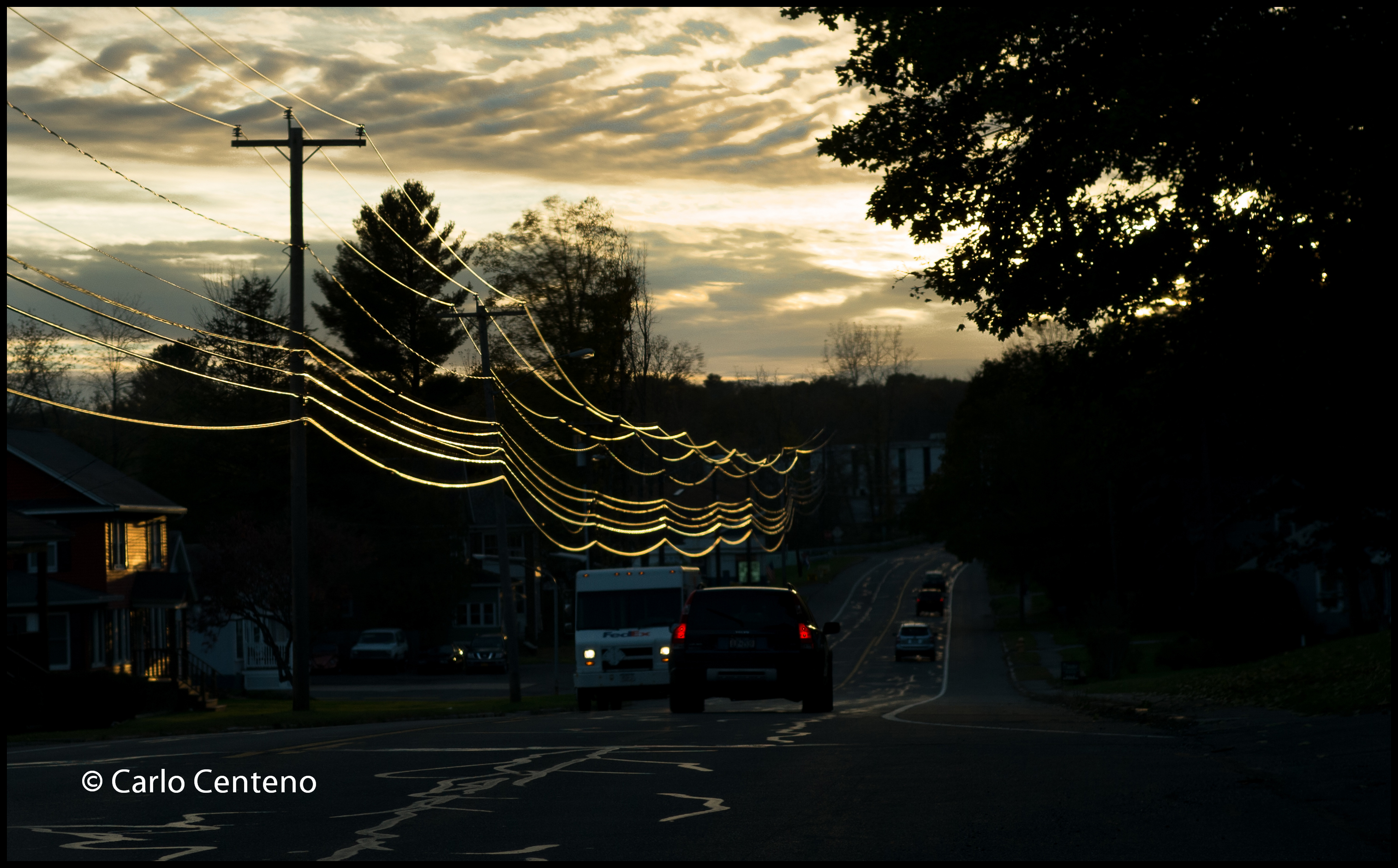
Whether it’s 4:30 in the afternoon or 8:30 at night, I don’t tire of sunsets. Some are dramatic in their intensity and expanse, others are less so, their palate of warm colors as soothing and inviting as those found in an impressionist painting.

There’s nothing standard about this light that quickly dissolves into shadows of dark blue and greys. The one constant I’ve felt through the years has been the brevity of the light which morphs an hour before and up to sunset. The times are few when I don’t have a camera by my side, yet on those days when I don’t, I sometimes forget about today’s most ubiquitous of cameras, the ones found in today’s smartphones. And they are amazing tools for photography, videography and more.

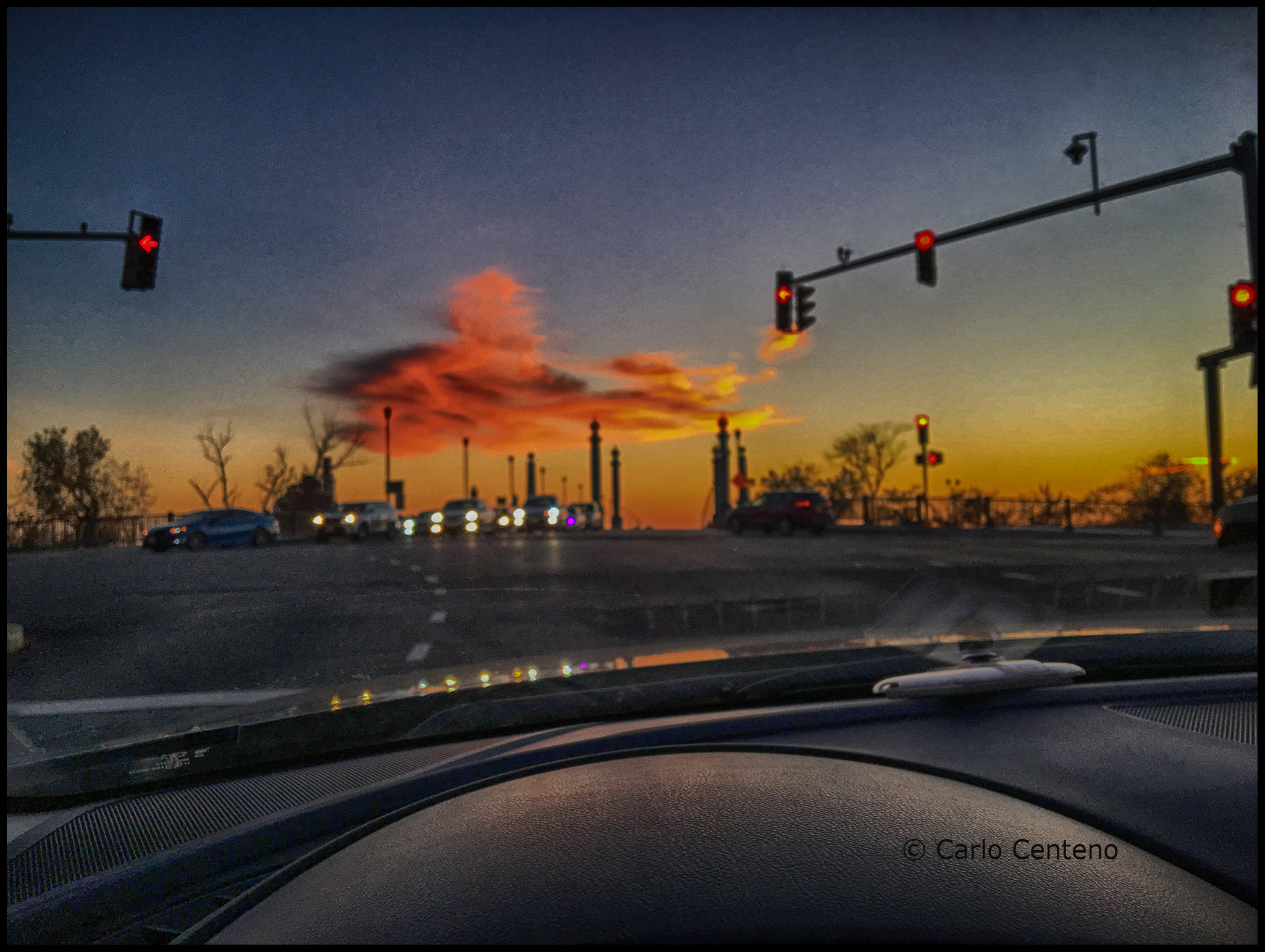
The photograph shown here was taken within that half-hour before sunset. The way the light and shadows shifted was a process all too short, perhaps as short as the traffic light that changed to green shortly after I took one photo. Figures. The one time I hoped for a few more seconds stopped at a red light just wasn’t there.

For the various times we use our phones to take a photo, we hope that one shot becomes the money shot. We want just one, a really good one, which connects with everything and anything that courses through our thinking and feeling. I relish the feeling of making this particular shot. The stoplight, the headlights, the reflections on the car hood, the gradations of orange and yellow, blue and grey are a surprising though welcome confluence of order.

A confluence of order. We can use some of that in the here and now regardless of whatever time or GMT standards we’re in.

Space

I am convinced that modern life has boxed us in more so than we’d like. It’s part of the contemporary territory which includes both our professional and personal lives. There’s a surfeit of information, misinformation as well as disinformation. We have data that’s important, partially accurate or altogether inaccurate, the latter done purposely in order to deceive and create confusion.

The spaces outside and within our mind are under siege. This coronavirus pandemic has produced a variety of empty spaces in the form of closed businesses, a void born from a lost loved one, an even larger, emptiness created by becoming unemployed and losing our face-to-face social connections with friends and family.
In addition we see meadows, forests and even arable acres, reshaped with new developments, new businesses, and right-of-way passages for utilities. These spaces, like others, will never resemble their former selves.

The modern mind is challenged with the illusory nature of augmented realities, misinterpreted online interactions, the CGI creations readily seen on the big and small screen and so on. I would wager that ruminating is a regular mental exercise for many, in ways that even the thinker didn’t think possible in the here and now.
It’s not that such spaces are wanting for content. Some of the content in our heads is twisted and distorted, an unattractive morass of schadenfreude and unforgiving defenestrations toward those with authority, power and privilege.

A lot of good space has been replaced with some nasty creations, tangible and intangible, palpable and even unreasonable.
We’re better than a lot of this, each of us capable of individual betterment. I remind myself in my own spaces of thinking and feeling that, at times it’s okay to be embarrassed in one’s journey to be genuine. I think it aids my ability to acknowledge what occupies my internal and external spaces other than what’s so obvious not only to myself, but to others.
As in marketing, perception is reality: it’s not what you’re getting, but what you think you’re getting.

Color

Autumn is my favorite season for a variety of reasons: the cooler, drier air is both invigorating and refreshing, the quality of light is remarkable, at times appearing clearer on even overcast days. Even time feels slower with a more gentle cadence though by mid-November, I wonder how it went by so quickly. Certainly it goes without saying that the foliage change can be magical, even personally restorative.

Many years ago, I attended a photojournalism workshop at what was then called The Maine Photographic Workshops in Camden, now known as Maine Media Workshop located in Rockport, a mere stone’s throw from Camden. Located half-way up the coast of Maine, the town of Camden sits next to Penobscot Bay. I haven’t been back since, so I hope it hasn’t lost its New England charm. It was quaint, quiet and photogenic to be sure.
You can glean techniques and technical knowledge from more places today than back then [now a surfeit of info sits on the web]. Convenience is nice, but for me, being engaged with a like-minded person is all the more rewarding. Levels of inspiration come to me when I visit an exhibition, a gallery or listen to or converse with a speaker whose work clearly validates that person’s passion for his/her choices.

I was fortunate to have heard and seen in person Jay Maisel, Ernst Haas and Dick Durrance. Titans of their craft, I learned more than just technique, but a whole lot more about this passion to see things in a new way, to transcend the connections of light, color, subject, interpretation and meaning. My brain needed to do some real lifting and learning, and was thus able to do so when my soul became the catalyst to assist with that lifting and learning.

I like to think of seasonal transitions as a form of recalibration. It’s more than a reset, because to reset anything is effectively returning to its default state. Recalibration is a nuance in alignment. If I’m not sure of what I’m feeling when I look through a viewfinder, I move a few or more steps to one side or another, as well as toward or away from my subject. Recalibrating.

There are similarities in writing, but they’re a bigger challenge for me to describe. I suppose the very title of this post lends itself to recalibrating: adjust the “color” of your words such as tone, passive versus active voice, even a tweak in aliteration to keep your narrative—and your thinking—interesting.

Autumn just doesn’t land here in the northeast; when it does arrive it’s akin to that sense of belonging, of knowing that your journey—in spite of personal hills and valleys—continues with the expected and as well as the unexpected. I like all the seasons, but fall is the one which captures the zeitgeist of the rest of the calendar. It’s a short period of time, that in its most fundamental form, feels like the comfort food that’s been sorely missing for more than half the year.

Connections

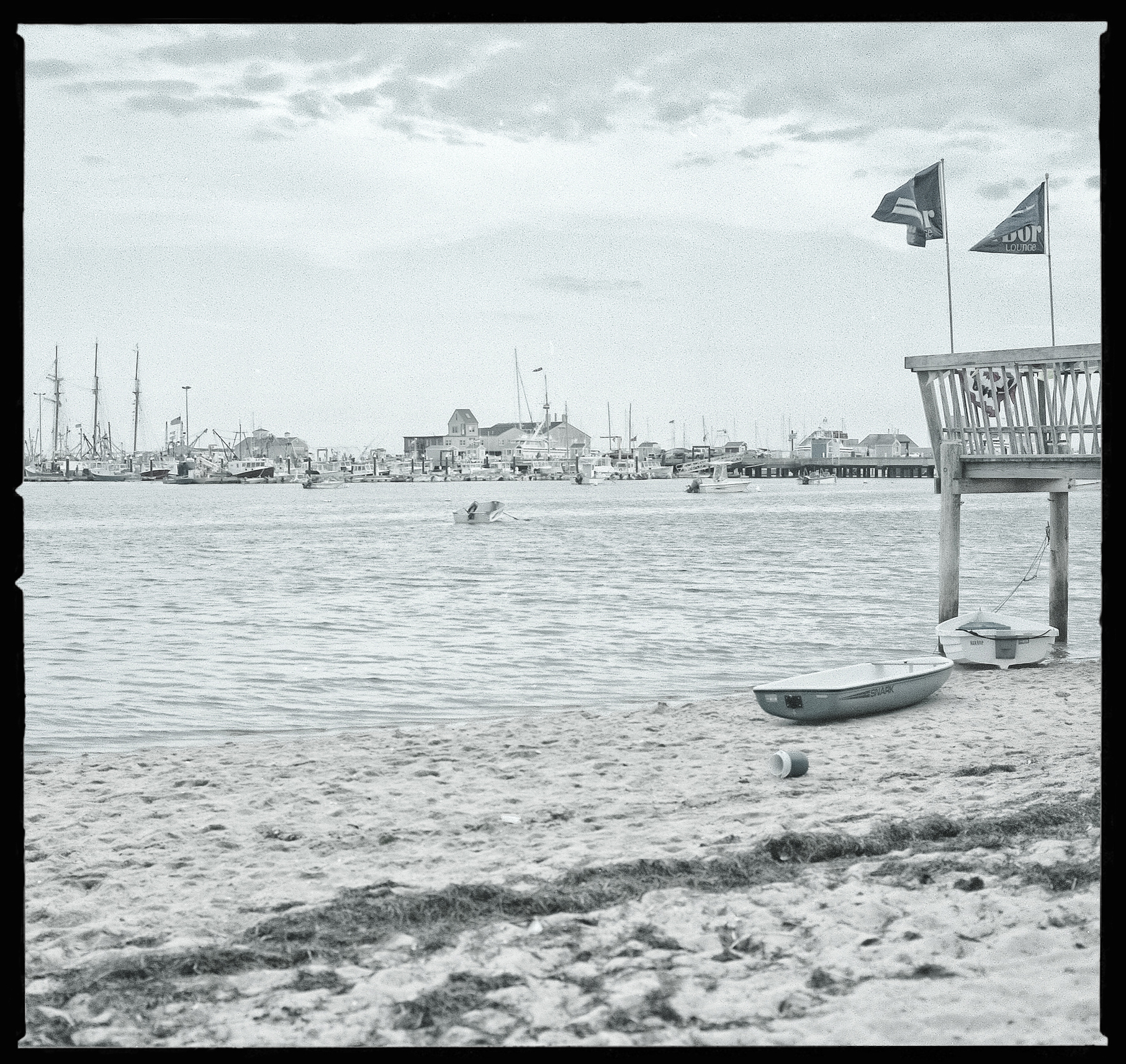
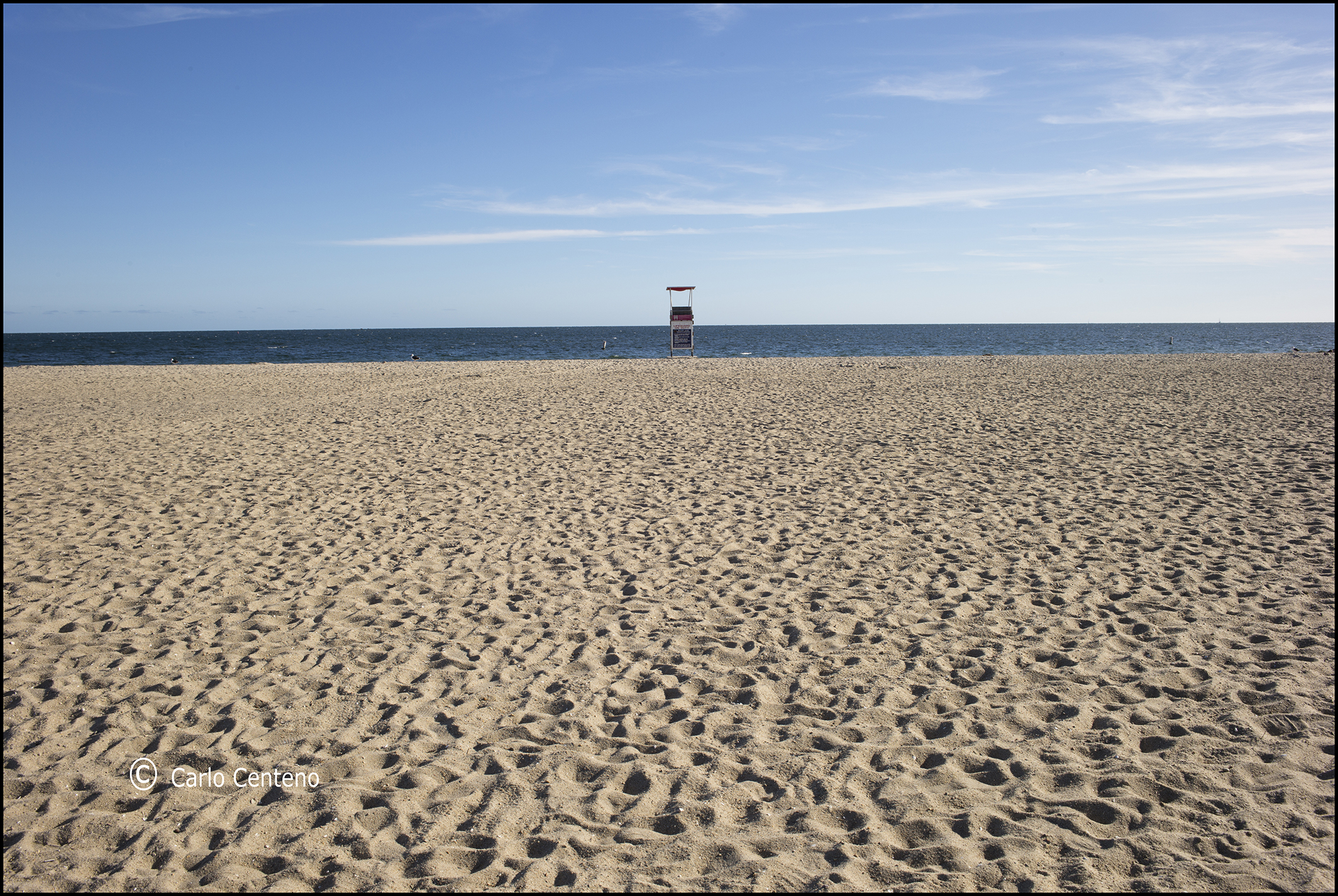
I love Cape Cod. The season doesn’t matter, but late summer is often a great time. There’s less traffic and a more laid back atmosphere. The beaches and wharfs hold less people, though there are those hearty souls who continue their routines swimming parallel to the shore.
I watch the few on the beaches, most in their chairs, some sitting or lying across a large towel. Others are involved in conversation or quietly engrossed with a book in hand.
You can always count on walkers tracing their steps first one way, then on their return trip to a starting point. The most jubilant are often a dog and its owner. They’ve waited for the moment when the beach was available to them and their joy is clearly displayed. This is the kind of connection that’s about as simple and straightforward as it can get: get out and spend time with good friends, family, your dog—even yourself.

The men enjoying their cocktails aboard a boat speaks of many types of connections: family, work colleague, college room mate, best friend, and so forth. Between the “remember when….did you hear….whatever happened to…” are those moments of hilarity, some brought on by something long past, others in more recent times. Nostalgia connects with the present.

I love the Cape, especially for the many connections its made for me.

Discovering Creativity in Art: A Personal Experience

When you’re bogged down with writer’s block, creative fog, even brain freeze, what do you do to break free from its hold? Here’s one way to purge the hive of such impediments. Go to an opening, an art exhibit, perhaps one which deals in a medium that you know little of. In my case, think fabrics, paper and ceramics and other materials—either in combination—or crafted exclusively with fabric. An oversimplification, but a few photos can better illustrate the creations displayed at the exhibit, Beauty is Resistance, our Fall Art in the Barn Exhibtion. I was impressed with the inventiveness, originality, concept development, creativity, and overall execution of the various pieces.

At browngrotta arts, co-curators Tom Grotta and Rhonda Brown have managed original art, crafted by internationally recognized artists for more than 3 decades. My “introduction” to the pieces of art at this exhibit was an A-1 engagement of diminishing my brain fog, creative block and so on. Neither words nor photos can describe the pieces. This is a case of what I actually see and feel is amazing, because of what is physically in front of me. A demonstrative be-in-the-moment activity, to say the least.
So, please take a moment to peruse a small sampling of what was on display.

A special thank you to Tom Grotta and Rhonda Brown for their hospitality and sharing their knowledge about the artists, the scope of this exhibit and their anecdotes of life in international Art. Photography: courtesy of Tom Grotta. All rights for the images and the Art are those of the artists.

Home artist Lija Rage; mixed media, wooden sticks, linen and copper [2-panels; detail shown in second image].

From Chaos to Reality artist Aleksandra Stoyanov; sisal, cotton

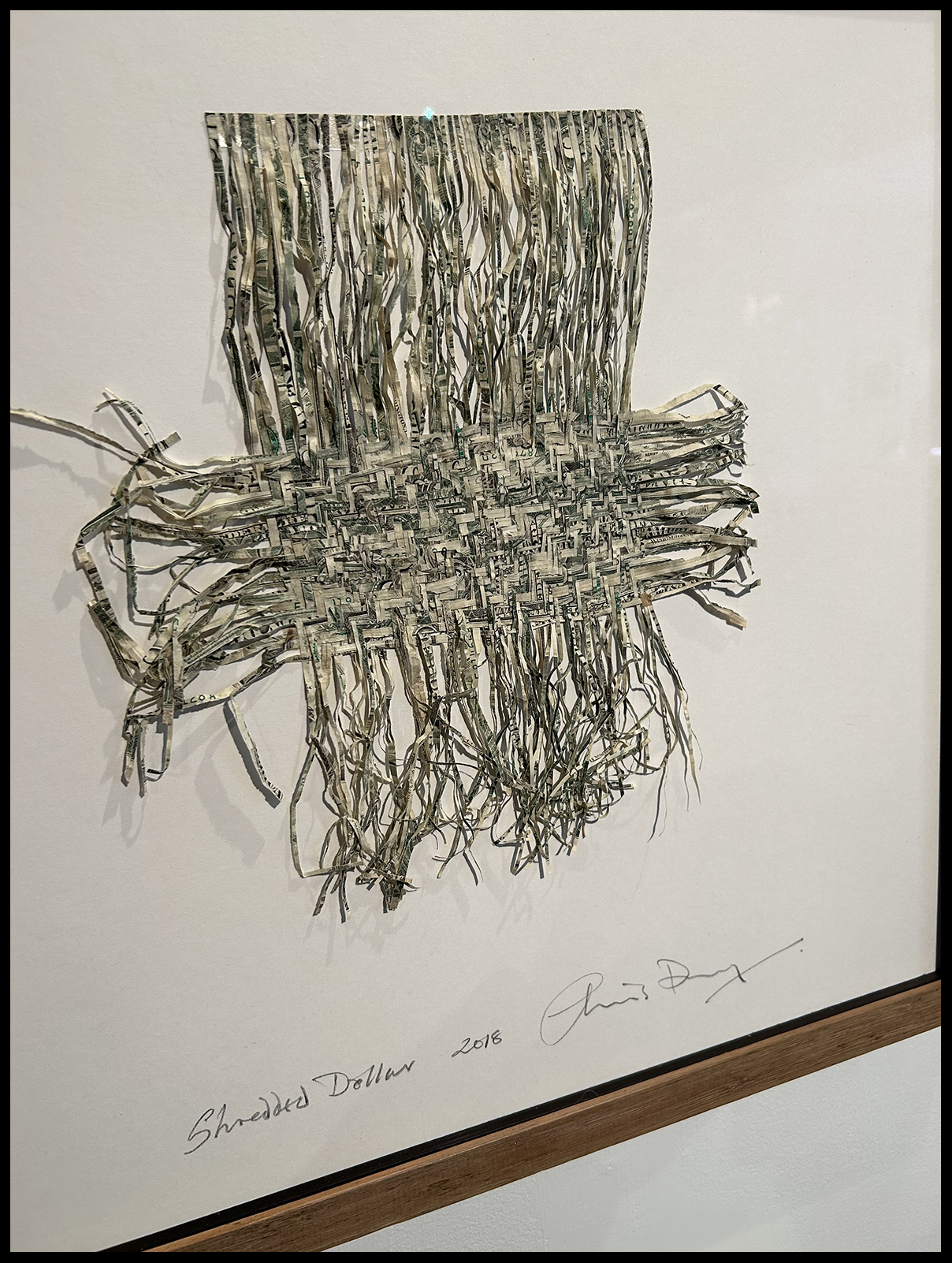
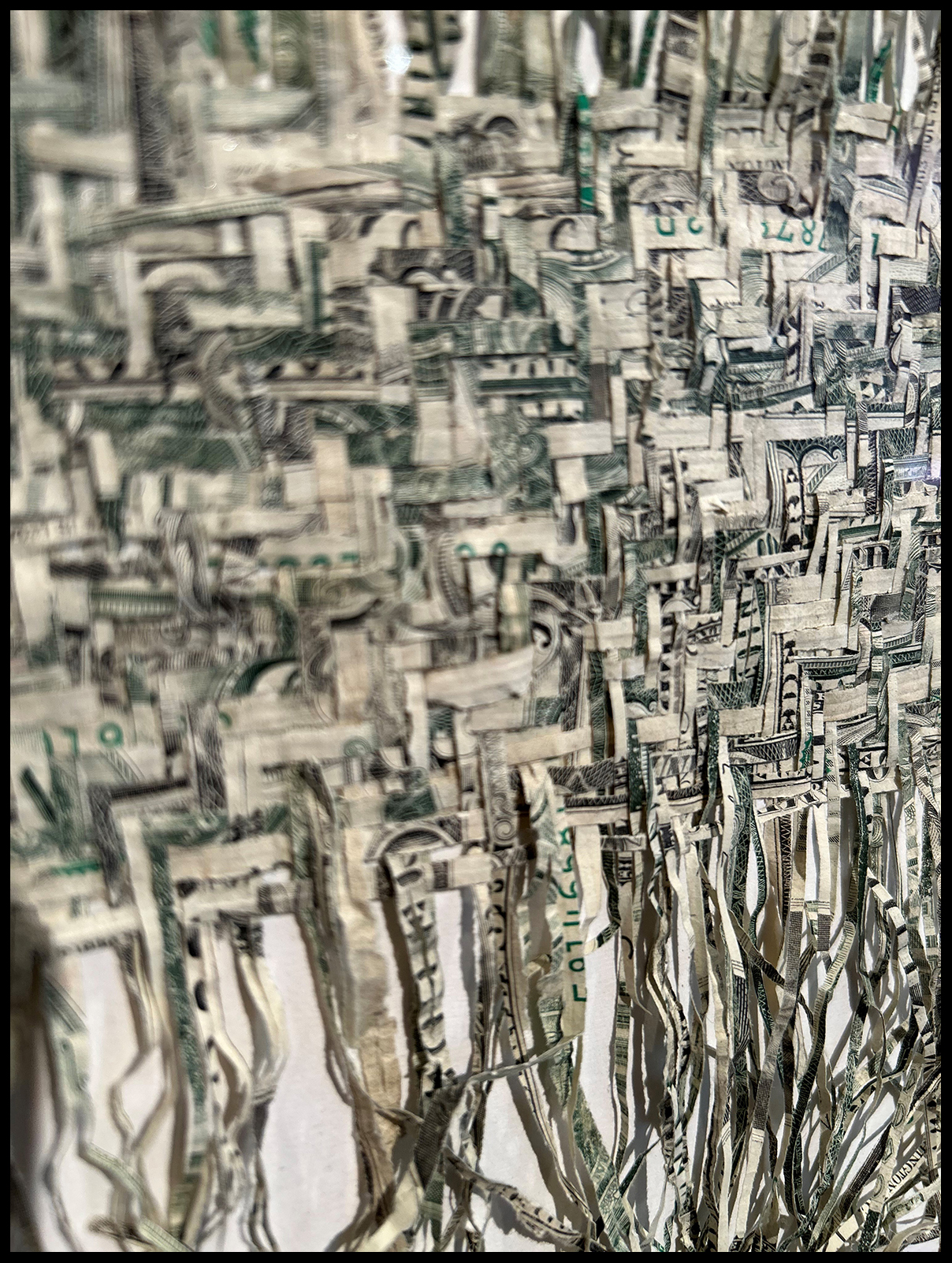
Shred dollar artist Chris Drury; US currency [detail shown below]

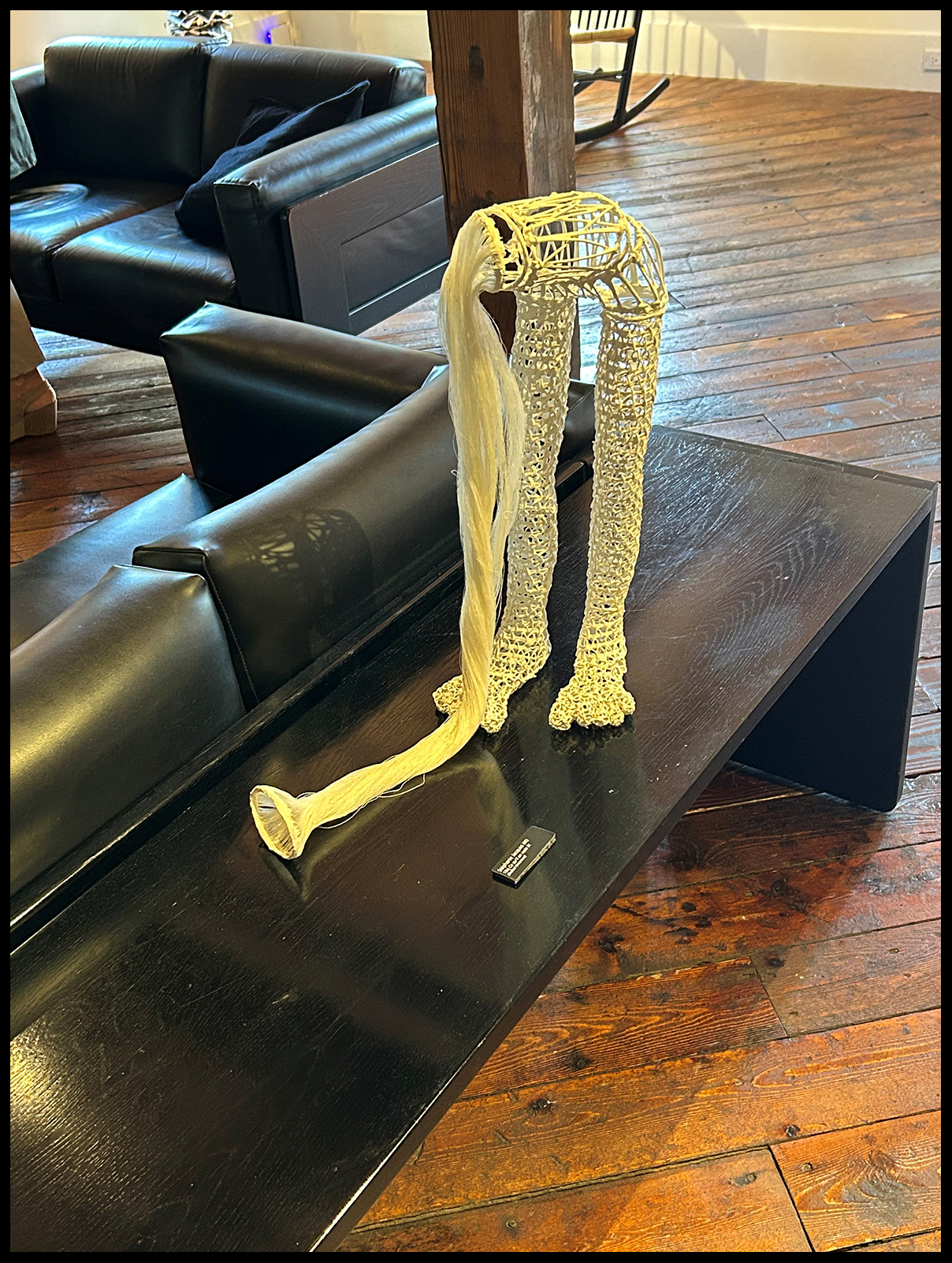
Female Husk II artist Anda Klancic; torso [from Momento Mori composition] with cone; palm tree bark, synthetic filament, acrylic, and metal wire

Ce qu’il en reste IX artist Stephanie Jacques; willow, gesso, linen thread

Flower Colors artist Mary Merkel-Hess; paper, cord, paper

Rhonda Brown co-curator

Tom Grotta co-curator

Photography a professional photographer, Tom Grotta created a display showcasing some of the literature and gear he has used through his ongoing career.

Late Bloomers

With all due respect to prodigies, I’ve looked at the histories of a variety of late bloomers, some familiar in stature, and of course others whom I’ve never heard of.

Let’s start with an author I think many readers will recognize: Bram Stoker. Yes, THE Bram Stoker, author of Dracula. Prior to the publication of his novel, Stoker worked at various jobs, the longest being that of a personal assistant and manager to noted stage actor, Sir Henry Irving. BTW, he was the first entertainer to be knighted for his contribution to theatre. This friendship started in 1896, when Stoker wrote a glowing review of Irving’s performance in a play. For about 20 years, he managed his affairs, tended to his day-to-day schedules and demands. The following year, Bram Stoker penned his literary masterpiece, Dracula.

When Irving read the novel, he thought little of it, even more so when Stoker thought his friend would take the lead role in a stage version of Dracula. Biographer Barbara Belford‘s book, Bram Stoker and the Man who was Dracula surmised that Stoker’s anti-hero was based on the conceited, self-absorbed, unpleasant person that was Irving. Irving’s pernicious behavior was relentless, and yet Stoker somehow prevailed. Irving’s repudiation of Dracula was his biggest loss, a loss forged in the theatrical history of the late 19th century.
Bram Stoker was 50 years old when he penned Dracula

For the sake of brevity, the rest to follow will be brief.

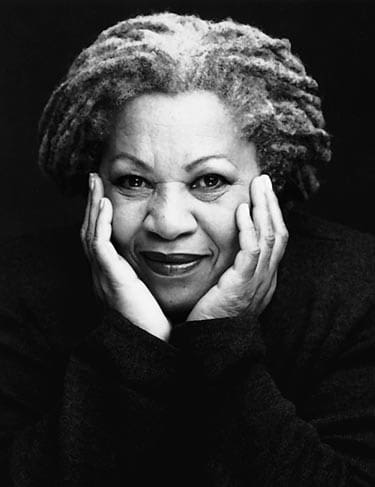
TONI MORRISON

Toni Morrison, an American writer was a long-time literature professor as well as an editor for Random House. Literature meant a lot to here; she is well recognized for her writing of the life experiences of Black women and life in the U.S.
She was 39 years old when she published her first book, The Bluest Eyes in 1970. Here second novel, Sula, was nominated for the American Book Award.
Morrison received the Pulitzer Prize for Beloved in 1987 and in 1993, she was the first Black woman to receive the Nobel Prize for Literature.

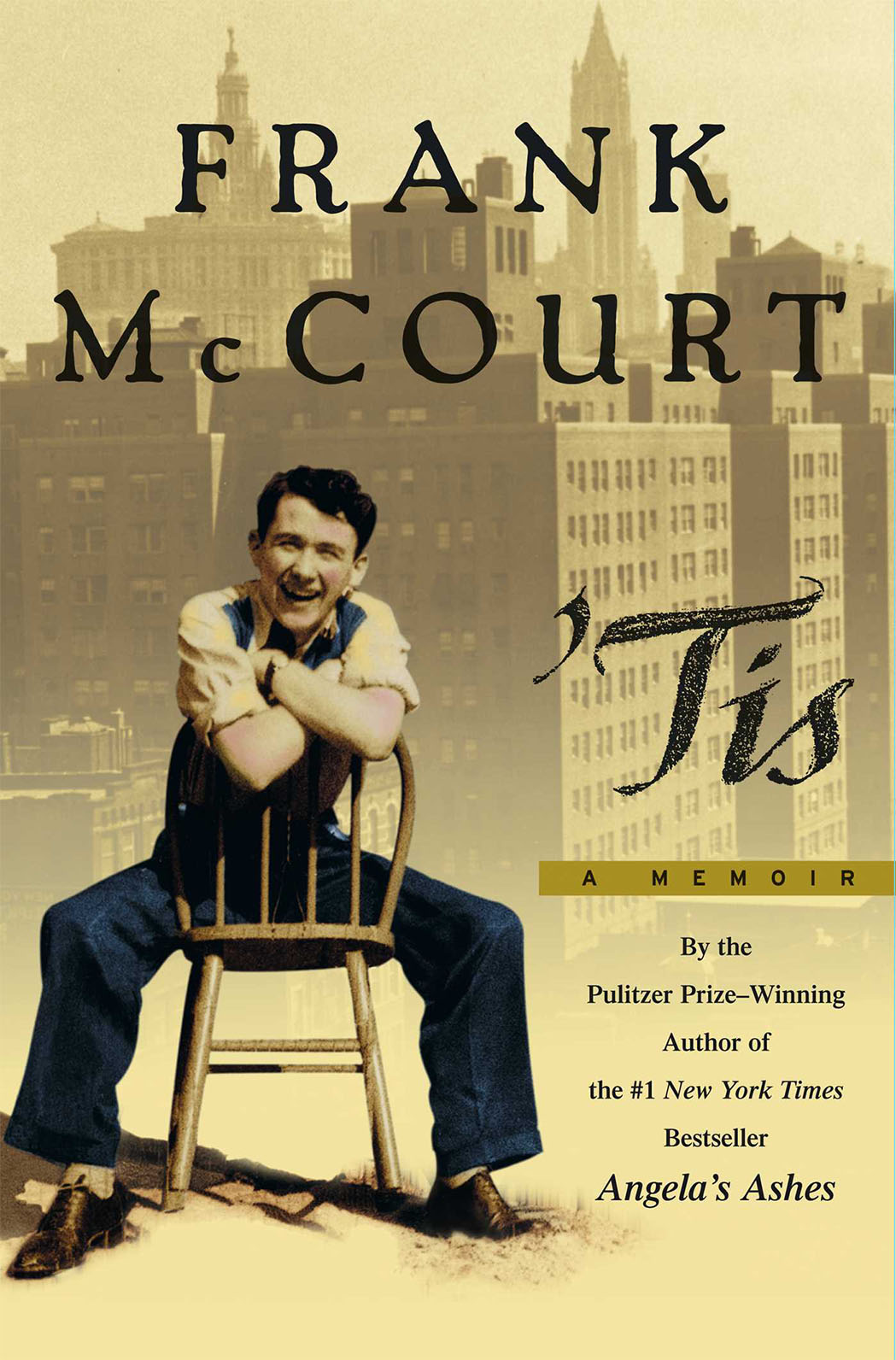
FRANK McCOURT

McCourt’s first book was published when he was 66 years old. Angela’s Ashes won the Pulitzer Prize for autobiography/biography in 1997. The memoir was also recognized with the National Book Critics Award, the LA Times Book Award and the Exclusive Books Boeke Prize to first time novelists.

GRANDMA MOSES (Anna Mary Robertson Moses)


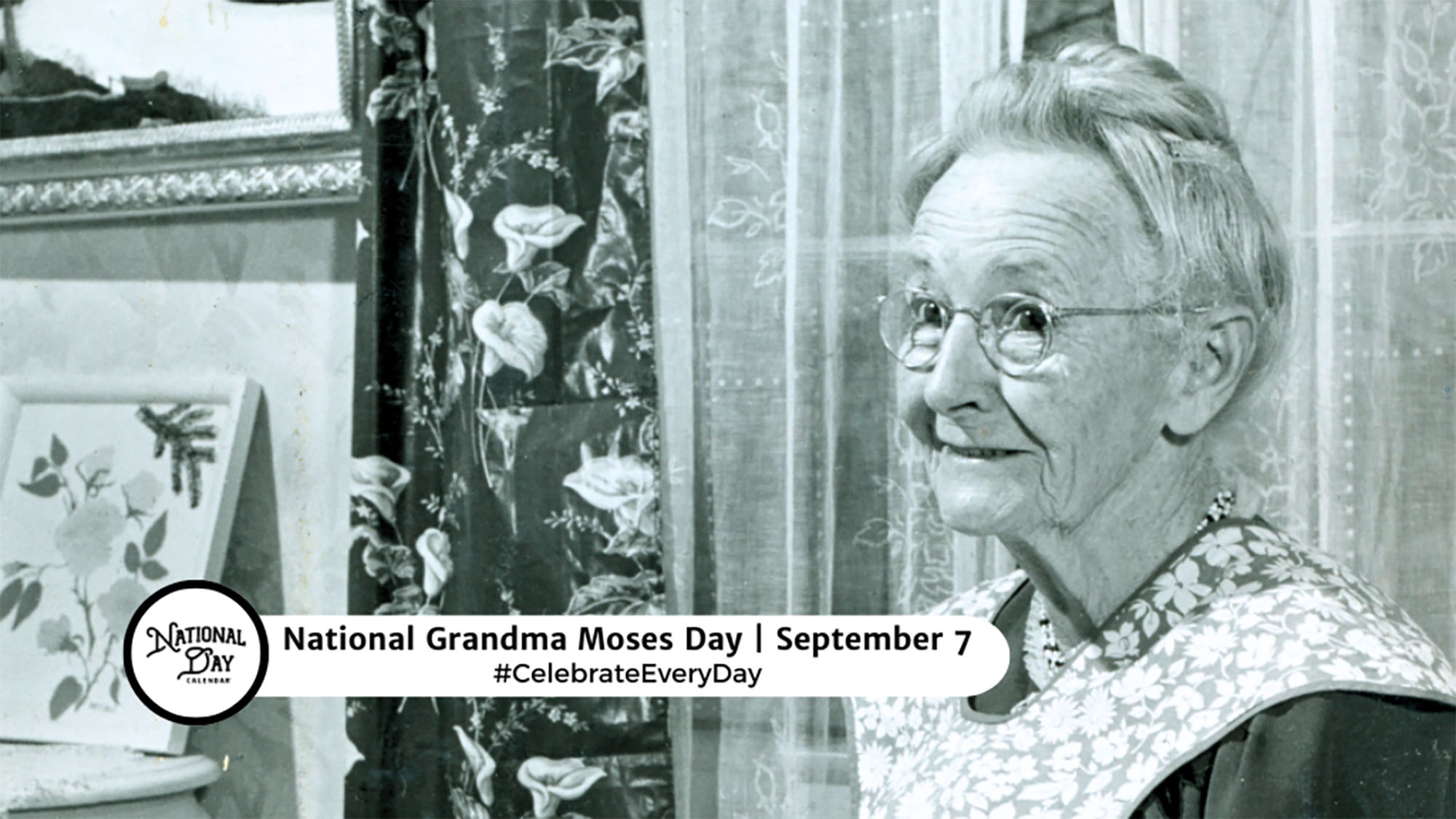
Ms. Moses was a celebrated American painter. She was noted for her needlework however, arthritis jettisoned that activity. Ms. Moses started painting at the age of 75. Her nostalgic style and depictions of rural life caught the attention of a collector and others, including large department stores who wanted to exhibit her work. Internationally, her work gained the interest of storied museums and galleries. A symbol of life in rural America, she passed away at 101, at the zenith of her painting creativity.

LAURA INGALLS WILDER

Laura Ingalls Wilder was a teacher, journalist, writer & columnist. Her life experiences were the subject material for her books, collectively a tome of perseverance, hardship and the challenges of farm life .She started writing her book series, Little House on the Prairie, when she was in her 60s. That first book, Little House in the Big Woods, was about her childhood. The Little house on the Prairie was Wilder’s eponymous version that proved popular in many TV households.

VERA WANG

Vera Wang had a successful career as a journalist and figure skater, but in her 40s, she started what would become a fashion empire that encompassed haute couture, high-end wedding gowns and licensed beauty products and home accessories.

NORMAN MACLEAN

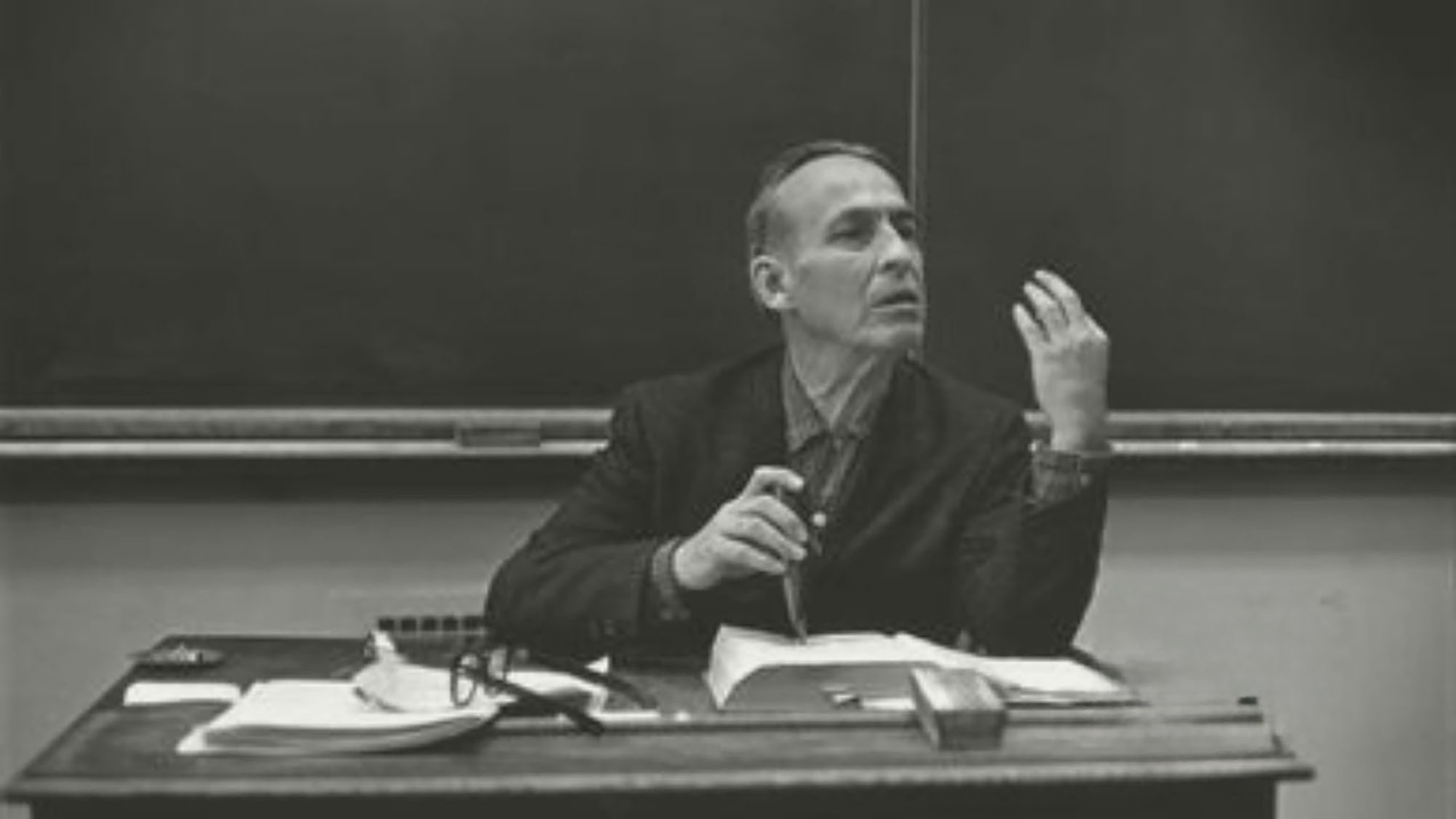
I can identify with this individual: lover of writing, literature and fly fishing. An English professor, Dr. Maclean attended Dartmouth College and earned his Ph.D. at the University of Chicago where he taught for 47 years until his retirement in 1973. His most celebrated, and only book, A River Runs Through It, was published in 1976.
He was 74 years old.

SALLY KRAWCHECK

Already a success on Wall Street, Krawcheck has long known that women clients were underserved by the wealth & financial management industry. She sensed that many women were not part of the discussions pertinent to financial management and more. So, she opened her own firm: Ellevest. She was 52 when she started her company that catered to women.

COLONEL SANDERS

A creative thinker, relentless believer, and one who demonstrated an enduring persistence, Harland Sanders is forever known as the southern gentleman who reinvented “home-cooked” southern-style chicken.
Colonel Sanders was in his 60s when he finally achieved his renowned chicken recipe and his first Kentucky Fried Chicken franchise.

And there are so many others. If you’d like to share your short list, drop me a note. Thank you!

Modern Soliloquy

Back in the day, “soliloquy” was a word associated with theatre. There have been some powerful, mindful soliloquys, many found in English Literature. William Shakespeare and Robert Browning come to mind; the former for his plays, Browning for his poetry.

I find myself tuning into my inner self with soliloquys. These are not conversations to me, but a way to be honest with myself. In the process, I voice [in my head…..not out loud]. the deepest feelings which need to be brought out from the inner sanctum of my soul. These sentiments, perceptions and more, represent a personal unspoken anthology of emotions which remain exclusive to myself. Everyone should try their own form of soliloquy. You become the subject as well as the audience. The orator speaks to the most relevant, but private person in his/her life.

A recent trip to the Massachusetts Museum of Contemporary Art [MassMOCA] located in North Adams, MA is one location that gave an opportunity for reflection and acknowledgement. Come to think of it, most any museum makes a strong location for a soliloquy. Other alternatives abound: a beach, a park, a forest, a solitary space, even a space filled with people. The options are varied, but I do believe, like the soliloquys expressed in plays, poems and so forth, a place relatively quiet proves hospitable to many. A calm atmosphere is a priori given the breadth of one’s soliloquy.

Where ever you stand, and what ever you see, there lies a confluence of provocations that may come to the forefront of your thinking or introspection. The time stamp—from which these thoughts come from—depends on its significance: an early relationship gone awry; a current relationship that seems too good to be true; the unknown realm in choosing one option over another; the challenge of working through options in light of a chronic condition that will not stop let alone disappear. There’s a universe of profound feeling and thinking we can only imagine.

The above photos are from the MassMoCa’s permanent exhibit, The Boiler House. When you walk into the building, you’re visually overwhelmed with the scale and the number of boilers, pipes, connectors and vents that course over the entire space. If there ever was a place that made me feel Lilliputian, this is at the top of my list.
The Boiler House is the facility that provided heat to all the space before it became MassMoCa. There are several floors, though I believe only the first 2 are open for visitors.

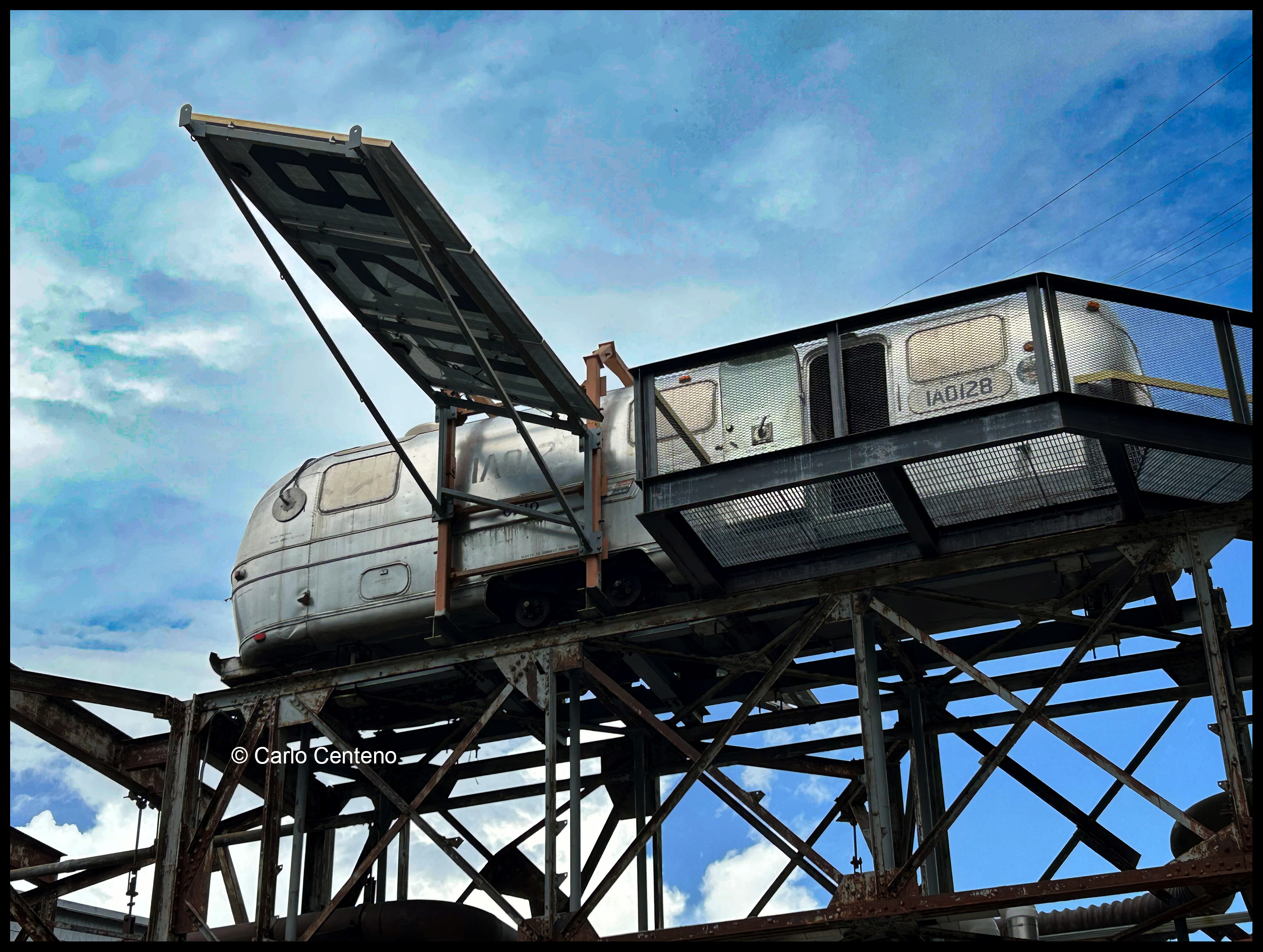
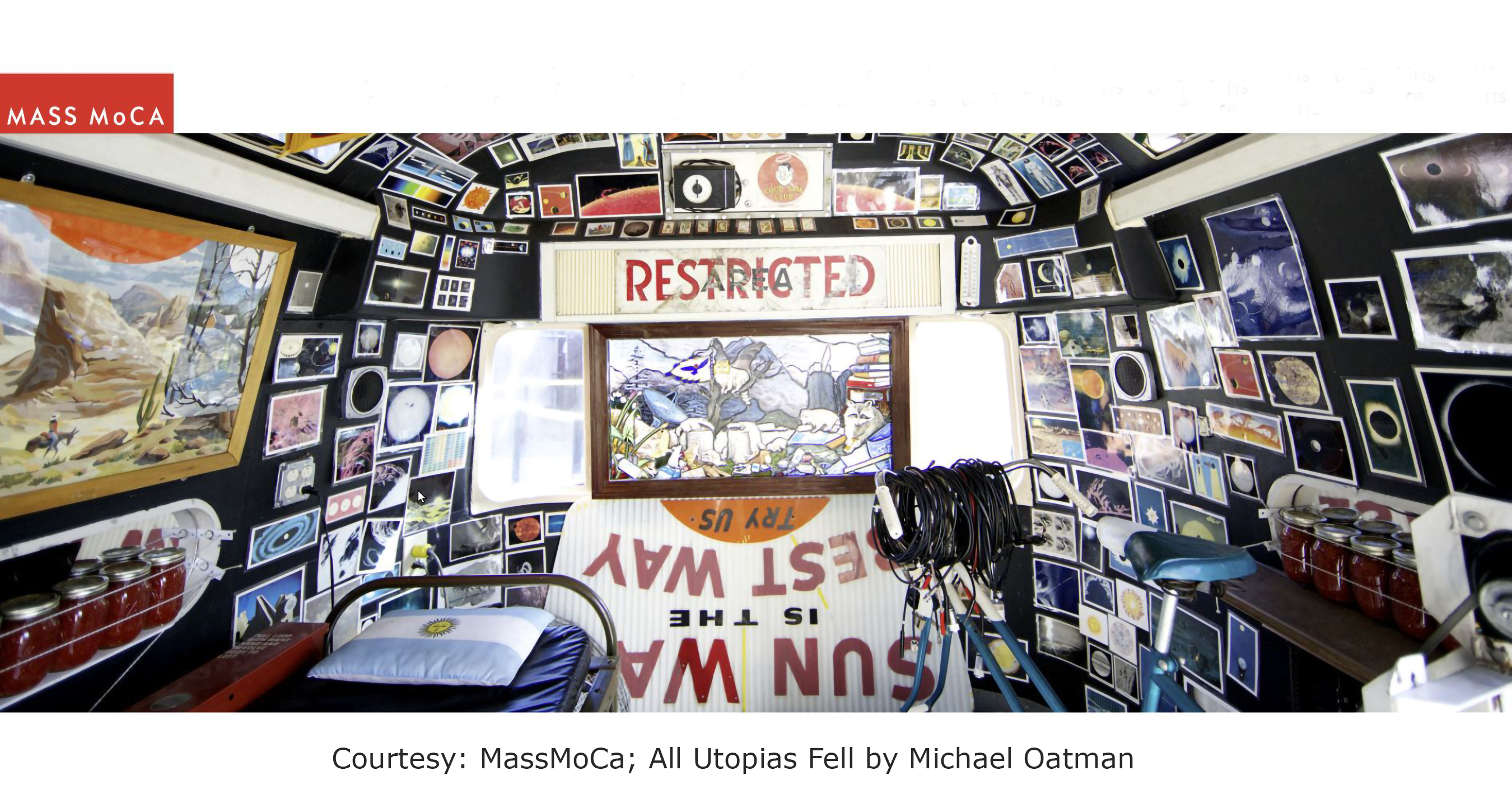
Suspended on tracks next to the Boiler House is an Airstream trailer. A walkway takes you to and from the Airstream to the Boiler House. This is the work of Michael Oatman, entitled “All Utopias Fell.”

A common theme in my soliloquy is this search for order and purpose, or a clarification of both. This is a challenge as I tend to overthink, excessively evaluate one over the other.
Upon entering the Airstream, a myriad of visual elements reach out to you. It’s as if each photo, drawing, sign, piece of paper, object and so much more want to make mental impressions on you, as in right now. This is sensory overload and perhaps a metaphor for the soliloquy stirring in your thinking. It’s as if each piece could be a catalyst for a specific thought process. And once that piece or pieces enters your thinking, you start that introspection or make it progress to another level.

There are several “Why this?” and “What ifs?” within the profound, introspective construct of choices and decisions that are created. The certainty of being your own person, unique and unduplicated by any other, is that choices and decisions you make create the questions that begin with “why” or “what.” And while you and others are individuals in that singular sense, the framework of questioning is common for everyone, but ancillary circumstances are bound to differ between people.

Dr. Faustus, the play written by English dramatist Christopher Marlowe, revolves around the angst of Dr. Faustus agreeing to surrender his soul to the devil in exchange for magical powers. His soliloquy in the last hour before that exchange, is one which poses questions and conditions had the choices Dr. Faustus made were different. Once made, the commitment is binding, non-negotiable. There are no pause, stop or rewind buttons in life.

Shakespeare’s Hamlet is the quintessential soliloquy in my opinion. With new realities [and previous uncertainties] playing out today, themes of life & death, the meaning of our purpose and existence, mortality and vengeance are wonderfully distilled into words that examines all that can detract or enhance our existence.

I came across the last photo as I finished my visit to the Boiler House. It dawned on me that this effigy is a personification of someone covered with details that make up her/his soliloquy.

Clark Institute of Art: “A Room of Her Own”

Time I spend at a museum of fine arts is about as cathartic an experience I can think of. Indeed, cathartic art is an emotional salve that can ease the burden of feelings that keep you down. For someone with dysthymia–like myself and others–engaging in positive activities helps mitigate the weight of dysthymia [Persistent Depressive Disorder]. PDD is not as well known as MDD [Major Depressive Disorder], but the former has less severe yet more persistent symptoms of depression.

With all that’s been bombarding us [unfortunately many instances are not positive] in our day-to-day, we can manage that which irks us and steer thought and action toward positive choices, which in turn can help generate positive thoughts and feelings. Some choices I lean to include blogging, letter writing, playing the piano, tennis, family time and more.

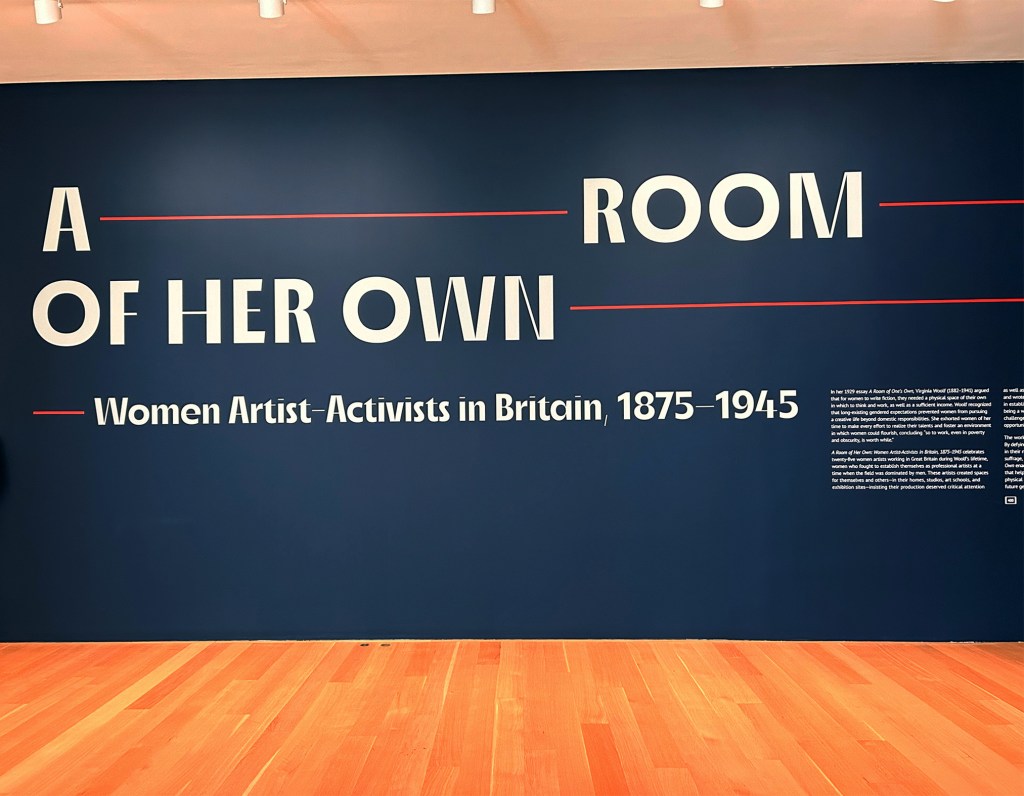
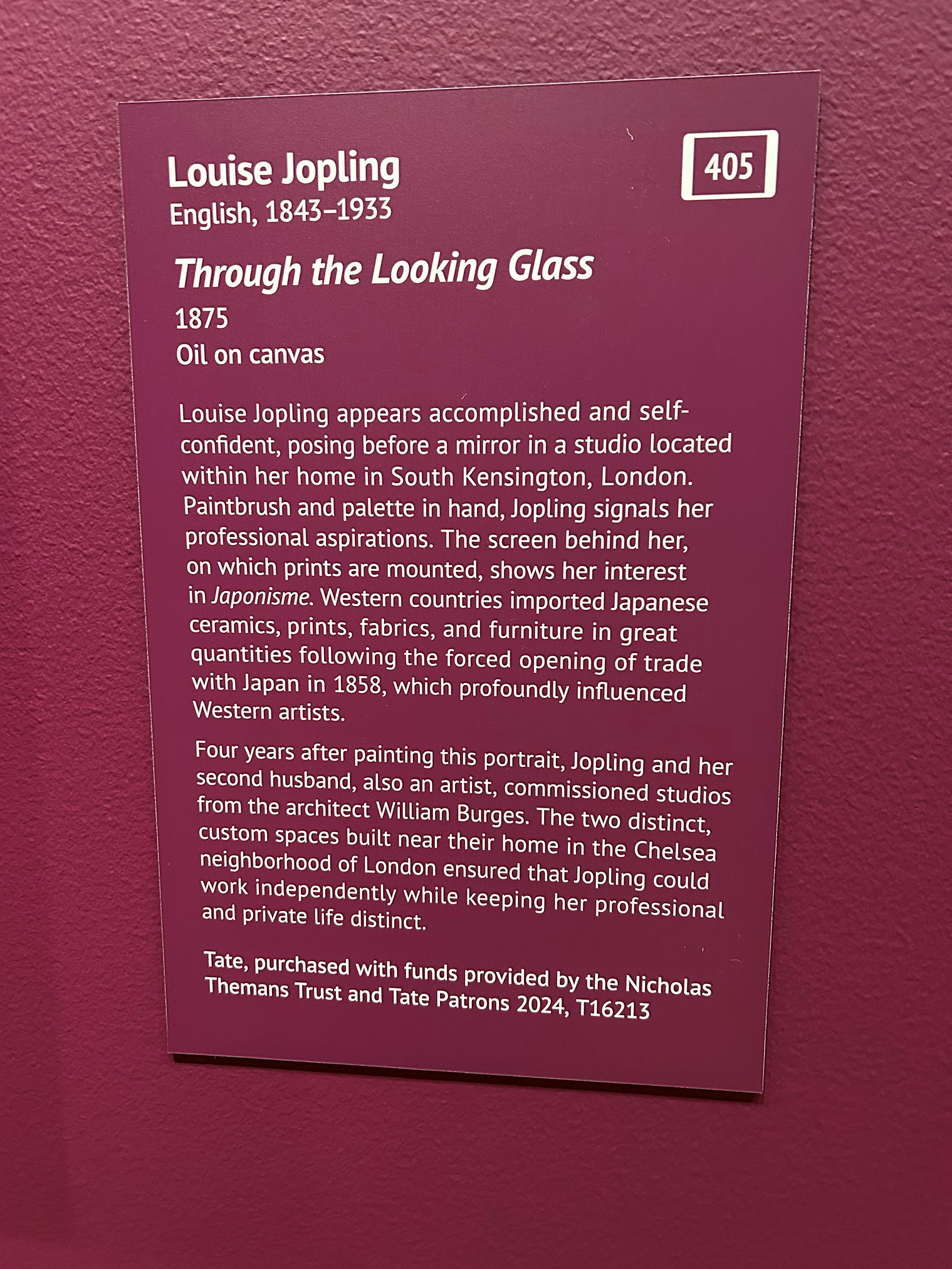
Recent family time with my 2 grown daughters, their husbands, children and their dogs percolated this thought: Both women and their spouses have full schedules with work, raising a family [includes a dog per family], volunteering etc. so then, how do these 2 women have a Room of One’s Own? I credit the exhibit now at the Clark Institute of Art, A Room of Her Own: Women Activists-Artists in Britain, 1875-1945, for germinating that thought surrounding my daughters. I encourage you to experience this exhibit; it runs until September 14, 2025.

The 1929 essay, A Room of One’s Own, was written by Virginia Woolf. You can see the tie between the title of the essay and the name of the exhibit. And if you read Ms. Woolf’s essay, all the better.

Photos taken, courtesy of Clark Institute of Art

Consider this post a “trailer” for the exhibit. It’s worth the trip, and not just for the love of art, but that of expanding our perspectives as well our own sensitivities toward women.

EPILOGUE
For additional perspective with respect to women in the workforce please refer to the Women in the Workplace 10th anniversary report [published September 17, 2024 by McKinsey & Company]

Navigating Dystopia: Finding Hope in Uncertainty

In our current state of dystopia, many of us choose to distance ourselves from news media in all its forms. All that noise creates too much anxiety, along with all the other discomforts that accompany “news and information.” We are exposed to a colossus of news briefs, articles and “breaking news at this hour” enough to ignite [or bore] the minds of writers/authors well versed in our state of fear, hopelessness, frustration, suffering et al.

Misery knows no bounds, but so does hope and happiness.

Relevance and purpose can hold both good and bad in thoughts and actions, but your choice in one or the other adjectives relies in your beliefs and values that help you deal with your day-to-day. You may not realize–or even think about–your own stoic qualities.

Consider the opening paragraph of Charles Dickens A Tale of Two Cities.

“It was the best of times, it was the worst of times, it was the age of wisdom, it was the age of foolishness, it was the epoch of belief, it was the epoch of incredulity, it was the season of Light, it was the season of Darkness, it was the spring of hope, it was the winter of despair, we had everything before us, we had nothing before us, we were all going direct to Heaven, we were all going direct the other way–in short, the period was so far like the present period that some of its noisiest authorities insisted on its being received, for good or for evil, in the superlative degree of comparison only.”

When you realize you can’t control everything, but manage the ones you can, then you’re in a better place than many others.

Festival of Flowers

courtesy Michelle & Donald D’Amour Museum of Fine Arts

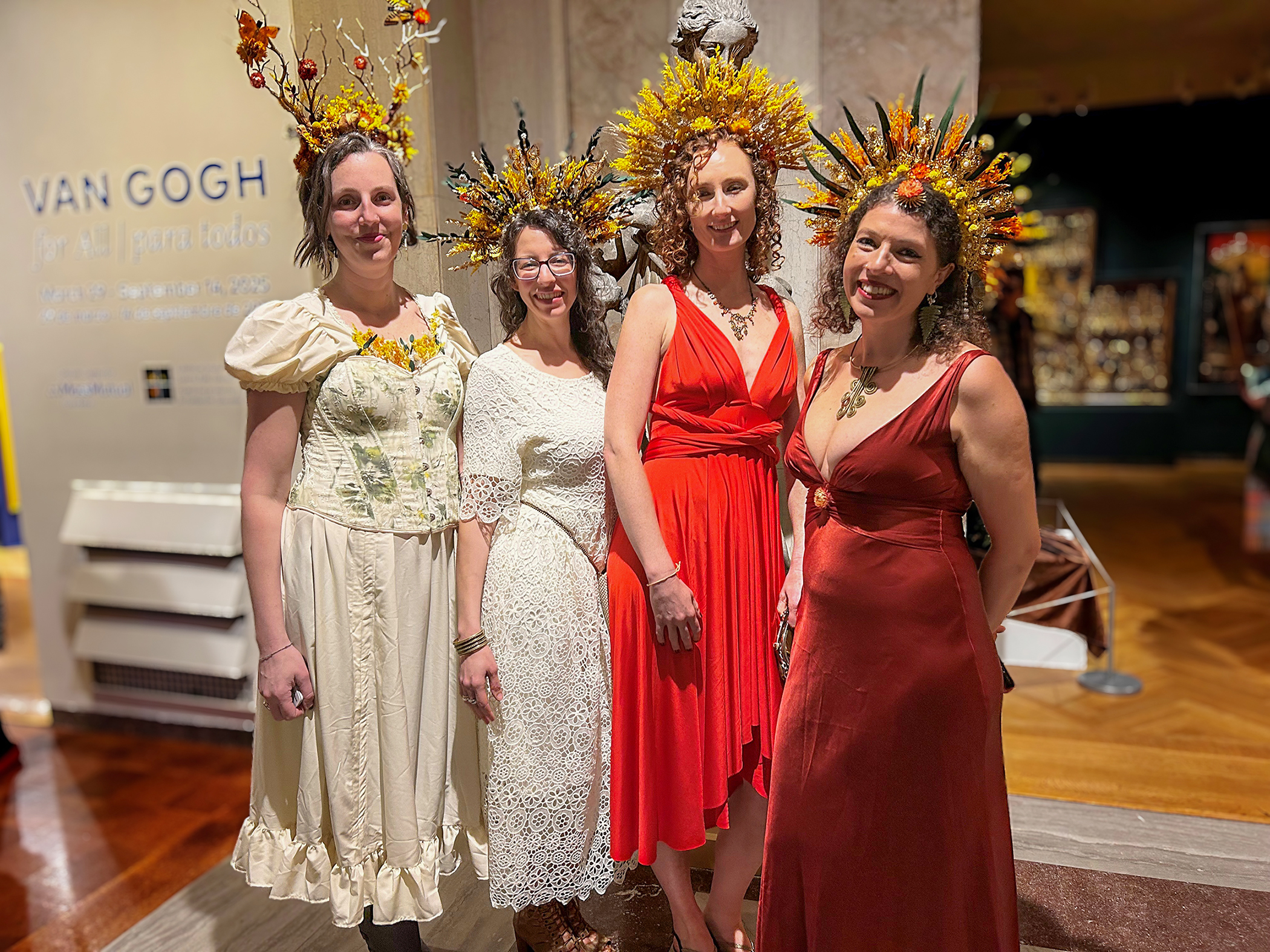
In each of the four museums that make up the Springfield Quadrangle, members of gardening clubs and florists based around the area created arrangements of colors, textures and other details in a manner that would intersect with a selected painting or other creation within the museums.

The creativity range was as eclectic and electric as anything I’ve seen, simply because of the relationship that attempted to “unify” two discreetly different pieces of art.

The juxtaposed subjects provided depth, perspective and of course relevance through the use of color and hues, manifestations of the blending of material, thread size, color, props, textures and so forth.

Some arrangements did not have a direct connection to a piece of art in the gallery. My sense is that such arrangements–such as the one displayed above–were created to compliment art already sitting in that room.

From headwear and accessories to…..

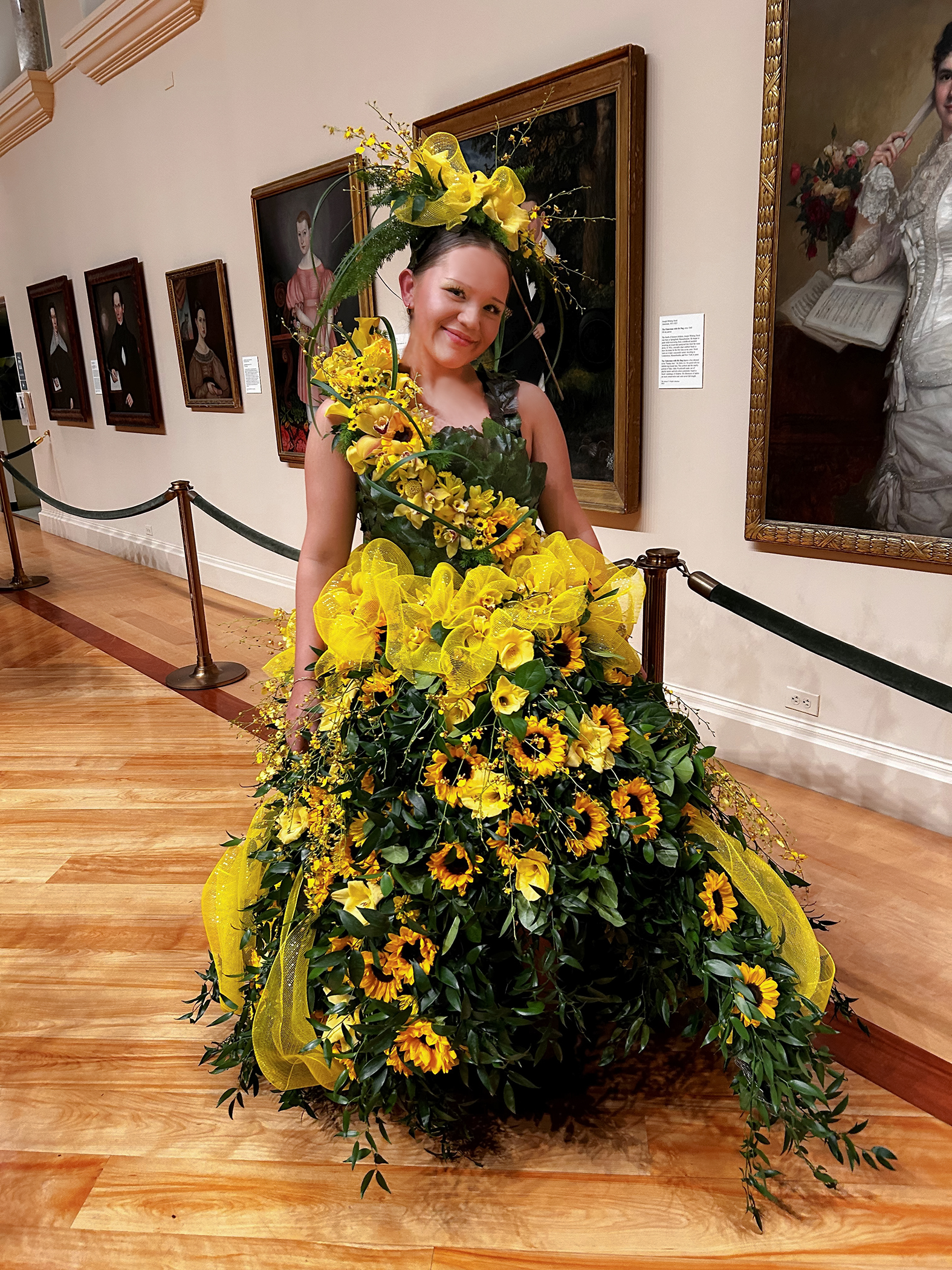
….gowns made entirely of real greens and flowers, the creativity was beyond words! Next April 2026, should be an interesting installation! See you then.

Consciousness in the Age of Irreverence

I’m not alone on this one, but it seems that many channels of communication [discussions, social media and various online postings, news media, e.g.] are quite inhospitable. Of course not all content is an incorrigible exaggeration, but it does seem that we’ve gone myopic of a rule that involves interaction and in particular, discussion, between different POVs. Essentially, such discussions are cleaved in 2. There are some instances where discussions cannot abide with the adage, One can disagree without being disagreeable.

Ironically, much of what we do that makes us feel lost, infuriated and misunderstood is, indeed, something that’s very human. And of course, we can be intractable and obstinate just as we can be manageable and flexible. It’s been said that politics and elections are catalysts to conditions of inflexibility, among other reactions and situations.

Consciousness Fine Tuned

Being aware of yourself and how you think about everything around you is uniquely yours. There are a few theories which attempt to explain consciousness, but one written by a researcher at Boston University School of Medicine is one which mortals like me can comprehend.
The end of October has rendered our landscape into a wonderful palette of autumnal colors: the reds, orange, yellows and hues in between are as beautiful as I’ve ever seen. I share this because watching and/or listening to the news is taking the wind out of my sails. So, to fine tune [or tune out] the bad vibes plaguing airwaves, print, and online, I retreat to places where I can hear my thoughts and submit to various feelings coursing through my consciousness.

You could say that I’m “rebooting” my consciousness, but I feel it’s more like a “recalibrating” effort to keep my sanity more or less where it’s supposed to be. The quiet and calm of places such as these act like a rheostat where mood, color, the smell of the air and so on can be dialed up or down or not at all. In doing so, I’m reminded that the angst raging between factions entrenched in ideologies are obstacles for realizing a common good. The greater good lies dormant, restrained with indifference and the stubborn personas that make life uncomfortable.

There’s no denying the subjectivity of consciousness, but there are constructs within it which allow for common ground. Without those common constructs co-existence would be, in a word, Sisyphian.

I look to writing and chasing the light, feeling immersed with either one or both, to purge distress, sadness, loss of concentration, etc. Certainly, when your mind is busy with something good, a good that pulls you away from angst, then jump in.
I won’t be chagrined by situations beyond my reach. It’s a waste of energy and time grinding about things I cannot control. That’s easier said than done, but I remind myself to ruminate less on what weighs me down and instead examine alternatives that have helped me before.

Can anyone deflect dissonance long enough to find even the smallest gesture or comment that closes distance and transforms distraction into possibility?

I relish the 4-seasons here in New England. I have preferences for the times in a year that are cooler and less humid, but I also welcome activities and distractions that come with the other seasons: longer daylight hours, trips to Cape Cod in Massachusetts [salt water and salty air are genuinely therapeutic], visits to the Berkshires and so forth.

How do you take care of your sense of–or even recalibrate–consciousness?

Who’s [the] Better Boss?

On August 27, 2024, The Harvard Gazette had an article, “You want to be boss. You probably won’t good at it.” click here

Within it were some details regarding qualities that are part and parcel of what makes for a good boss, a good manager and so on. These are details for HR managers,, pundits of MBA programs, the erudite captains of industries, C-suites and so forth. In this day and age of online realities, there’s no shortage of career coaches, executive publications, employment placement services and psychologists focused on behaviors.

Experience, age, personality and examples of how difficult situations were effectively handled etc. Nothing unusual in checking on those aforementioned qualities, but the research paper commissioned by the National Bureau of Economic Research [NBER] states that the way most managers are selected is lacking, AKA ….“they [companies] may not be doing it right.”

Published
Categorized as POV

Un Point de vue Parisien

A Parisien Perspective

Keep an open mind. It matters when traveling to any destination that piques your curiosity. Whether it’s a neighboring state/province or an altogether different country, it requires elasticity in learning, appreciating and understanding. An open mind can open doors. It means possessing a willingness to be out of your comfort zone. And as you stand in your discomfort, your perspective may need adjustment or refinement. This is where you take the initiative to help others see your perspective. Naturally this requires staying attentive for the different position[s] you may encounter. It’s fine to disagree without being disagreeable.

Remind yourself that having an open mind tames the myopia that limits one’s ability to think beyond your horizon of possibility.

Arc de Triomphe

Eleven days in France this July made for quite a vacation. The coming of the summer Olympics turned Paris into a mixed bag of barricaded icons and walkways, detours and traffic. Our Parisian stay covered 3-days; not enough time to explore Paris, but 3 is better than none. A first visit to another city is as they say, an experience. Visually, aurally, olfactorily you cannot ignore the architecture, the gardens, the people, the language, the aroma of freshly baked croissants, baguettes and coffee and so on and so forth.

After Paris the next 8 days would be at Vignon-en-Quercy in southwest France. Fortunately, our flight back home was 7-days before the opening ceremonies, and we knew that more walkways and some open areas would be cordoned off. Predictably, logos and phrases proudly reminded of The Games coming to town. Still, nothing took away from our sense of discovery in this storied city.

We had thoughts of visiting the Louvre, Musee d’Orsay, among others, but the detours and limited access made it a physical and mental marathon. We were close to those museums and other points of interest as they say, but we unabashedly savored our quiet time in the Jardin des Tuileries, a garden between the Louvre and Place de Concorde. In a more relaxed pace, we enjoyed le Jardin and even took advantage of the cafes within the grounds. Seeing the Louvre from a different vantage point provided an unrushed appreciation for a 231 year old institution.

Le Louvre
La Place de Concorde/ courtesy Paris Visuel
Detail de l’exteriur de Louis Vitton
Pedestrians be Careful Cross in 2 steps

We thought of adding 2 more days in Paris. It would’ve certainly helped my french conversation, but other plans were already in place. Entering any business or eatery, saying bonjour is always helpful and polite. After the greeting, the most frequent words from my mouth were, Ou est…? or quelle direction est…? or pardonnez moi, sommes-nous pre du……? and of course, merci, bonne journee!

Our first morning, we walked to a bistro teeming with commuters and visitors. The menu on a sandwich board offered something we liked and I recognized: Petit déjeuner supreme ! Deux œufs [au choix] avec jamon et frommage, cafe, jus d’orange, baguette, croissant, confiture de fraises et salade. [Supreme breakfast! Two eggs any style with ham and cheese, coffee, orange juice, baguette, croissant, strawberry jam and salad].

We sat outside among a cluster of small tables and chairs, but the waiter advised we sit inside, though not far from the open frontage. Il y a trop de fumee dehors. Too much smoke outside as cigarettes are popular in most of France. It was a perfect time to watch people going on with their lives: scooters and bicycles carried a cast of characters; small french cars ruled the streets alongside taxis and Ubers, motorcycles and buses.

Based on our waiter, my french was so-so. Monsieur, I speak and understand english; you do not have to speak french…. Ouch. Polite but humbling. As he turned toward the kitchen order-window, I mumbled, C’est dommage….it’s a pity, too bad.

“The solution for your industrial waste.”

NEXT VISIT: a week in the town of Vignon-en-Quercy [….See you there.] !!!