


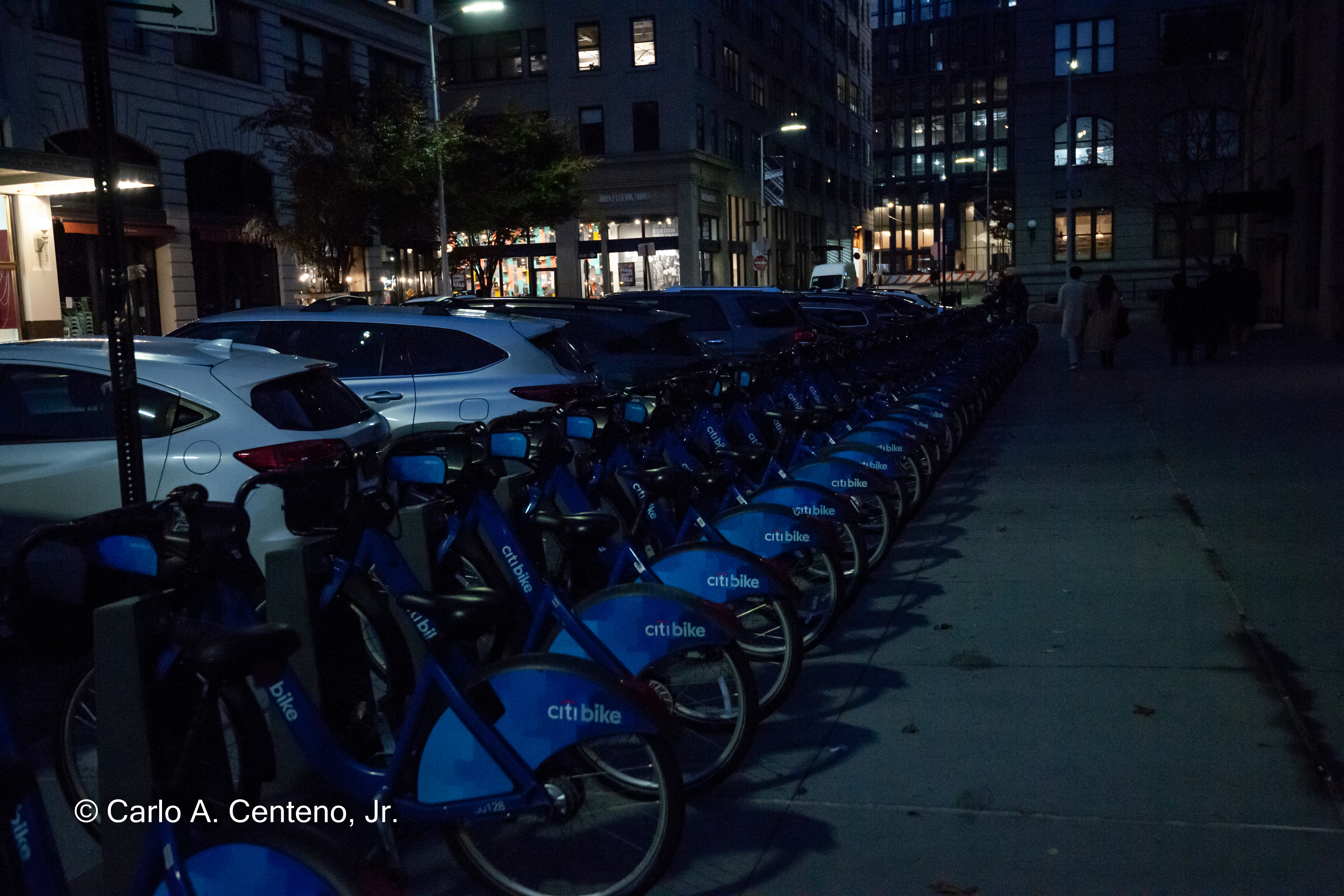

With a pen and camera
Marketers and consumers share an underlying condition that produces second-guesses to decisions and even behaviors. In the realm of behaviorists, psychologists and therapists, this is often referred to as, cognitive dissonance.
Though the condition is often used in psychology/psychiatry, the right-brainers in marketing can take certain liberties in applying the essence of its definition to feelings and behaviors in our consumption-driven economy. What shapes your decisions and expectations when you buy something, work on a project or to make a single decision at a given time? What influences your “…on second thought, I better…?”

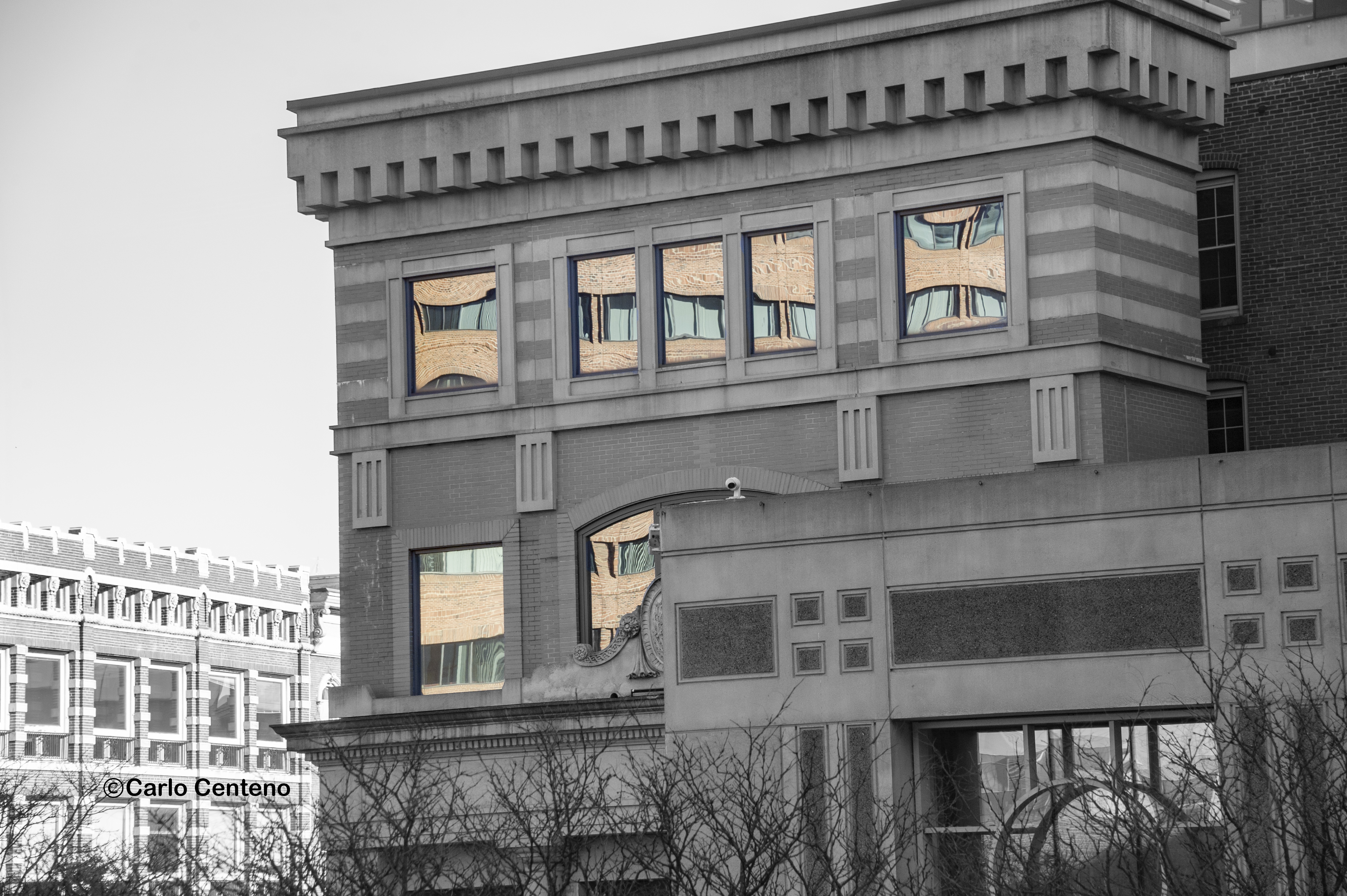
As I’ve noted in previous posts about marketing, it’s not what you’re actually receiving, but what you think you’re getting. This is a stretch, but at times I think some marketing is a form of trompe l’oeil. Are the cluster of lights actually on the bare trees?

Like a product attribute [example: price equates to exclusivity…though it can certainly suggest something else]. Do the light projections draw your attention? Or do you first see the small cluster of lamps in the lower left? Are the lamps somewhere near the building? Or suspended close to it? Clearly direct sunlight is apparent on the face of the building. Which light source peaks your curiosity?
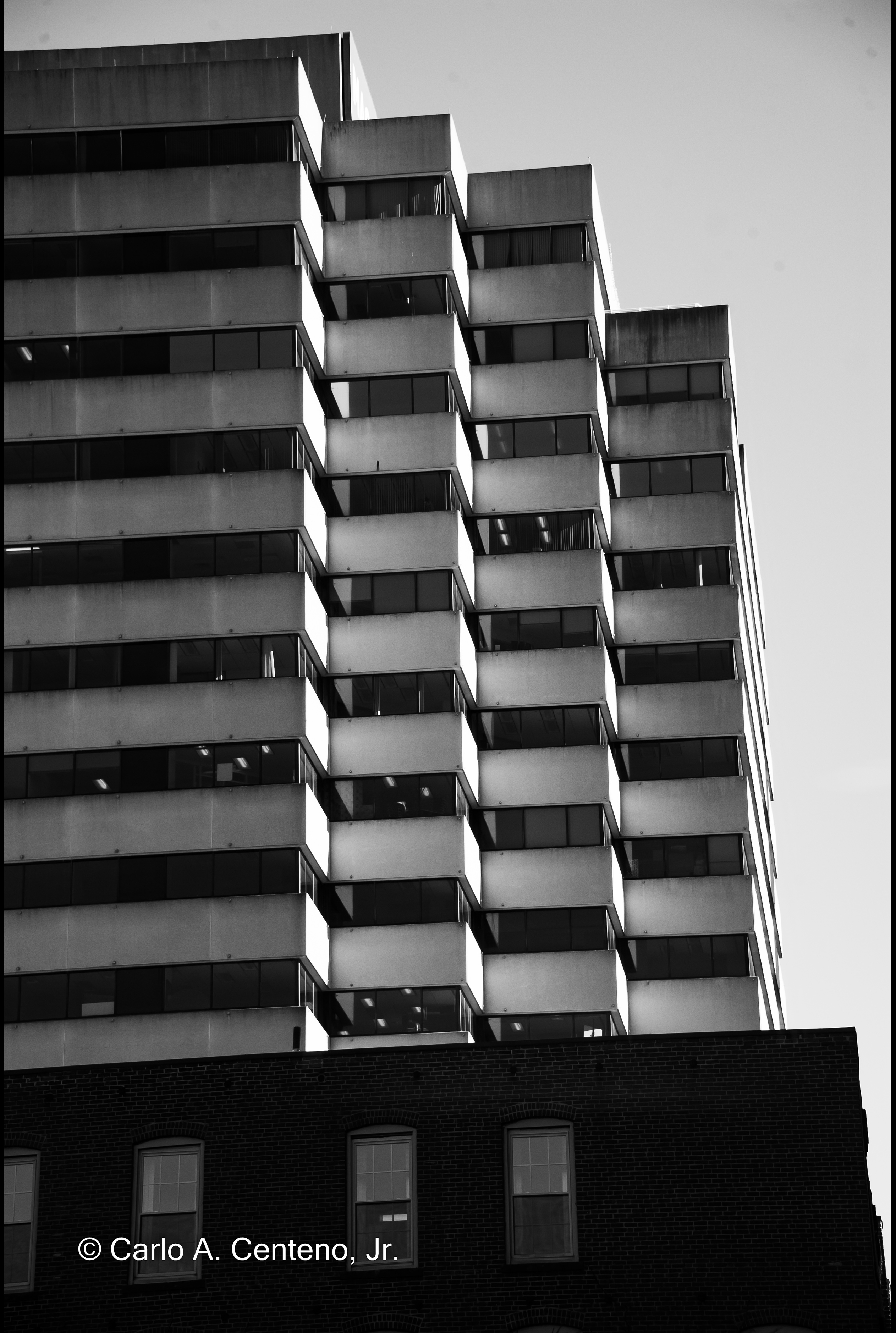
There are numerous examples of classic trompe l’oeil art such as the one painted by Sameul Dirksz van Hoogstraten entitled, Still-Life. It’s a timeless piece, one that can feel more contemporary than its 360- year age might suggest.

Marketing can, indeed, fool your eye. The pima cotton sweater I saw in a catalog looked like a keeper….until I tried it on. Fortunately, returns are the norm for many online purchases.

What a strange, odyssey we are on. Are we in the initial stages of a pre-dystopian epoch? That’s an unnerving take on our tomorrows. I am as guilty as the next for failing to live in the moment. Thus you could–and perhaps should–interrupt my ruminating about the past while also worrying about the future.
No one can undo history and the future is not promised to any of us. So, it’s the here and now, the very present moment where we consciously or rotely go through our lives with purpose or with routine motions of day-to-day life.
Fly fishing for many, for me, is part of life. Time spent on the water delivers familiar notions of preparation, anticipation and the knowledge that the day is, quite frankly, a gift. With all that’s going on in the world, I would say most readers looking at this are doing much better than many others. And having the gift, a day such as being able to go fly fishing is one that should not be taken for granted. Getting to a favorite spot–whether somewhat new or all-too-familiar–jump starts my awareness for the here, for the right now. For those few important things that are usurped by the ephemeral things that entangle us, yes, we all need to live in the present moment!
So, on this Independence Day weekend, take a chance. Make the most of whatever day you have. Any one is a gift. Even when things go awry [I fell into the water moments after releasing this trout!], or not according to plan [I could’ve left the water empty handed but for the wet clothes that chilled me to the bone!] , don’t dwell on what might’ve-could’ve-should’ve happened. That’s done.
I think you’d be much better off acknowledging how far you’ve come.
And for the aspiring fly-fisher, that beautiful brown was caught and released on an an unusually cool late June, mid-morning [10:00 am?].
The details:
o I used a #16 pheasant’s tail nymph I tied with a barbless Partridge hook [unweighted];
o tied to a 5X fluoro tippet about 2-to 2 1/2 -feet in length;
o attached to a tippet ring on a 6-foot furled dacron [?] leader;
o to a 4WF fly line;
o spooled onto a Grey’s cassette reel with #20-backing
o all collaborating with a Winston Biiix 9-foot 4WT fly rod
……From a distance
You look like my friend
Even though we are at war.
From a distance
I just cannot comprehend
What all this fighting’s for.
From a distance
There is harmony
And it echoes through the land
And it’s the hope of hopes
It’s the love of loves
It’s the heart of every man
It’s the hope of hopes
It’s the love of loves
This is the song for every man.
God is watching us
God is watching us
God is watching us
From a distance.
Excerpt from the song, “From a Distance” by Julie Gold ©1985*
*Songwriter Julie Gold composed this song when she was working as a secretary at HBO. She wrote during her free time. The song has been covered several times by other artists such as Nanci Griffith and Bette Midler.

On a recent flight home, 2 songs came to mind. An epiphany of sorts became apparent as I looked down on Springfield, Massachusetts and Ski Sundown in New Hartford, Connecticut.

In light of the Ukraine-Russia war, it’s not a stretch to understand the effect of distance when watching something from afar. Things are not always as they seem, but up close, enough details emerge to create a clearer picture.
Most of us see what’s happening from a distance, from the safety of our screens playing out “breaking news” of the terror and the maddening reality of one country imposing its incorrigible intentions on an independent nation.

At altitude, it’s easy to “not see” the actualities of what’s coming and going at ground level. And yet what impacts me the most is how the innocents and defenders suffer and die, of how the children struggle to understand this detestation that arrived from nowhere. Modern journalism can report events as visceral and undiluted, anywhere at anytime. In that sense, we see more than what we want to.
I leave this post with the words Enjolras sang during the scene At the Barricades, from the musical, Les Miserables.
Do you hear the people sing?
Singing a song of angry men?
It is the music of a people
Who will not be slaves again.
When the beating of your heart
Echoes the beating of the drums.
There is a life about to start
When tomorrow comes.
Les Miserables by Victor Hugo
Les Miserables, the London Musical, trademarked by Cameron Macintosh Overseas.

I am an odd person out. I’m certain I shared this in a previous post, namely that winter, the shorter days, the snow and the cold don’t bother me the way I know it really bothers a lot of other people. However, when freezing rain, relentless winds from the north and sleet show up, doubts perk up about my relationship with winter.
My enjoyment of this season is greatly enhanced by a few other small details: no biting insects, most nasty smells are frozen in place, it’s easier to layer up to stay warm versus shedding attire to get cool. Fireplaces are invaluable for the way they comfort our weary minds and bodies.
And then there’s the light. By late October, shorter days manifest that longing for days that end at 9:30 in the evening, versus 4:15 in the afternoon. But for me on any given day, winter light can be nothing short of amazing [well, to my eyes anyway].

For those enamored with snow, it doesn’t matter how you enjoy it, just as long as you get out to enjoy it. Snowshoes. Boards. Skis [alpine and cross country]. Insulated tie-up boots [aka “moon boots”]. Building snow forts, a snowman/woman/sculpture. Tubes, sleds, and toboggans. They all generate smiles at one time or another.

Even the most ardent worshipper of other seasons can understand why winter can be a favorite. There’s a sense of solitude, even in the busiest of urban environments. Indeed most folks are rushing—as it’s often said—to get out of the cold, to get inside to warm up. And yet there are those who look to get out to be invigorated by the cold air. When it’s cold, it’s only natural that you move to stay warm: motion generates heat and heat consumes calories and the consumption of calories means soothing cups of hot coffee, hot chocolate, hot soup, hot tea among other choices awaiting your selection. Admittedly, it is bliss having such hot consumables balance out the chill at the end of a day. The yin-yang of warm & cold becomes apparent.

A cold drink can bookend a hot summer day just as a hot toddy can on a cold winter day. This radiating cocktail of hot water, lemon, honey and a bit of whiskey is also hydrating, indeed soothing since it’s a drink perfect for sipping.

Cold light, winter light, is especially sharp when it reaches across a landscape as far as you can see. The shadows are longer and details stand out like bas-relief etched into tree trunks. On ski trails, the tendrils left by carving skis add to that dimension of depth, or even height, as if lengths of dark thread randomly lie atop the snow.
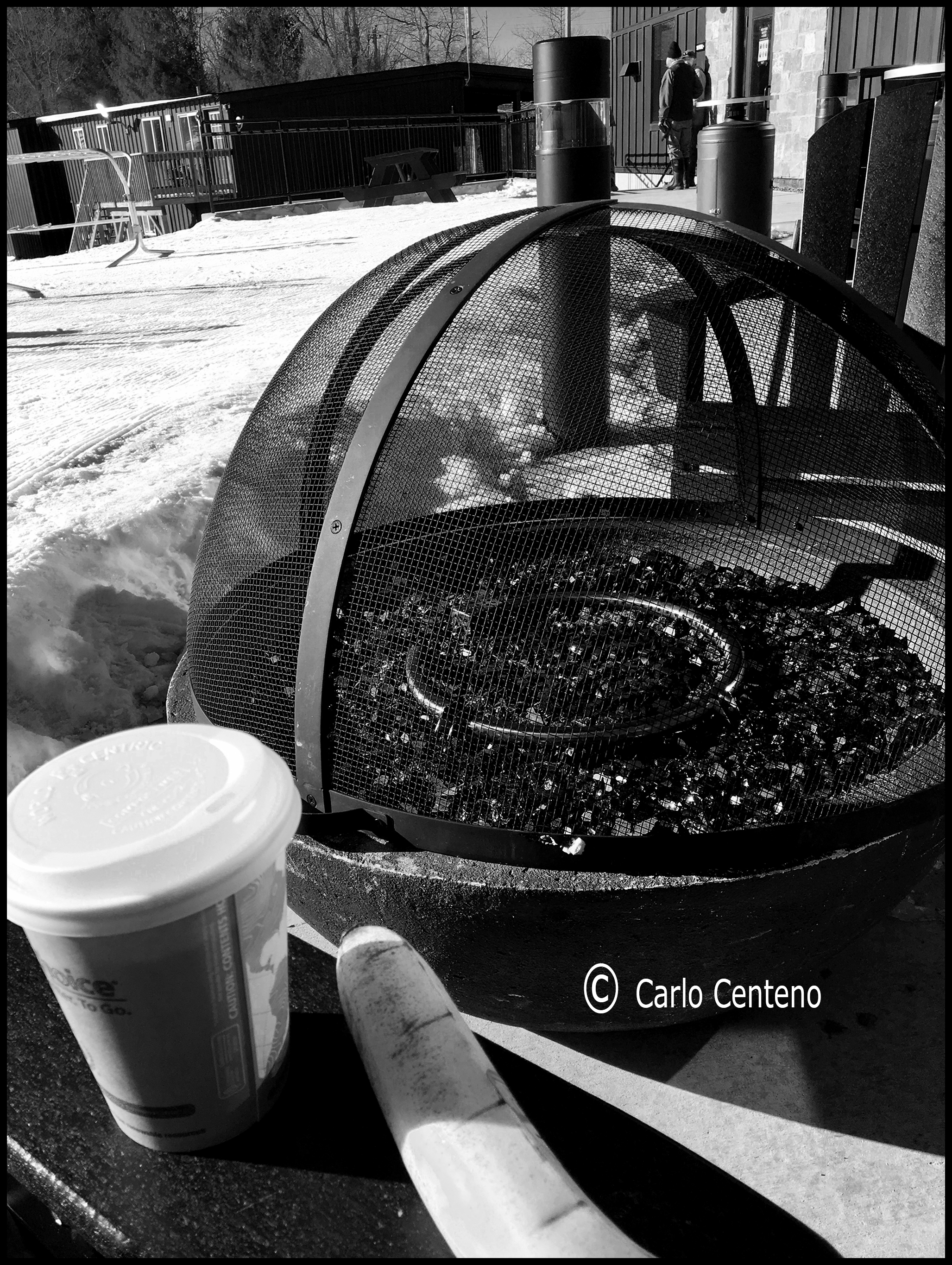
Winter’s light—especially later in the day—can feel cathartic and the sun’s warmth enhances this catharsis. A cup of hot chocolate, a banana, a comfy, large Maine Adirondack chair and a pit fire are all good company.

There are several places I always look forward to visiting. The Catskills is one of those places. Marketers have positioned it a number of ways, two which I can refer to: the first being that author Mr. Washington Irving created a mystical dimension about these mountains and valleys as demonstrated in two of his works, Rip Van Winkle and The Legend of Sleeping Hollow. The second is that these same mountains are the birth place of American fly-fishing, this, toward the end of the 19th century.
The eponymous short story tells the tale of Rip Van Winkle, who after accepting a drink or drinks from other Dutchmen, went into a deep slumber. A twenty year slumber at that. And to think that suspended animation had yet to be imagined. Like Irving’s other short story, The Legend of Sleeping Hollow, there’s no denying the intrigue and fascination with the dark arts as it were, an ethereal construct of feeling displaced, out of touch and powerless. The spells, debauchery and intrigue hold the reader captive, and the Catskills is both crucible and container to the kind of narrative that keeps young and old awake at night.

Along the roadways that weave up and down and around these mountains you’ll see places with names like The Washington Irving Inn, Sleepy Hollow Mercantile, Rip Van Winkle Golf, etc. etc. From eateries to where locals meet and catch up on recent news, to bed and breakfast attractions, there are many hints at Catskills history and folklore.

As for the fly-fishing, there’s enough rivers and streams to keep you occupied. Certainly there’s enough real estate to get you lost as well or put another way, give you solitude and quiet like no other in the northeast. I’m told that Mr. Theodore Gordon is the one credited for starting American fly-fishing in the 1890s. This feeling of where fly-fishing started in the USA is supported by a smattering of fly shops and other related businesses, several found close to the rivers. For many die-hard enthusiasts, these are sirens that are as strong as the waters and fish that beckon us to get our fly lines in the water.

Covid has altered some of our pursuits, but it hasn’t put a dent on my love or time in the outdoors. Factor in the openness and scale of outside and one can understand the fascination, the desire to get up and out of the house/office and do something for yourself or for perhaps someone else. It’s rare to see another person here in the Catskills or in other wooded areas I’ve been in. Social distancing is a non-issue. In our uncertain world, being wrapped in the outdoors is invigorating and yes, even fulfilling.

Not again. I can’t imagine the number of times I have thought of that remark let alone the times I’ve said it. I’ve been fortunate on many fronts and I’m more than grateful. The past 13-14 months or so, has been a journey of minor inconveniences compared to what others had to suffer through. I have no reason to complain. Then again with the Delta Variant on a rampage, I can’t help but wonder yet hope that common sense will prevail….

I have a handful of avocations, each having one thing in common: I am comfortable when it’s me and myself involved. That sounds a bit self-absorbed, but it simply means I’m fine being alone. Being alone and lonely are two different things, obviously. Having alone time is important for one’s rejuvenation, at least for me.
Photography, journaling, letter writing, playing the piano and fly-fishing are welcome pursuits for me. Granted the first and last distractions can be shared and done with others. On several occasions my wife, daughters and other family members have kept me company on nearby waters. Our fly rods might look like conductor batons in a free-for-all, an ensemble of asynchronous metronomes, where each length of graphite is tuned to the individual holder.

On those days when I’m out with a camera, my wife keeps me company. In the city, she waits for me to catch up when I stop to take a photo. After awhile though, the distance and the time it takes to catch up get a tad longer. On jaunts through the woods, the converse is true: our pace is calmer, slower than the one we use in the urban environment. Time takes its time [read: less frenetic] in natural spaces; and for me that’s how it should be.
To see something in the wild is often fleeting: the songbird you hear only to take flight once you actually see it; the whitetail deer that suddenly, inexplicably pops out from the background in what feels like a whisper’s distance, only to bound away just as you look to acknowledge its presence.
And then I’m handed a “pause” button. Fly-fishing can put a slight pause in what you’re looking at before the moment disappears. Having a landing net is an appreciation multiplier. It allows an opportunity to add a few seconds to really appreciate what you’re seeing. The Eastern Brook Trout is a jewel among fish. I never tire of catching this wild* freshwater creature that can only live in a healthy river or stream. Healthy, as in cold, clear and running. The existence of wild trout means the habitat we’re visiting is good for the fish and everything else that’s dependent on the river and surrounding area.
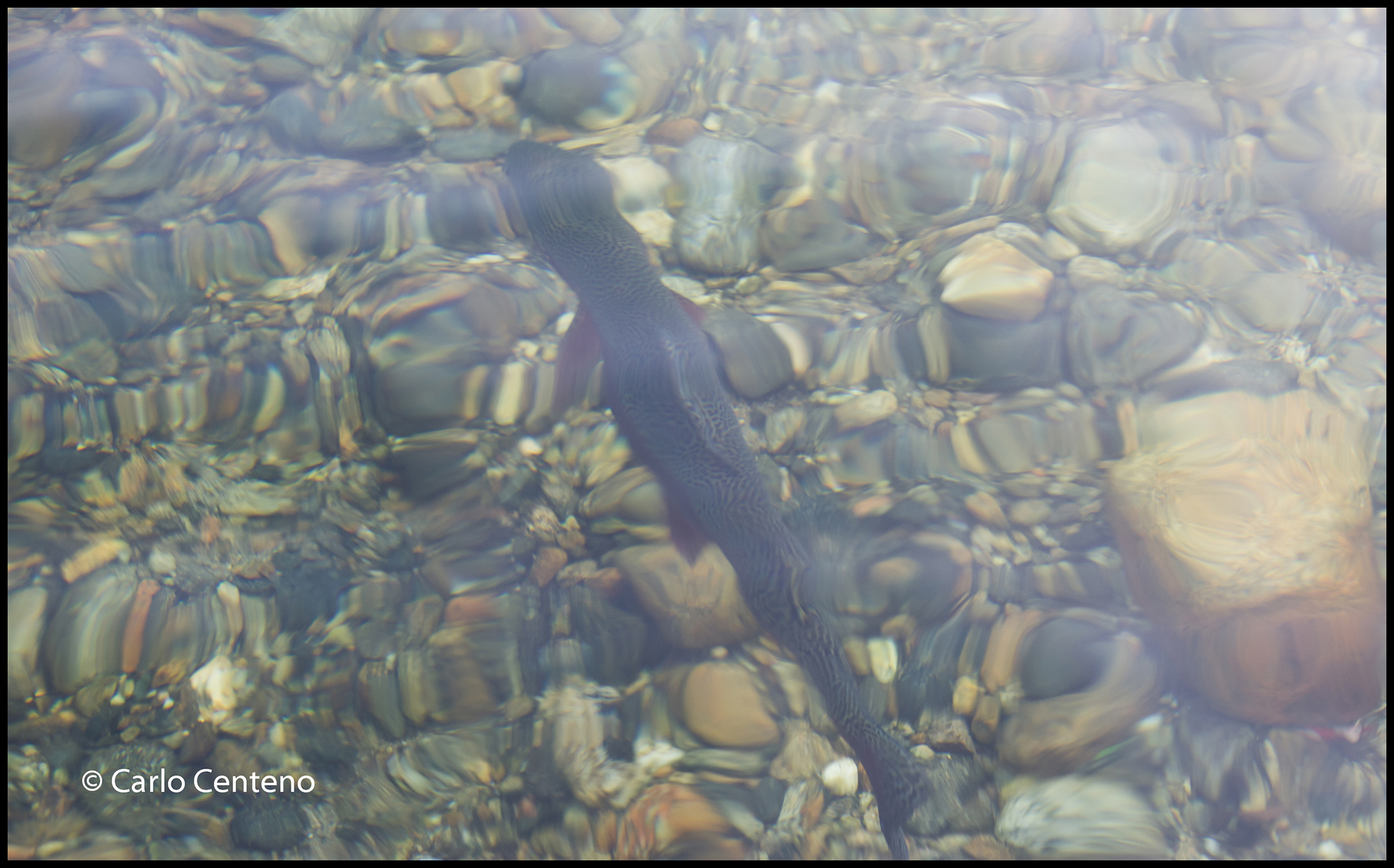
Ours is a symbiotic relationship with the natural world. Unfortunately, that relationship is out of balance and all things wild and natural are being short-changed by humankind’s behaviors. I find the safest social distance in the outdoors and the time there prompts me to examine the symbiotic and personal relationships I hold dear.
*wild versus native: a wild trout is one that’s been born in the very water it lives in. Wild trout/fish reproduce naturally in their habitat and sustain their populations. A native fish are those that have lived and thrived in areas that have had no or very little human interaction. A stocked fish is from a hatchery that’s typically managed by the state’s wildlife management. Regardless, please make an effort to carefully release these fish [a fly-fishing practice called catch-and-release]. It’s good for the neighborhoods we visit.

By all appearances, he patiently cares for his pigeons. While I cannot verify if he’s out regardless of weather, my sense is he’s devoted and committed to his feathered friends. I have this feeling he’s been at this for a long time. The 3 or 4 times I’ve seen him on the roof is a study in stoicism, or maybe a purposeful, self-administered state of calm and reflection which is part of his daily schedule. Click HERE to learn more about the hows and whys of raising pigeons.

On a cold March afternoon, I was surprised to see a large flock of birds flying closely together, first in one direction, then back toward the direction they came from. When they hovered and eventually landed, I noticed someone walking on a flat roof top, nothing more than his head and shoulders visible from the street below.
Having access to the roof of an apartment across the street, I made my way up and discovered the gentleman sitting on a bench, his back against a column of white-painted brick. His focus was on a rather large screened-in coop housing perhaps a hundred or more pigeons. Having nothing to compare this to, seeing it was impressive.
I only know of 3 reasons why someone would raise pigeons: some enthusiasts race them, another group trains them to return home to their roost and others rear them for special occasions. During some festivals, you might see a flock released from a specific area often during a program within that festival. Or you may witness a blur of white-feathered pigeons take flight moments after an officiant proclaims the union of two lovebirds [indeed, pun is intended].

It’s unwise to assume. Assumptions often miss their mark, but in this case, I believe the birds and their caretaker have a strong connection. It’s a reciprocal relationship.
For his efforts, the pigeons have shelter, food and water. He in turn relishes his role and acquires satisfaction knowing his handiwork allows him a unique form of social interaction.
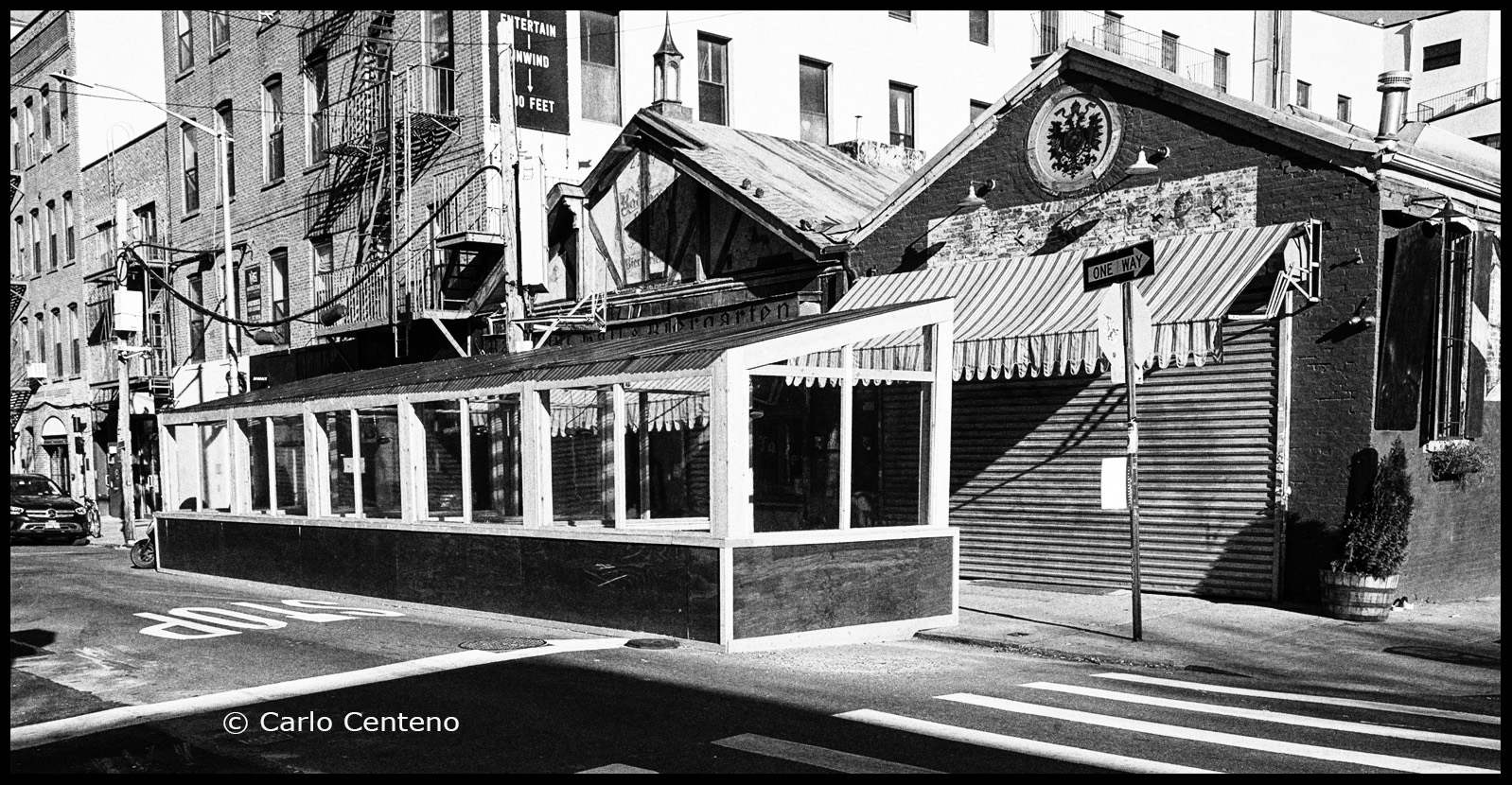
On a cold, windy January day, I took a walk to familiarize myself with another area of Brooklyn. As I do on such sorties, I have a camera in hand. It’s just an integral part of me carrying that, along with a fountain pen. In combination, perhaps an odd idiosyncrasy. Go figure.
There has been so much news about struggling businesses in an economy best described as uncertain if not scary. Regardless of your own standing, uncertainty feeds fear. It’s like that for many, even those who still have a job. There have been a myriad of changes in less than a year, and many of them are unprecedented as we know.
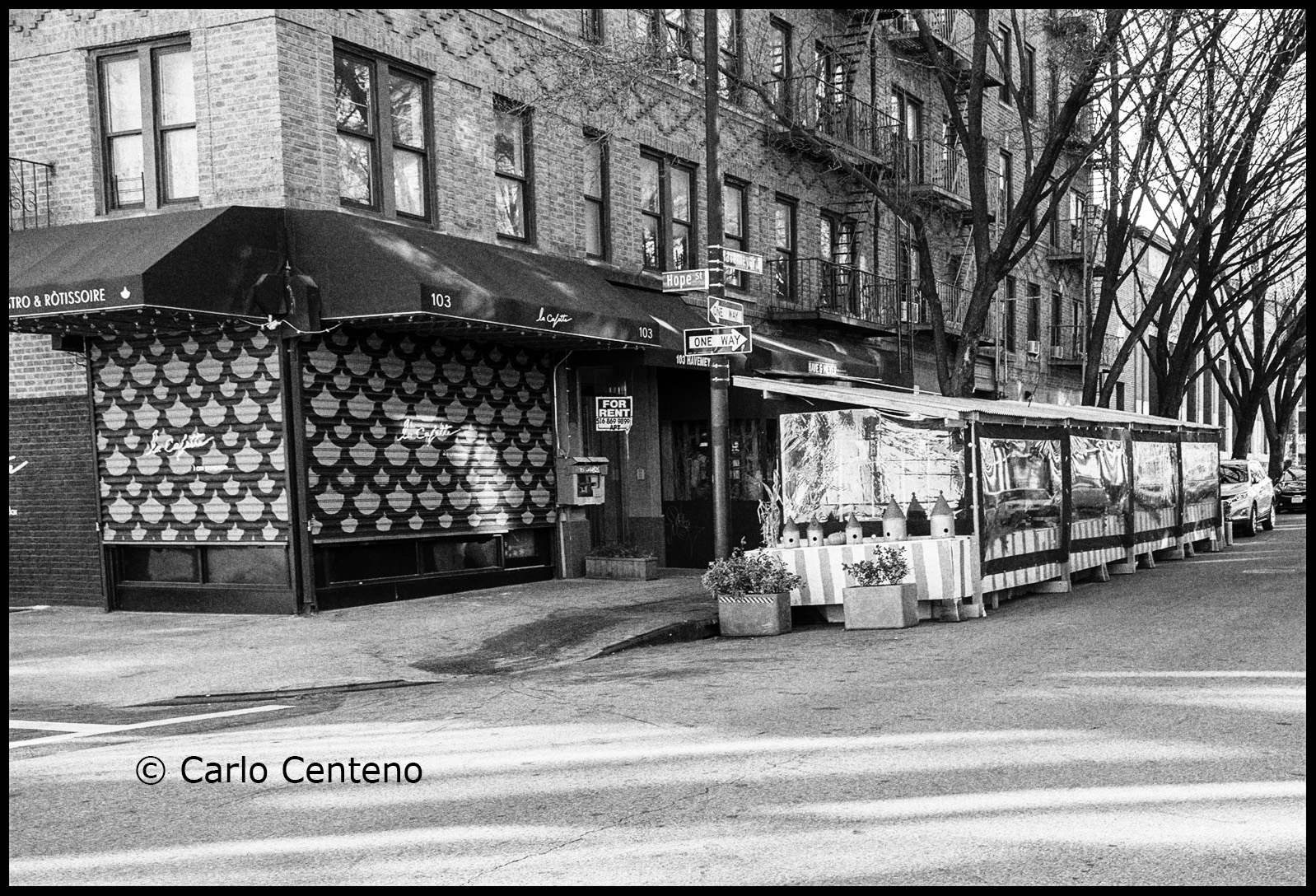
And yet I’m encouraged with the way businesses evolve, regardless of the risks and constraints of an unrelenting pandemic. Adaptation abounds. As I pass several restaurants and eateries small and large, I can’t help but notice the physical changes in these venues. Where there was once a length of curb used for parking has now been pre-empted by saw horses and orange pylons, cuts of plywood fashioned into walls and even structures with lockable doors, sliding windows, and other things that can make or break an outdoor dining experience. Being early in the day, most of these venues were still closed.
The way these dining improvisations unfold reminds me of a line from Shakespeare’s Richard III, which says,
Now is the winter of our discontent
Made glorious summer by this sun of York;
Summer is still several months away, but we can long for it. For now, our discontent, our malaise and all that has transpired has made burdens to bear heavier by the frigid air. Winter can represent discontent, but I can also make an argument for the hot, unbearably humid days of summer offering the same.
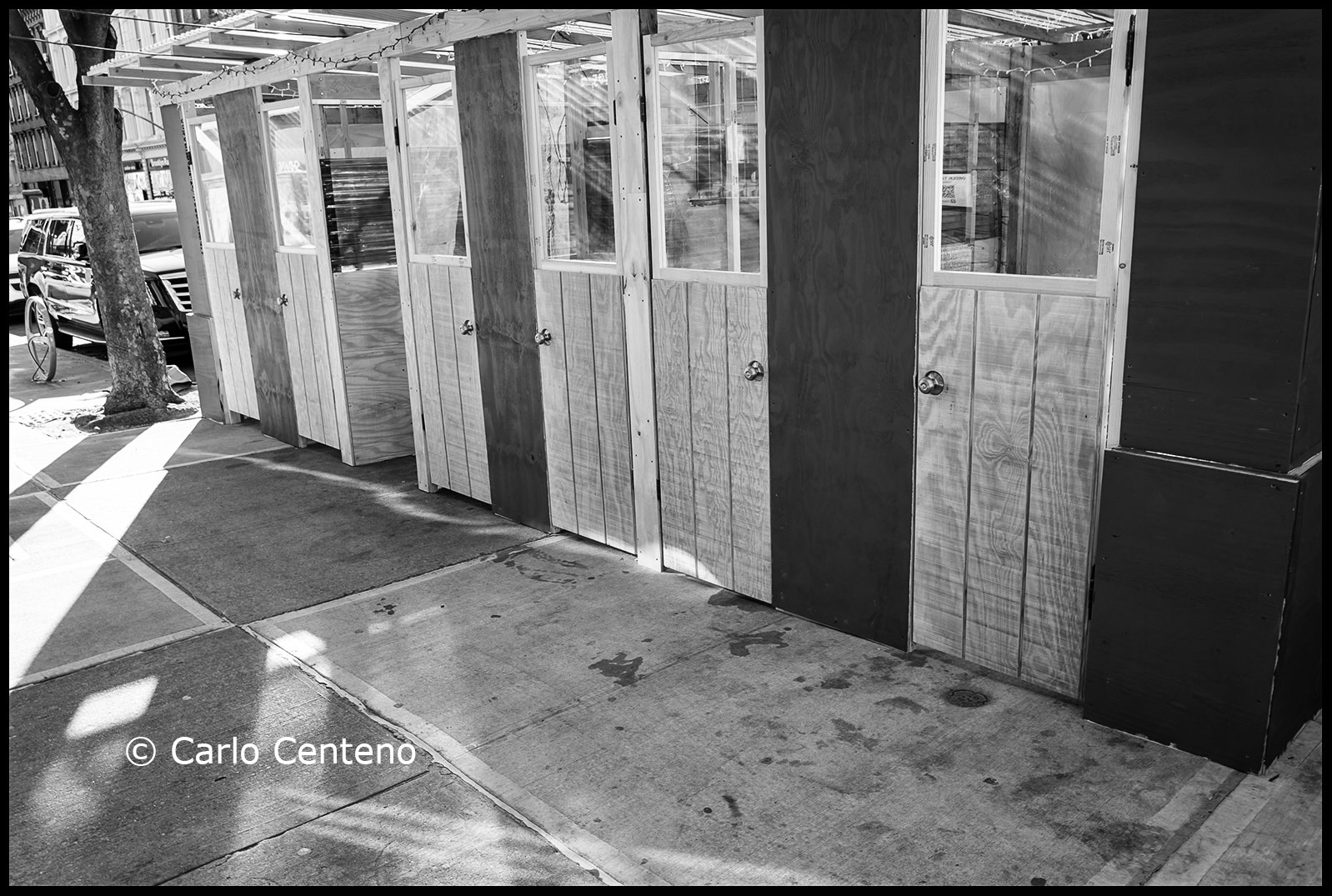
Bricks and mortars have had to survive with 25% capacity. As anyone who owns a restaurant or pub will tell you, to survive is one thing, but to thrive means sustainability. And sustainability means recency and frequency of patrons through limited seating, curbside pick-up and delivery. All modes need to be deployed.
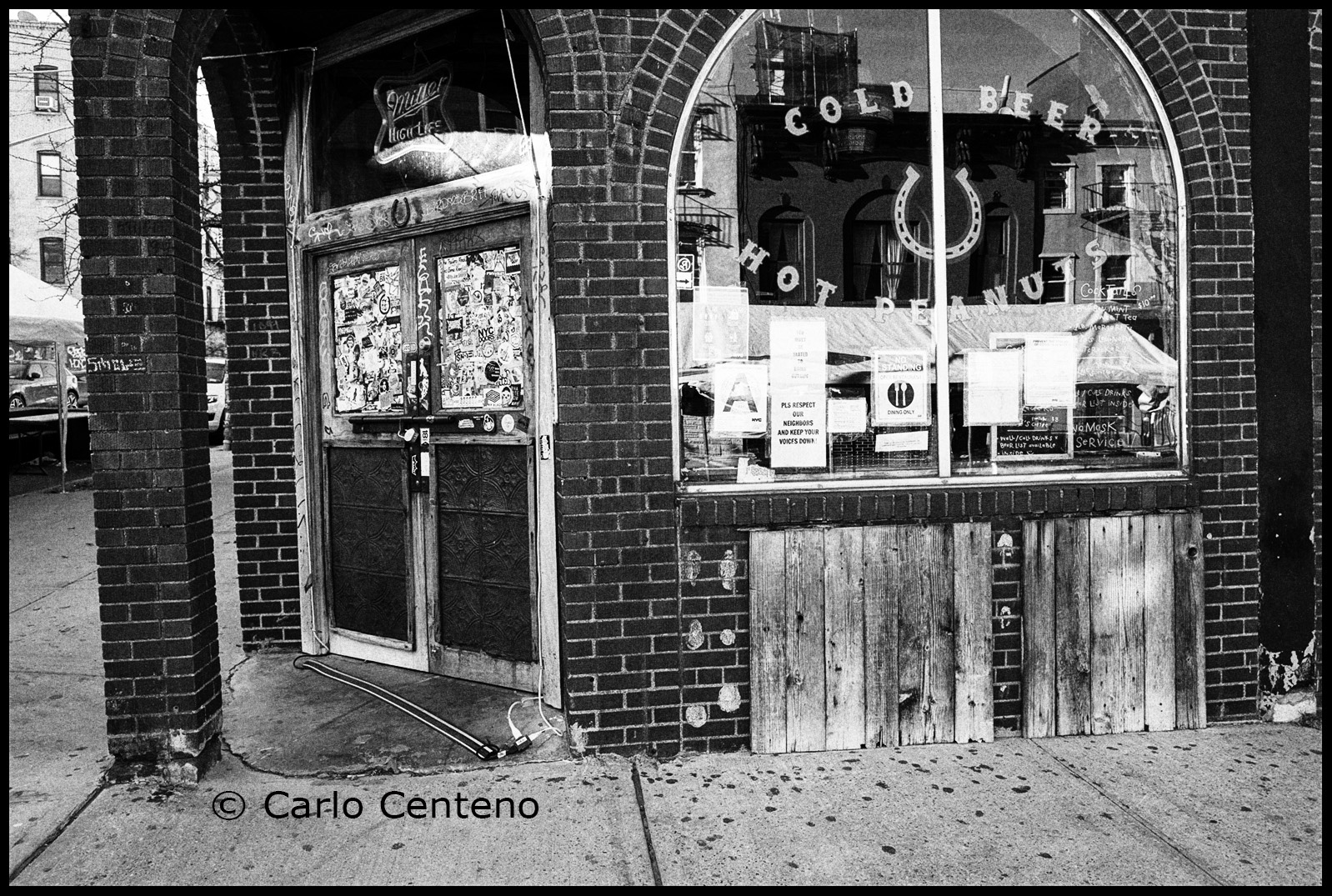
Let’s take the 80-20 rule, where 80% of a business is generated by 20% of the total customer base, and extrapolate to a pandemic index of sorts. I think if this entire 20% group supports their favorite restaurant, diner, food wagon or cart at least once a week for say the first 6 months of 2021, well, that recency and frequency in commerce and service could make a difference. For patrons, a feeling of outreach and support; for the eateries, a glimmer of hope and possibilities heretofore unseen if not improbable.

Perhaps my thinking is too simplistic, too unrefined and certainly enough to have my MBA stripped from my CV. But who am I not to think outside the box, to consider actions however “small” as things unworthy of effort and possibility? Because there’s enough doubt to go around these days, I’ll let Shakespeare have the last word:
Our doubts are traitors, and make us lose oft what we might win, by fearing to attempt…
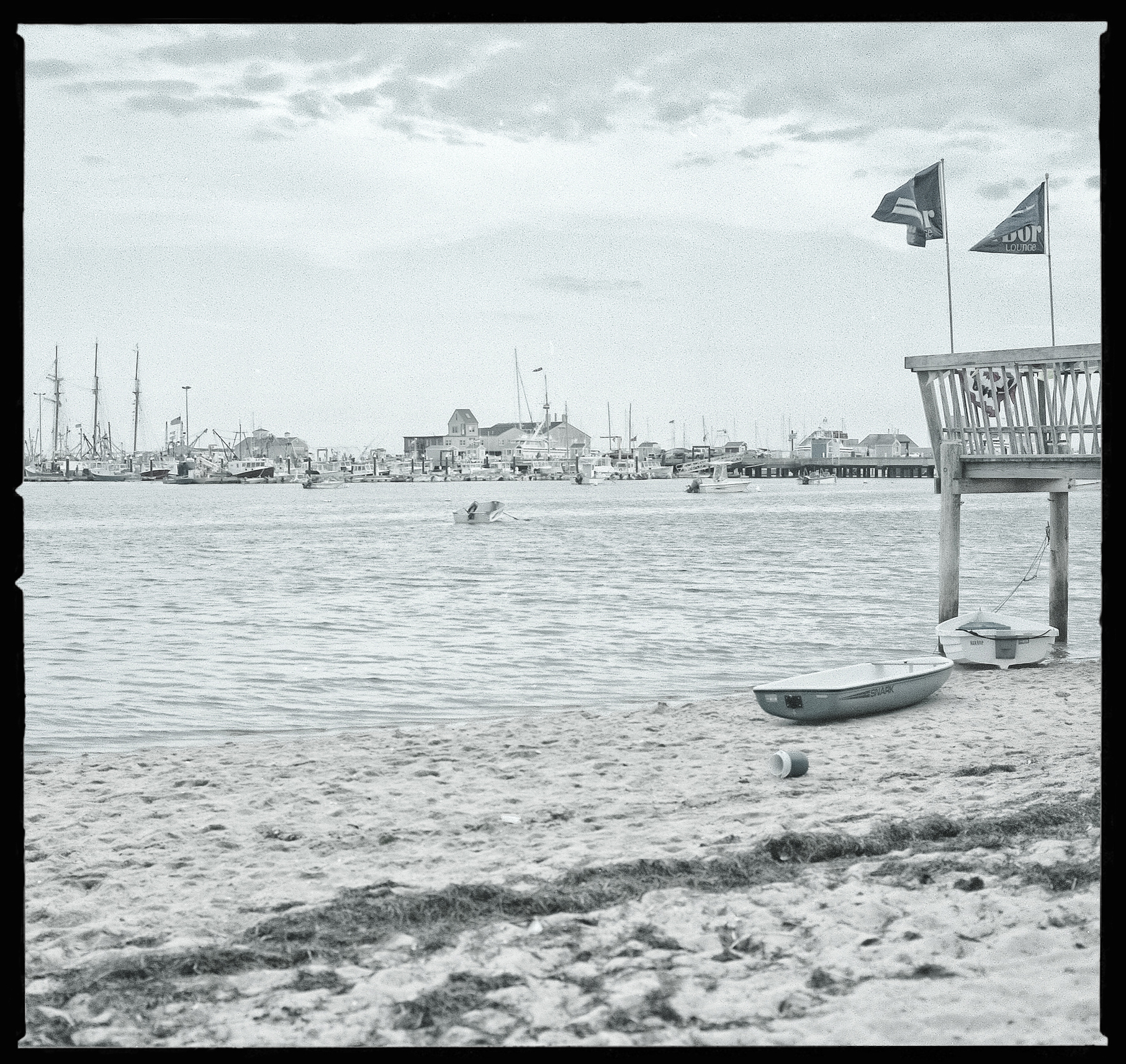
It’s been noted in different ways, but anything that could be said about 2020 has already been said. There are new normals and our previous ways of living and working have undergone something more than a reboot. I wonder about the sustainability of our modifications to the changes we’ve been subjected to. At present, 2 things loom large for me in our modern ethos: the scale of loss [life, careers, homes, e.g.] and the contraction of education systems for students, Kindergarten through college.
The burden shouldered by first responders, caregivers, allied professionals, physicians, peace officers, firefighters, et al, is without precedent. Supporting them goes without saying. The COVID-19 story continues to unfold, though I hope the developing narrative produces more positive than negative outcomes. And yet I am still looking through a glass darkly.

Many conventions, routines and well-defined standards have been poured over with uncertainty. That change takes place, is to be expected, but the fog of what happens or what should happen clouds our view near and far. Supposition greets us through this dark glass of modern life. There’s the world before the new coronovirus, and the one hereafter.

All of this thinking takes me back to much younger days, days of academe, of discussion, of expository writing. This dark window we’re peering through—including windows like broadcast and online news, social media, Twitter, FB, e.g.—does shape our perceptions and expectations. Many are unclear, even misshapen or unrecognizable, perhaps even hinting at what was once familiar. Plato’s Allegory of the Cave posits we should question our assumptions. Thinking across and through assumptions helps nurture self-reliance and problem solving. I like to think of it in more practical terms: use your knowledge, experience and current life stage to shape your own conclusions versus being told what they should be.

None of this is new. Some of you probably realize that this post of mine references scripture.
Now, we see only an indistinct image in a mirror, but then we will be face to face.
Now what I know is incomplete, but then I will know fully, even as I have been fully known.
1 Corinthians 13:12
When it comes to recognizing things or acknowledging details from “the big picture,” several expressions come to mind, such as “….I couldn’t see the forest for the trees…..the devil is in the details.” My typical reaction after further scrutiny goes along the line of, “….oh, yeah, well…if it was a bear, it would’ve bit me…” Granted, through some Jumanji-esque manifestation, I would undoubtedly be covered with bite marks.

For me, nothing draws more attention than an infant. They change right before your eyes. Case in point: my granddaughter you see above, is all of one week young, and yet in the past several days, she has changed with little fanfare. Other times I marvel at her physical development. All of sudden, fingernails have grown, her eyelashes are longer and her eyes are clearer and probably tracking motion. Before too long, her onesies, and probably diapers too, will have to go up in size.
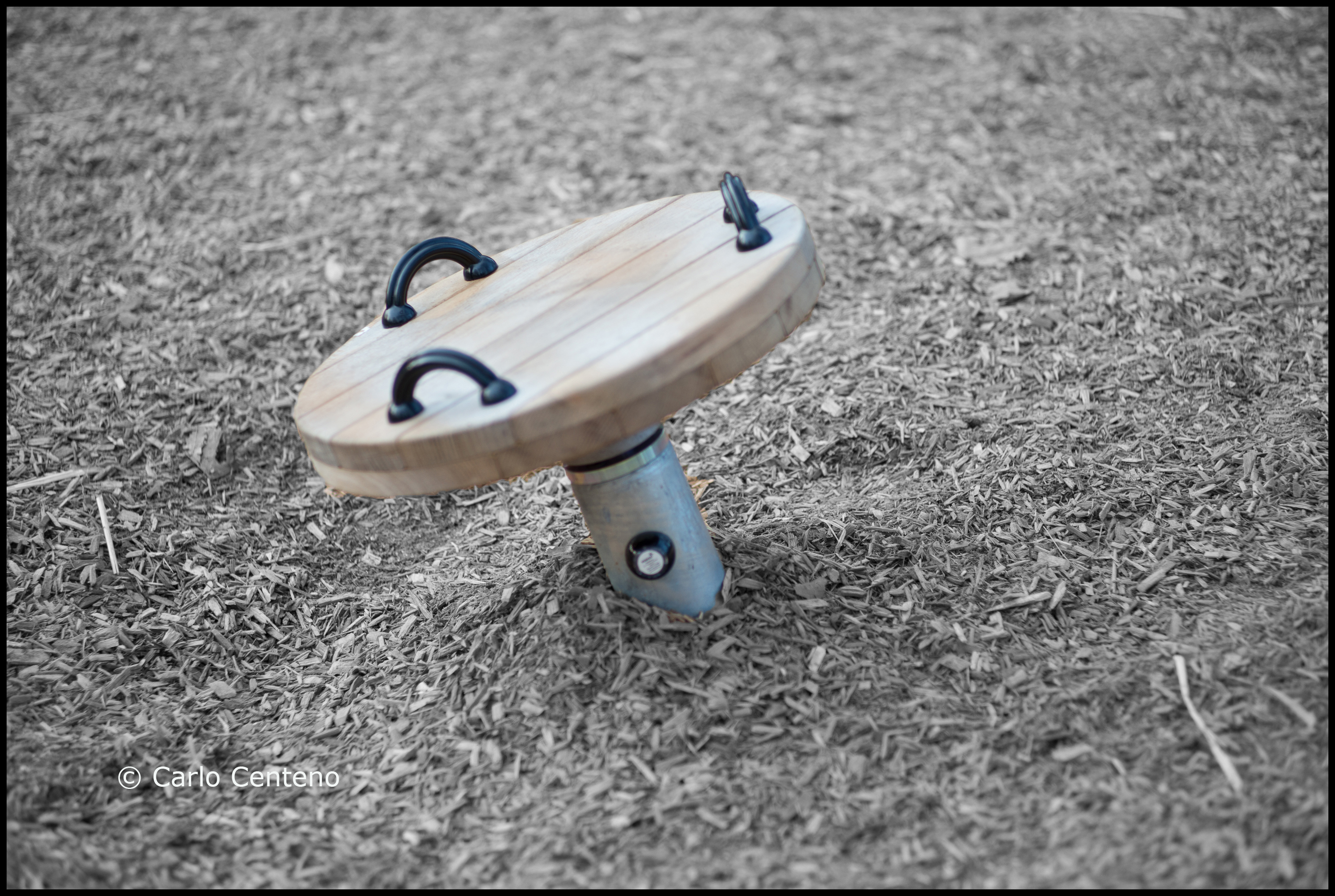
From a distance, the spinning wheel looks like a badly installed table top for pre-schoolers. No, I didn’t demo this playground-attraction. For fearless children who repeatedly spin themselves silly, the attraction delivers. With dizziness in full force, a smile of wonder and novelty appear. Not surprisingly, none of the kids I saw walked straight and narrow upon getting off the spinner. Think wobbly and crooked on any given stride. It’s enough to make you nauseous just watching them weave across the playground.
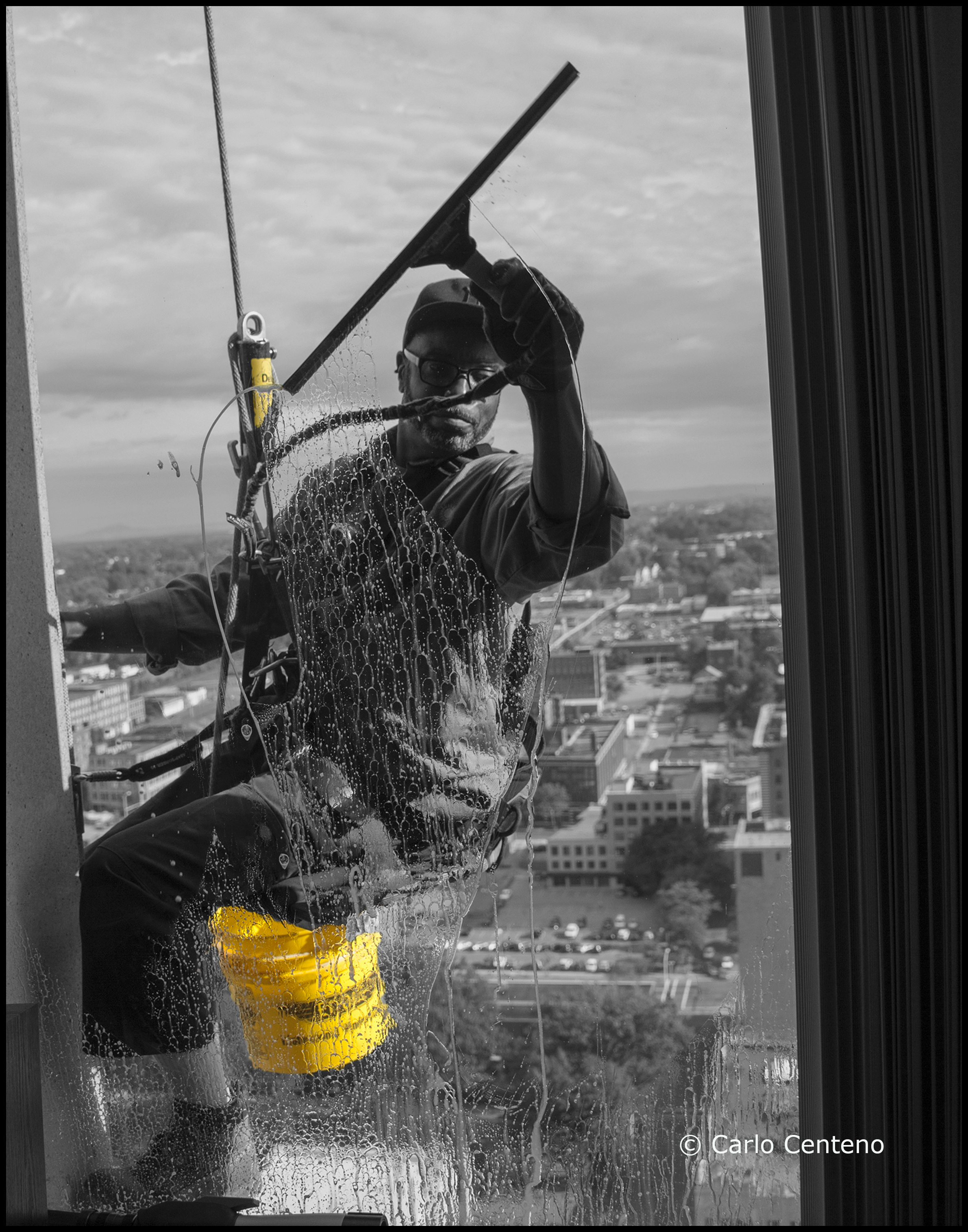
When you’re 25 floors above the street, strapped into a harness, wobbly doesn’t fit into the picture. I’ve seen these pros accomplish their tasks on breezy days, certainly when the weather is warmer than it is now. The color yellow stood out in large part because it was bright and the rest of the scene—originally in color—looked monochromatic. I also learned that 2-3 drops of dishwashing fluid into warm water makes for a thorough glass cleaner. There’s a detail worth noting…
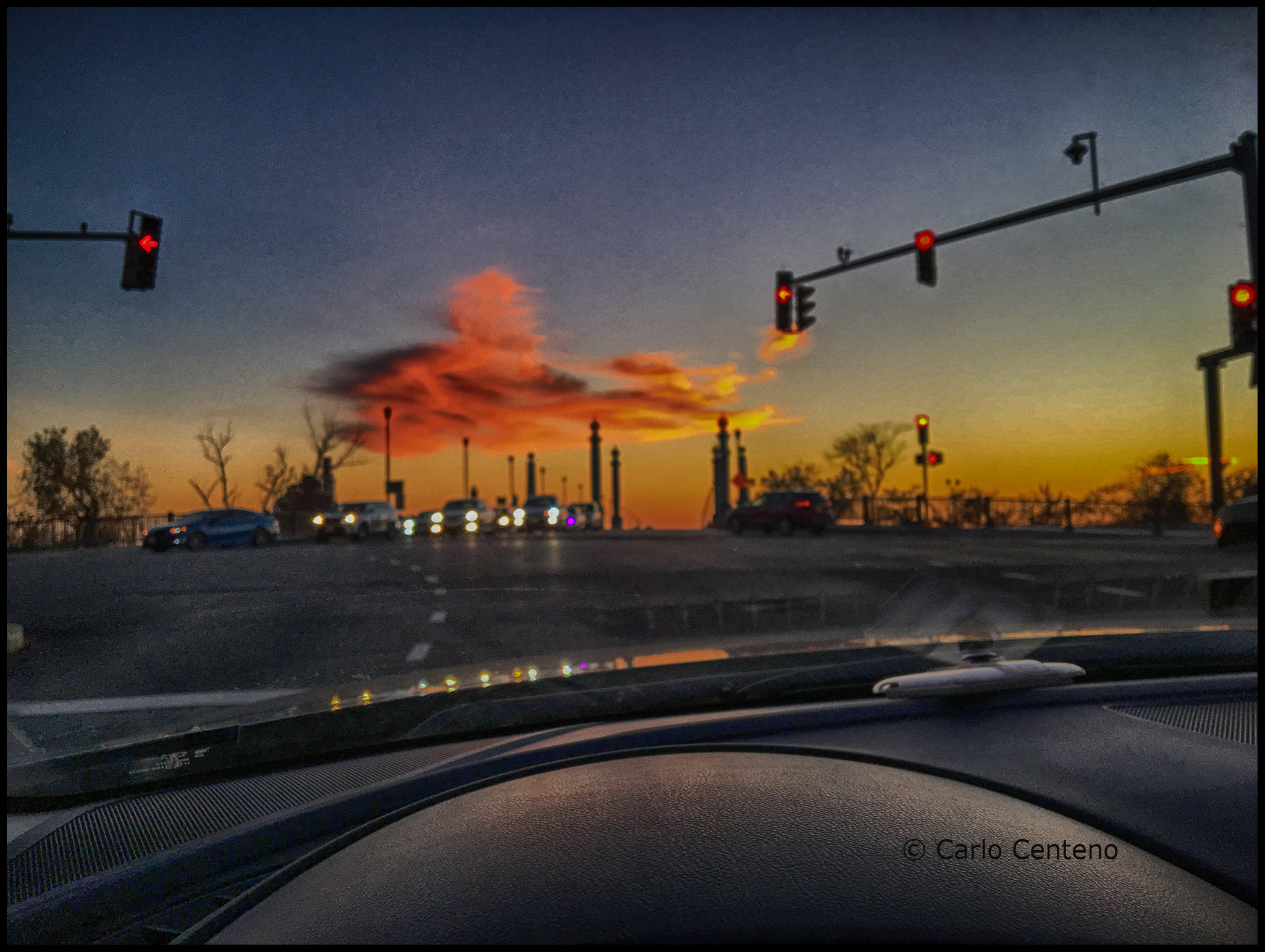
For a few days toward the end of October, there was some fuss about turning back our clocks one hour. The running complaint focused on days getting shorter even though we “gain” an hour of time. Early darkness just made things, well, darker, physically and qualitatively; it gets darker outside and for some, darker within one’s psyche.
I suppose I’m the odd person out; I shouldn’t “suppose” as I am an odd person with such things. Sunsets that announce evenings arriving earlier is not a big deal for me. Like some form of line dancing flitting across the horizon, once again daylight and night trade places, and time marches on without losing a single beat.
Whether it’s 4:30 in the afternoon or 8:30 at night, I don’t tire of sunsets. Some are dramatic in their intensity and expanse, others are less so, their palate of warm colors as soothing and inviting as those found in an impressionist painting.
There’s nothing standard about this light that quickly dissolves into shadows of dark blue and greys. The one constant I’ve felt through the years has been the brevity of the light which morphs an hour before and up to sunset. The times are few when I don’t have a camera by my side, yet on those days when I don’t, I sometimes forget about today’s most ubiquitous of cameras, the ones found in today’s smartphones. And they are amazing tools for photography, videography and more.
The photograph shown here was taken within that half-hour before sunset. The way the light and shadows shifted was a process all too short, perhaps as short as the traffic light that changed to green shortly after I took one photo. Figures. The one time I hoped for a few more seconds stopped at a red light just wasn’t there.
For the various times we use our phones to take a photo, we hope that one shot becomes the money shot. We want just one, a really good one, which connects with everything and anything that courses through our thinking and feeling. I relish the feeling of making this particular shot. The stoplight, the headlights, the reflections on the car hood, the gradations of orange and yellow, blue and grey are a surprising though welcome confluence of order.
A confluence of order. We can use some of that in the here and now regardless of whatever time or GMT standards we’re in.
 Carlo Centeno