Time I spend at a museum of fine arts is about as cathartic an experience I can think of. Indeed, cathartic art is an emotional salve that can ease the burden of feelings that keep you down. For someone with dysthymia–like myself and others–engaging in positive activities helps mitigate the weight of dysthymia [Persistent Depressive Disorder]. PDD is not as well known as MDD [Major Depressive Disorder], but the former has less severe yet more persistent symptoms of depression.
With all that’s been bombarding us [unfortunately many instances are not positive] in our day-to-day, we can manage that which irks us and steer thought and action toward positive choices, which in turn can help generate positive thoughts and feelings. Some choices I lean to include blogging, letter writing, playing the piano, tennis, family time and more.
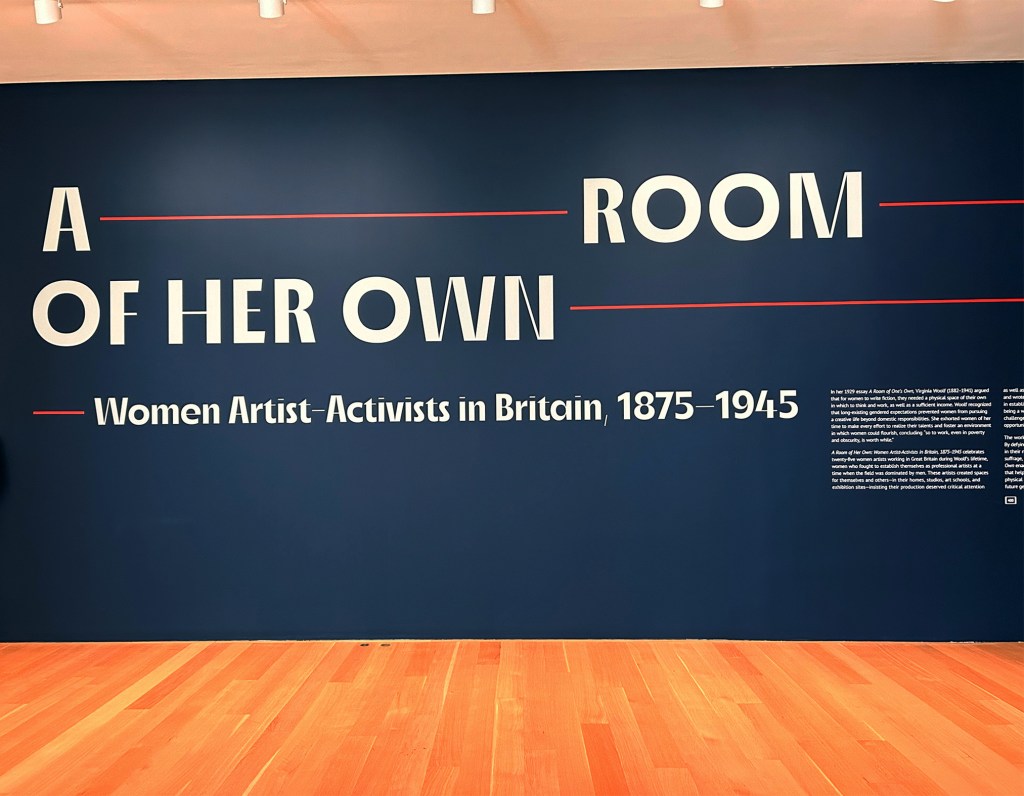
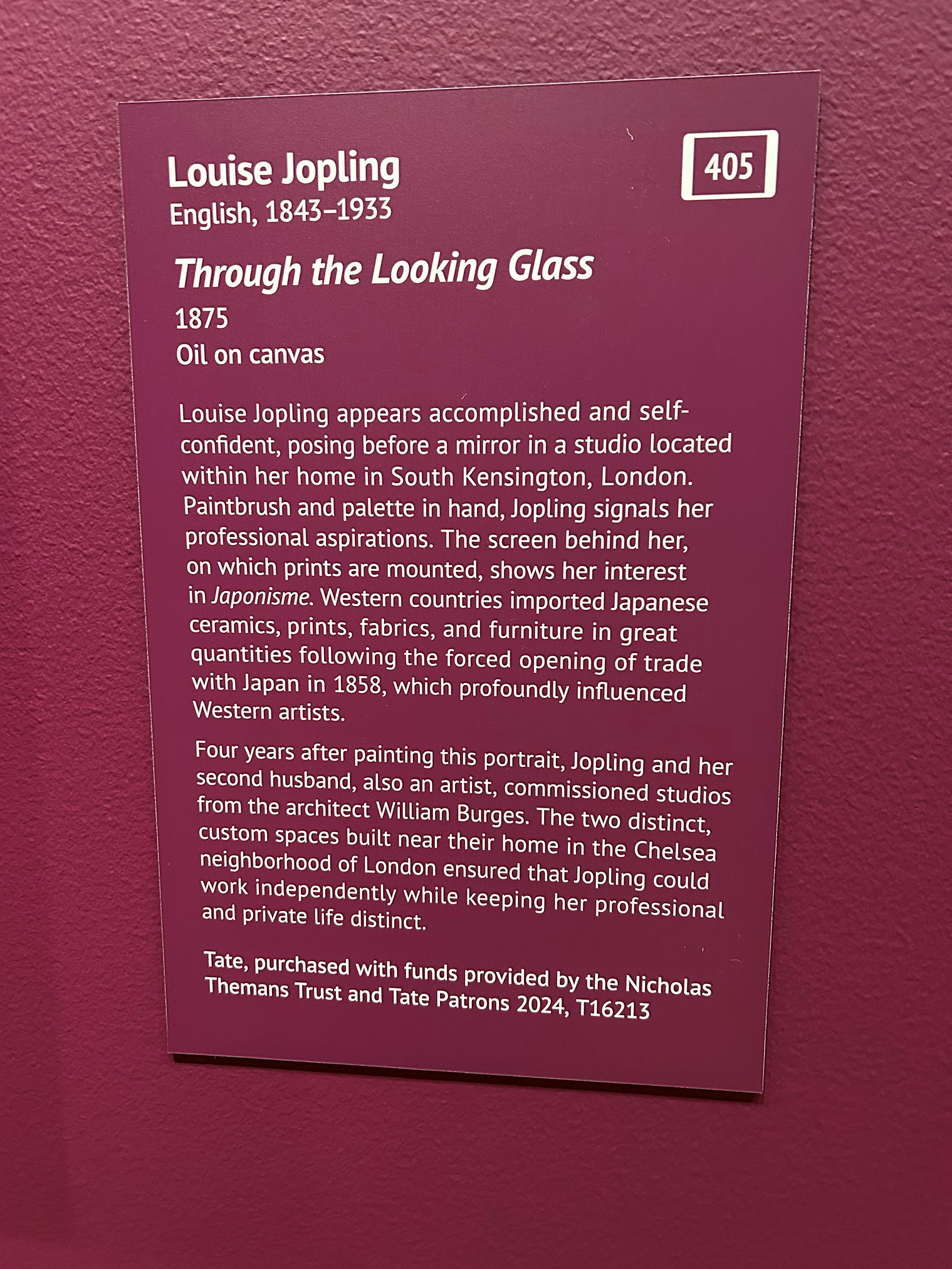
Recent family time with my 2 grown daughters, their husbands, children and their dogs percolated this thought: Both women and their spouses have full schedules with work, raising a family [includes a dog per family], volunteering etc. so then, how do these 2 women have a Room of One’s Own? I credit the exhibit now at the Clark Institute of Art, A Room of Her Own: Women Activists-Artists in Britain, 1875-1945, for germinating that thought surrounding my daughters. I encourage you to experience this exhibit; it runs until September 14, 2025.
The 1929 essay, A Room of One’s Own, was written by Virginia Woolf. You can see the tie between the title of the essay and the name of the exhibit. And if you read Ms. Woolf’s essay, all the better.
Photos taken, courtesy of Clark Institute of Art
Consider this post a “trailer” for the exhibit. It’s worth the trip, and not just for the love of art, but that of expanding our perspectives as well our own sensitivities toward women.
EPILOGUE For additional perspective with respect to women in the workforce please refer to the Women in the Workplace 10th anniversary report [published September 17, 2024 by McKinsey & Company]
I’m not alone on this one, but it seems that many channels of communication [discussions, social media and various online postings, news media, e.g.] are quite inhospitable. Of course not all content is an incorrigible exaggeration, but it does seem that we’ve gone myopic of a rule that involves interaction and in particular, discussion, between different POVs. Essentially, such discussions are cleaved in 2. There are some instances where discussions cannot abide with the adage, One can disagree without being disagreeable.
Ironically, much of what we do that makes us feel lost, infuriated and misunderstood is, indeed, something that’s very human. And of course, we can be intractable and obstinate just as we can be manageable and flexible. It’s been said that politics and elections are catalysts to conditions of inflexibility, among other reactions and situations.
Consciousness Fine Tuned
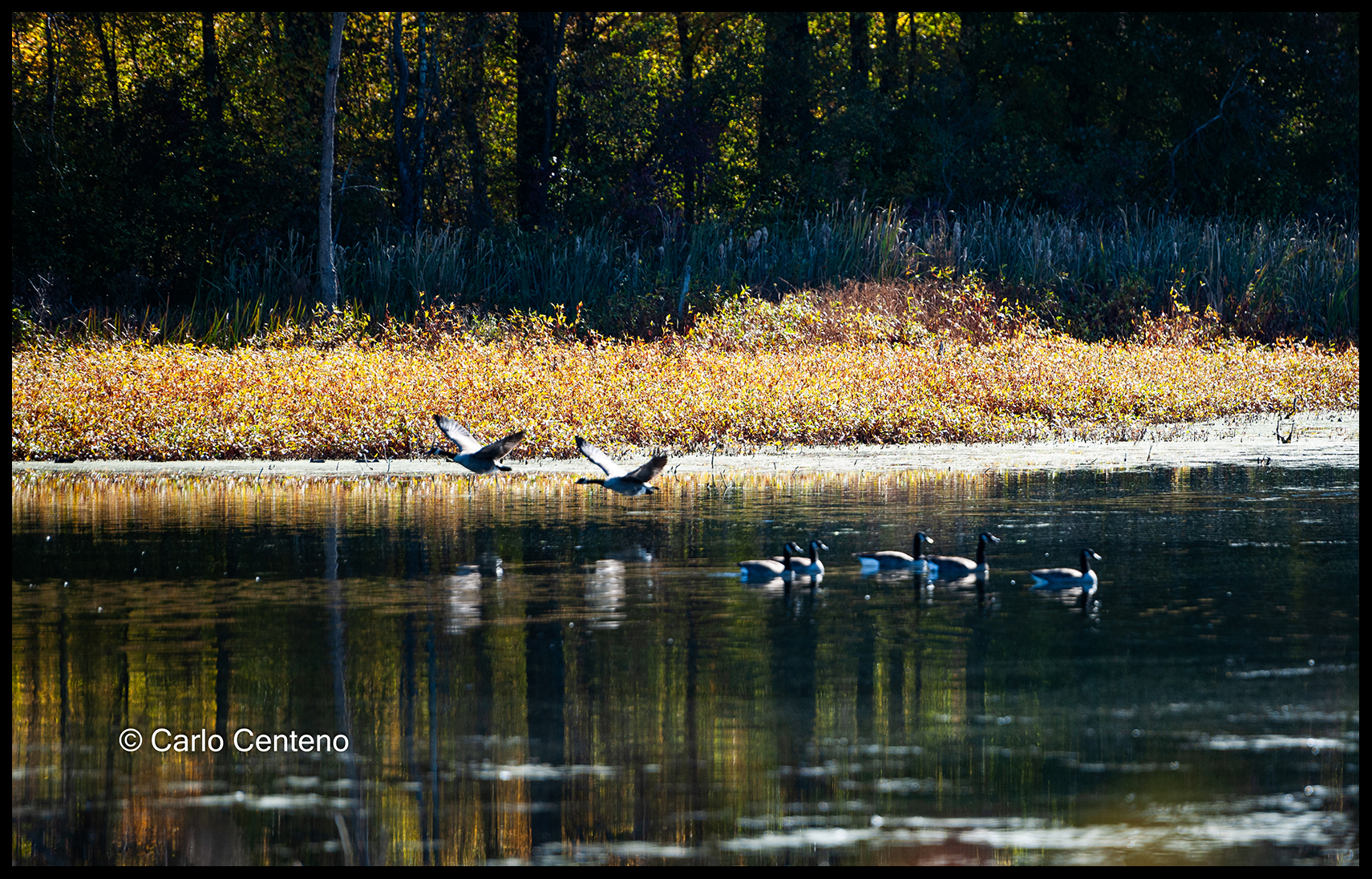
Being aware of yourself and how you think about everything around you is uniquely yours. There are a few theories which attempt to explain consciousness, but one written by a researcher at Boston University School of Medicine is one which mortals like me can comprehend. The end of October has rendered our landscape into a wonderful palette of autumnal colors: the reds, orange, yellows and hues in between are as beautiful as I’ve ever seen. I share this because watching and/or listening to the news is taking the wind out of my sails. So, to fine tune [or tune out] the bad vibes plaguing airwaves, print, and online, I retreat to places where I can hear my thoughts and submit to various feelings coursing through my consciousness.
You could say that I’m “rebooting” my consciousness, but I feel it’s more like a “recalibrating” effort to keep my sanity more or less where it’s supposed to be. The quiet and calm of places such as these act like a rheostat where mood, color, the smell of the air and so on can be dialed up or down or not at all. In doing so, I’m reminded that the angst raging between factions entrenched in ideologies are obstacles for realizing a common good. The greater good lies dormant, restrained with indifference and the stubborn personas that make life uncomfortable.
There’s no denying the subjectivity of consciousness, but there are constructs within it which allow for common ground. Without those common constructs co-existence would be, in a word, Sisyphian.
I look to writing and chasing the light, feeling immersed with either one or both, to purge distress, sadness, loss of concentration, etc. Certainly, when your mind is busy with something good, a good that pulls you away from angst, then jump in. I won’t be chagrined by situations beyond my reach. It’s a waste of energy and time grinding about things I cannot control. That’s easier said than done, but I remind myself to ruminate less on what weighs me down and instead examine alternatives that have helped me before.
Can anyone deflect dissonance long enough to find even the smallest gesture or comment that closes distance and transforms distraction into possibility?
I relish the 4-seasons here in New England. I have preferences for the times in a year that are cooler and less humid, but I also welcome activities and distractions that come with the other seasons: longer daylight hours, trips to Cape Cod in Massachusetts [salt water and salty air are genuinely therapeutic], visits to the Berkshires and so forth.
How do you take care of your sense of–or even recalibrate–consciousness?
It’s been said that everything you needed to learn and know in order to get through a day was taught in kindergarten. That was the early-in-life primer, essentially a course in fundamentals: polite behavior, expressions of gratitude, common courtesy and common sense in all things you say and act upon. Some life lessons around loyalty, unconditional love, patience, trust, kindness–among others–were influenced by my dog, Humphrey. Naturally, various experiences with family, teachers/professors and good friends added to that mix as well, as well it should.
Humphrey
Humphrey was a miniature cockapoo, but there was nothing small in his character or demeanor. Simply put, he acted like he was the biggest, baddest, dog east of the Mississippi. He possessed a radar that had a way of measuring and reading the nature of most grown ups, and of course other four-legged creatures [read: neighborhood dogs he didn’t quite like]. I’ve heard it said that the size of the dog doesn’t matter as much as the size of its heart. And that little guy had a huge heart. Children were another story. He was comfortable around them. Humphrey was just as curious about kids, as the kids were with this little guy. Throughout his life, many thought Humphrey to be a puppy. In a sense he was that in many ways.
Our winter dress code.
It makes sense to me that the weight and burden of grief that comes from the loss of a pet correlates to the amount and type of affection you gave the pet, and vice versa. Reciprocity at its finest. Quite frankly, that equation is the same for family, significant others and close friends. When you truly care about someone or something, you give it your all, certainly your heart and soul as a minimum. MJ and I support each other in all of this. She did, indeed, have a big part in Humphrey’s life, as did our kids and grandkids. Those connections or bonds don’t disappear at death. Not surprisingly, we had thought about ways to extend Humphrey’s life, perhaps just a bit more care or special intervention would’ve helped, but time waits for no one. Second thoughts arose wondering if any intervention for Humphrey could still help him. I think part of understanding what love is revolves around one’s willingness to let go. We’d like to think that as the end drew closer, that that pup knew he added so much to our days, and vice versa. Life lessons arrive from many points. From the smallest of vignettes to those large and complex, there’s something one can glean from experience and interaction.
Two happy, ol’ dogs…
Not surprisingly, other events or milestones reach out and overwhelm us, including one in particular. About a week after Humphrey died, one of our daughters and her husband added to the number of grandchildren. Their second child–and our fifth grandchild–was a welcome sight!
Welcome, dear grandson…!
He was the salve to our sadness. The sounds and expressions of loss and affirmation differ. Death and grief are shadowed by life, not the other way around. That new baby dampened down some of the grief we’ve been carrying. The creation and arrival of a new life, affirms the reality that dying and being born are conditions each of us cannot deny. With one, comes the other.
Fate added another exclamation point to all of this. Just before the end of March, MJ’s sister suddenly passed away from heart failure made more complex by cancer. And just like that, death set us back yet again. Nostalgia, sadness, regret and second guessing returned in force. No sooner than when the new baby arrived home, MJ and I were thinking about an obituary and a funeral to attend in short order.
In all of this, I’m reminded of what MJ’s mom said about the passing away of loved ones: remember them on their birthdays, not just on the day they died. That notion has stuck by us for quite awhile now. With birthdays come celebrations, the gathering of family and friends, and an opportunity to reconnect with good times and the people who are and were a part of that. To auld lang syne, to “times that have gone by.” We can think of any number of experiences that raised a smile, a laugh, a few tears, but don’t mistake this as longing or living in the past. It’s really a time to be in the moment, a key one at that, to share recollections with those in attendance and in doing so, our connections to each other are again [or for the first time!] affirmed.
My take on all that’s happened is that our willingness to interact with each other can never be replaced with the efficiency of Facetime, Zoom Meetings, teleconferencing and any other present-day digital communication. The attributes of efficiency cannot separate us from emotions and empathy. There are lessons woven into experiences that can be shared, indeed as some should anyway. It’s what makes each of us a wholly unique, sentient being.
The peaks and valleys this past March, made clear that we need to nurture our connections to family and friends, to dogs and cats and pets, and to others outside our zones of comfort. Good or bad, joyful or sad, the confluence of your feelings shared with others enhances many of life’s lessons…
If there’s one thing obvious about marketing and advertising is that they attempt to shape your perception, to one of acceptance or revulsion. In this politically charged environment, I’d say most political advertising encompasses the latter. But we’re not going there today.
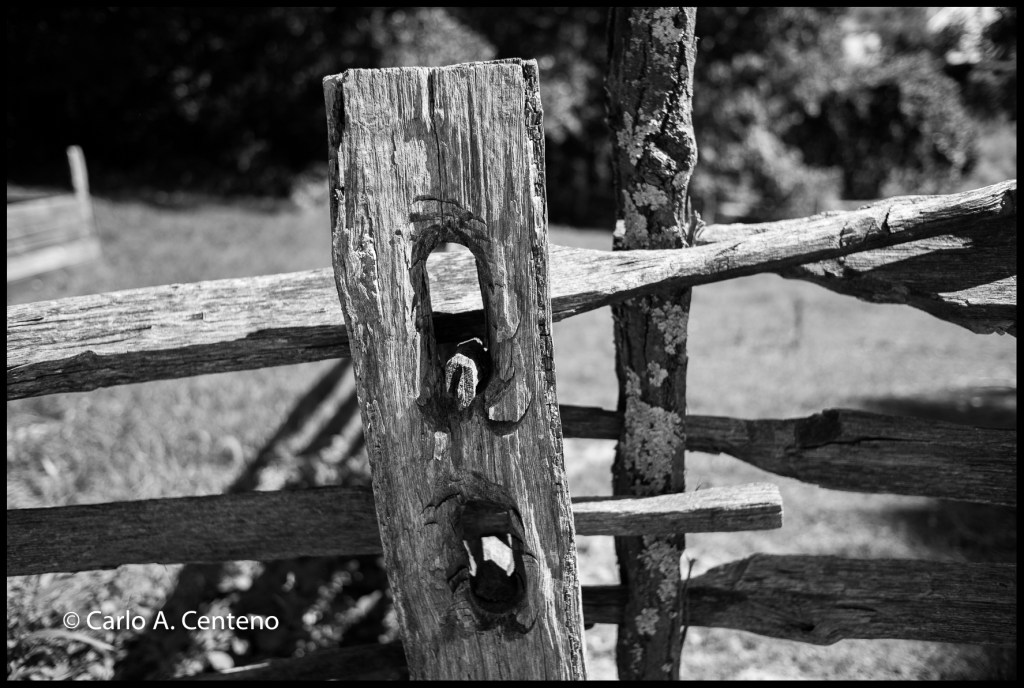
Here we have 2 wooden structures, one historical [circa 1800s], the other modern. Now, one may think that the modern structure offers more features: pressure treated wood, steel anchor collars, robust carriage bolts, nuts and washers [possibly even zinc treated to resist corrosion] etc. Well, it does have more features; it has to given its function. But it doesn’t mean it’s better than the simpler one, rather, the modern structure is built specifically for conditions and utility common to coastal areas. Both types share similar benefits albeit differentiated by design, materials and construction. Well, the purpose of the modern structure may be the same as our historical one, that is, to prevent something from entering or leaving a specified area, perhaps protecting one side more so than the other.
Before you clobber me with the apples-to-orange inequality of this comparison, the point I’m making is that consumers often equate features as benefits. If you’re anything but a design engineer, you may think that the metal anchors or collars wrapped around the angled stanchions may be unnecessary. However, if you live, perhaps even work along this shoreline, you would know that the tides and storm surges exert an astounding amount of pressure against barriers. The added strength of the collars is beneficial to the overall strength of the structure.
“This unit can do more than its closest competitor.”
courtesy: Whirlpool
On a recent trip to one of the box stores, I couldn’t help but overhear a salesperson singing the amazing features of a particular dual-door refrigerator. NOTE: the courtesy photo is for illustration and is not the product being referenced herein. “…..with the app on your computer, that model can sense when it’s time to restock, bread or cheeses or certain vegetables or frozen dinners…” The technology, the artificial intelligence that’s coming to market, can be impressive. But will it work on my iPhone 6S or will I need an Android system? You know, my home fridge has an ice-maker, though it doesn’t automatically dispense into my glass when held below a special port. Mine? Open the freezer door and grab ice from the container, a container purchased separately, BUT, looks like it came with my fridge. Typically I empty two ice trays into that container, refill the trays with water and return to the freezer. In less than 10 minutes, you’ll have ice that’s just as good as what the cyborg-fridge can automatically deliver to your glass.
My hand is the delivery and presentation vehicle. And it works. No downloads, no firmware, no software….basically, I’m somewhere with basic technology versus, being nowhere or confused with this hi-tech stuff. Now, if I was that customer learning about the smart appliance in question, perhaps the dialogue would go something like this:
Salesperson: It’s an amazing piece of technology. It can monitor your food and beverage consumption, conveniently at your fingertips. You use an app on your smartphone.It’s a big plus for busy families. Me: That’s impressive, but it’s a feature that I don’t need or really want. Salesperson:You can even check it from just about anywhere in your house. That’s real convenience. Me: Actually, I find it more convenient doing it my way. Salesperson: And how’s that? Me: I walk into the kitchen, open the door and make note of what’s still there and what needs to be added onto the grocery list. Salesperson:How is that more convenient? Me: Well, it’s not just convenience for me, but a benefit. Salesperson:Oh….? Me: It’s called walking. For me that’s a benefit. I already do too much sitting at work. Salesperson: That’s a valid point, but not really helpful. I mean we’re talking about making your life simpler, by doing less chores, to get more time to do things you’d rather do.. Me: I’d rather get up and move. Besides, I get a chance to scope what’s not in there, but whether the shelves need cleaning or if an expiration date goes back to the Nixon administration. Salesperson:Wait, who’s Nixon…?Anyway, think of it as an evolution towards the future of appliances. You, the homeowner, can control all your appliances such as your TV, your A/V installations, the lights and the thermostats and so forth. Me: ….and without even breaking a sweat. Salesperson: Exactly. Me: Will people really adapt to this technology? I imagine someday my health insurance being able to buy data regarding my food preferences, and since I love ice cream, well, a dietician or cardiologist may take issue with that…who knows? Salesperson: Hey, well, hopefully that won’t be the case. I mean there’s a ton of places where information can be bought for marketing or research…that kinda stuff. Me: Of course….you know and I know that your actual mileage may vary…capisce? Salesperson: Ah, yeah, sure….have you seen the new washers and dryers that are out now?
Once upon a time there was a tavern, Where we used to raise a glass or two. Remember how we laughed away the hours, And think of all the great things we would do. Those were the days my friend, We thought they’d never end. We’d sing and dance forever and a day. We’d live the life we choose, We’d fight and never lose For we were young and sure to have our way.
Songwriters: Boris Fomin, Gene Raskin
Ever an optimist, it is possible that you’ve heard the song, Those Were the Days as sung by Ms. Mary Hopkin. It was one of the first singles produced by Apple Records and Paul McCartney in 1968. My recent postings and our current new normal [or is it our current abnormal?] made me think of this ballad. And not only about changes that have taken place, but of many things unlikely to occur in the same way as before.
We are at summer’s threshold. We’ve evolved to accept crowded places, an expectation of more time spent with family and friends and to be part of those timeless happenings and celebrations that define this time of year: graduations, picnics, time on the beach, attending ball games, concerts & performances inside and out, barbecues, pool parties and a lot more.
And then there are the country fairs.
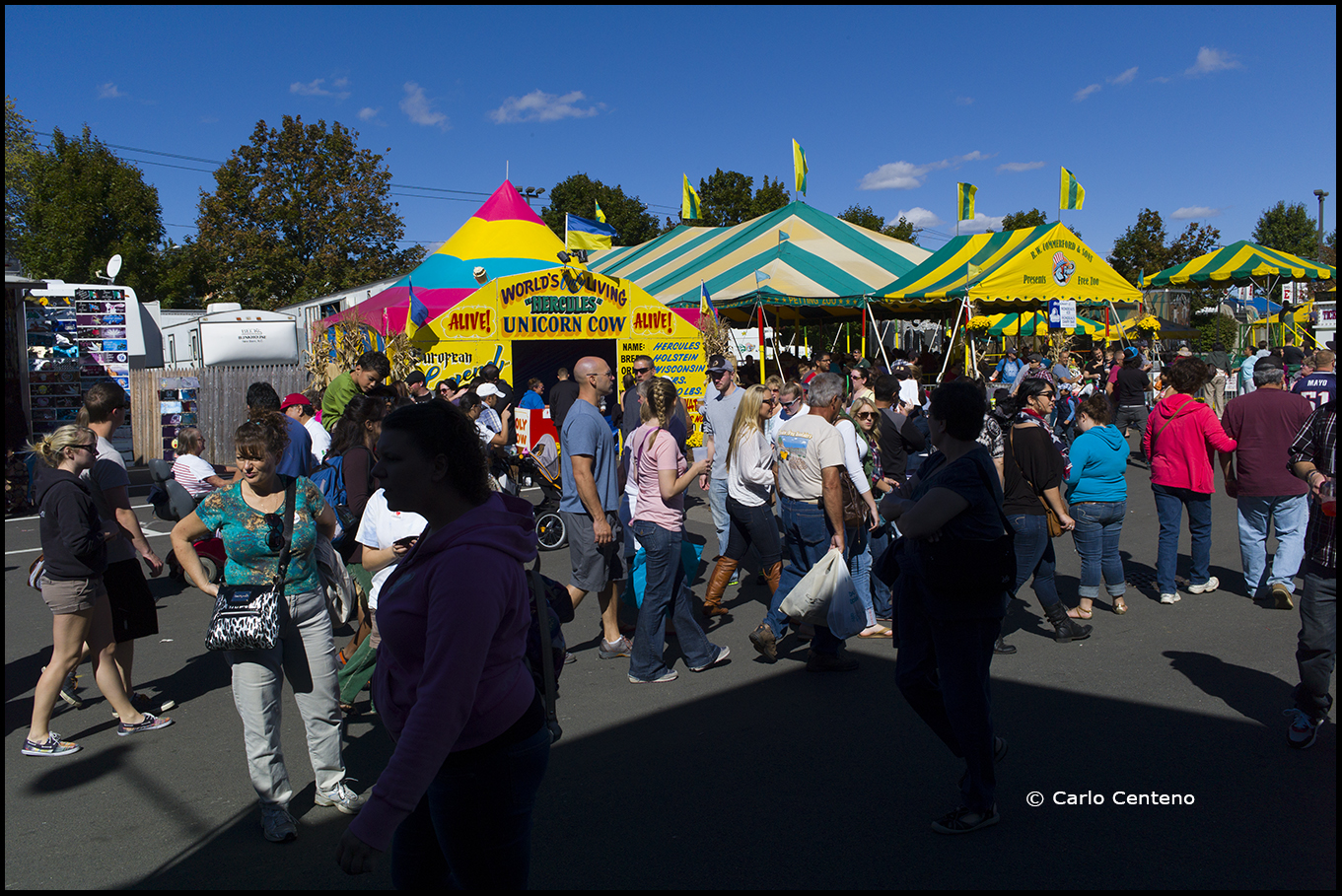
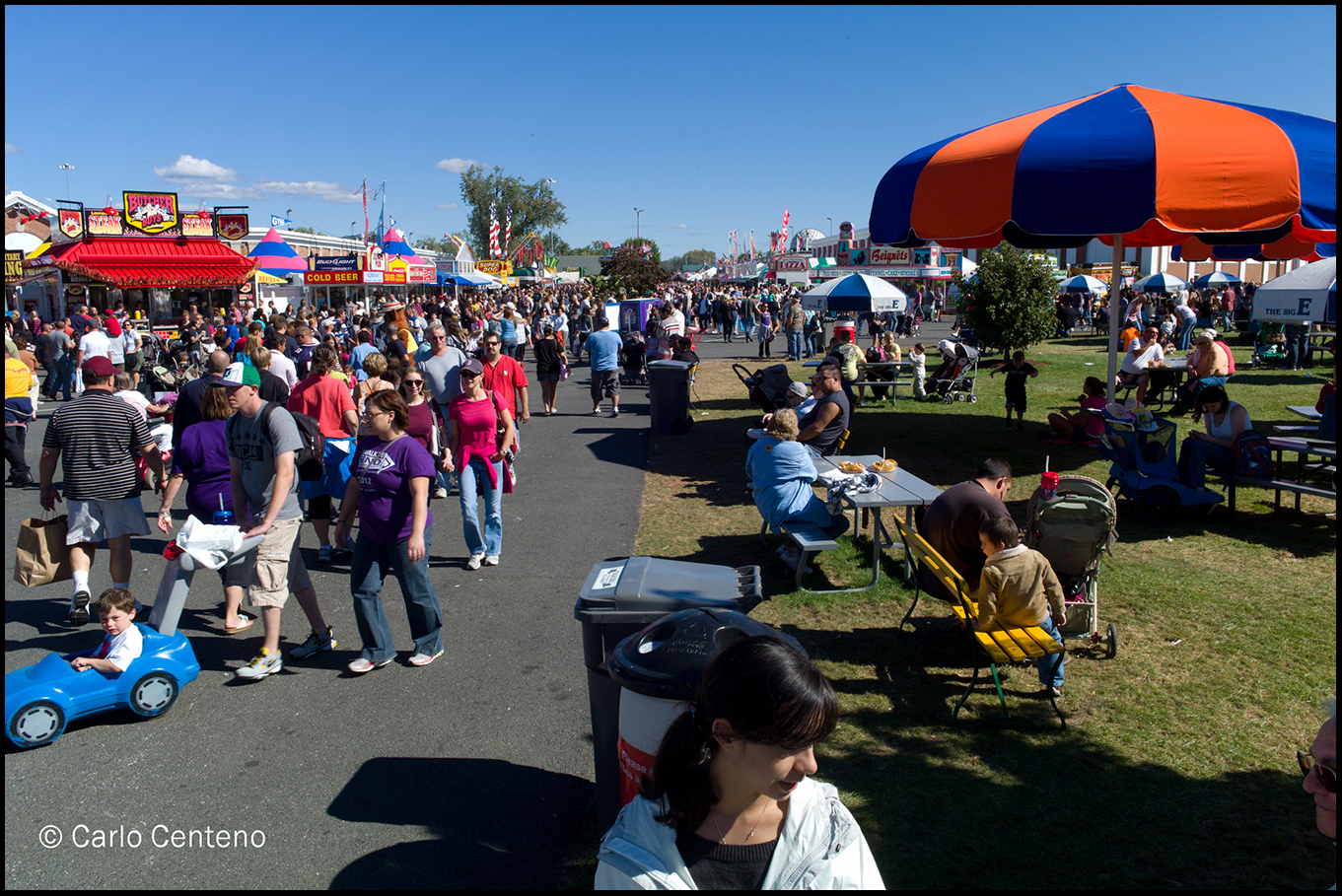
This unique piece of Americana born of traditions in farming and agriculture, will never be the same. To heed social distancing at these and other events is not going to happen. It’s part of our social DNA, to see a flurry of activities and to be part of the atmosphere or happenings. It’s standing in line if not for the anticipation of getting into an exhibit or performance—or something savory to eat—but to avoid losing your place in that line.
It’s a place to experience sensory overload. Merchandise of all kinds court you with such promises as having something fun-for-the-kids; of having the last mop you’ll ever need or the complete knife set that rarely needs sharpening. Then there are the culinary pieces de resistance: fried dough that could work as trash can covers, cream puffs the size of softballs or that deep-fried turkey leg that can double as a hammer in a pinch.
This year will be different for most everyone. The crowds can never be as large as before. Perhaps reservations need to be made to limit the number of visitors. Adjustments are already in place, yet still changing. We’re armed with masks, hand sanitizers and wipes and a growing awareness of our personal space and limitations. It may not be all bad, but much of what’s currently unfamiliar, even uncomfortable, will become all too familiar.
For years we’ve made a trip to one of the largest country fairs in New England, a sortie that has become part of our own tradition. On a weeknight, we head to West Springfield for “The Big E” aka, the Eastern States Exposition. My wife and I head to a favorite Polish food stand to order the inimitable Polish Plate: galumpki, pierogies, and kielbasa, all chased down by a “pint” of Dinkel Acker Pils, a German beer crafted from heavenly made hops.
And after that, it’s a walk across the grounds to burn off a few [very few] calories, only to add a bunch more when we stop for a homemade blueberry pie a la mode. All of this adds up to an entertainment feast. Certainly many things are always there, often the same vendors and merchants. But what makes each year different are the recollections of many other visits to the Big E aside from our annual beer with dinner.
It’s about our daughters coming with us during the toddler to tween years. Then came the teen years when it became apparent we were no longer cool, the two escaping with a fistful of tickets for rides and the arcade at the fair’s Midway.
It’s about people-watching, of getting lost in a crowd knowing that similar dreams and fears are as common as balloons, stuffed animals and kettle popcorn. Summer is as much about the quiet and solitude found in the woods as is the cacophony of gatherings and festivities that confirm our sentient selves and how we’re all connected.
Contrary to the expression, “it is what it is,” I’m reminded that many things in our day-to-day lives aren’t what they appear to be. What it is, is often isn’t.
It comes in many forms, but this spectre of self-doubt, worth, value, meaning, purpose,etc. is more apparent now than ever. We may not say or admit to it, but I sense many from all walks of life are experiencing an existential crisis.
We may not feel smart enough. Or attractive enough. We may think, “why don’t I have more of what he/she has?” The forces of social media, the rise of celebrity status, the persistent beat of consumption, the increasingly divisive discourse of “I’m right, you’re wrong” all contribute to this hunger for meaning and purpose.
But the larger question shouldn’t be, “why are so many things messed up?” Ask yourself, “what can I do to make life a little easier for someone else?” At the end of every spinning class, our instructor encourages us with these directives: believe that you can do what you plan to do and if you want to feel good about yourself, do something good for someone else.
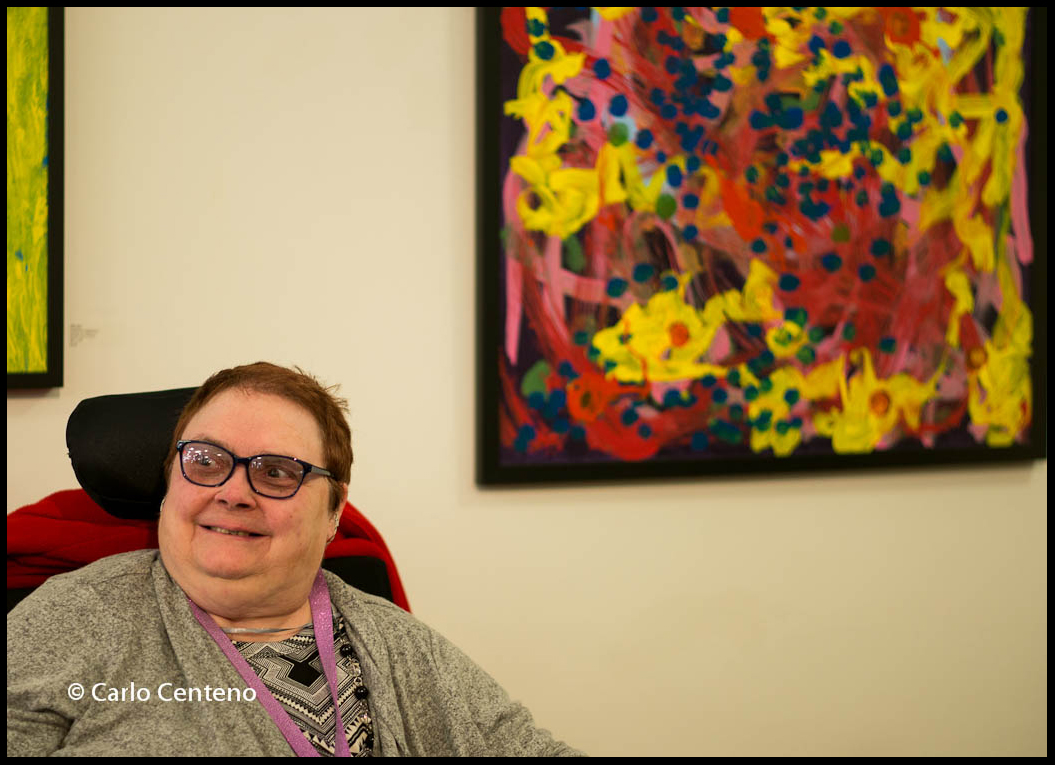
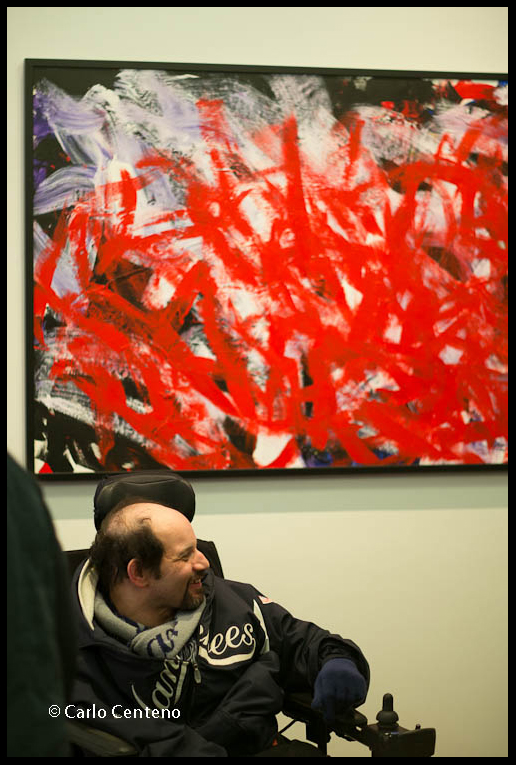
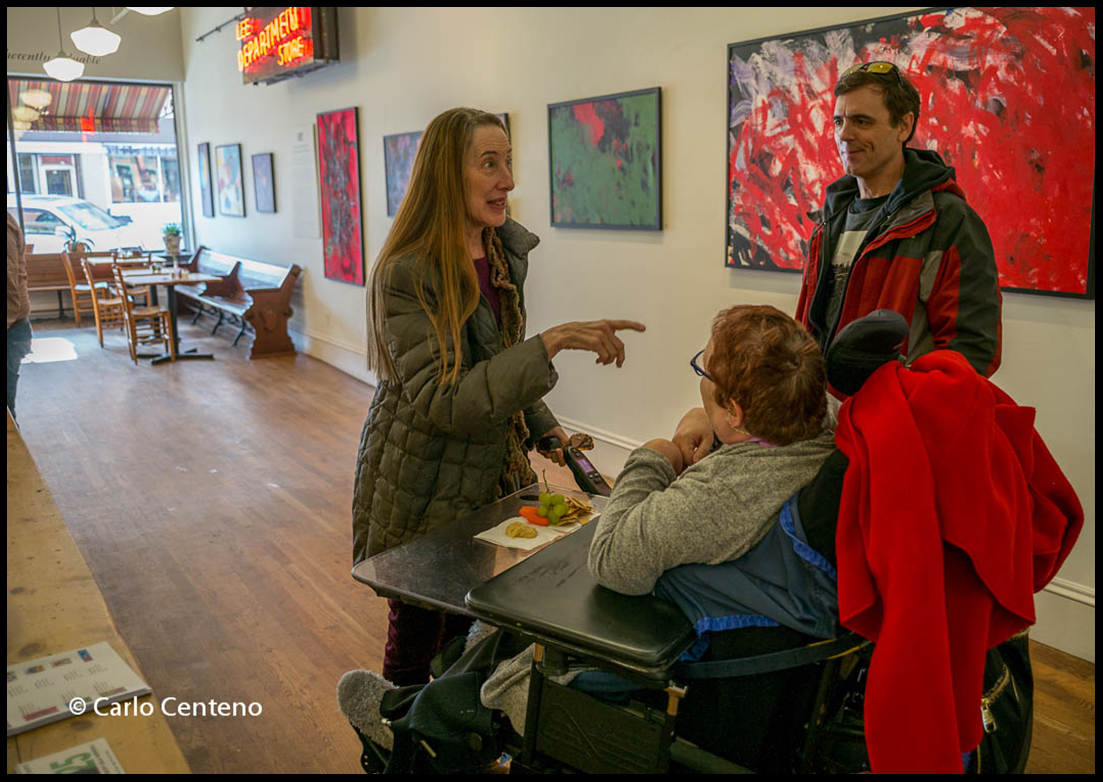
Dr. Stephen William Hawking was an amazing human being for many reasons. His recent death made me think that the realm of possibilities in life are practically endless. He was proof positive that we should diss “dis-” in disability. We all have abilities in one form or another. I recently attended a gallery opening for CATA [Community Access to the Arts]. Through an innovation known as Art Realization Technologies [see image below], people with physical disabilities get to express their artistic abilities.
So then, here on canvas, each one attributed to a person, is their artistic awareness of their individual sentience. Expressive. Personal and self-aware. Fragile. Powerful. Confident, each canvas like the artist, one of a kind.
Artist David Gardner with Red Bird, acrylic on canvas.
Artist Julie Raymond with Untitled 2011, acrylic on canvas.
Artist Carol Neuhaus with Outside the Box 2016, acrylic on canvas.
Artist Myles Tosk with Untitled 2008, acrylic on canvas.
CATA founder Sandra Newman [L] with Carol Neuhaus and Carol’s art trainer.Yes, every piece is for sale and the artists along with CATA benefit from the sales.
Creating confluence, understanding & compromise 101. Photo: C. Centeno
We have met the enemy and they are us. Circa 1960s: Walt Kelly from his comic strip, Pogo, in reference to the US involvement in Vietnam. The phrase is a variation from Naval Commander Oliver Hazard Perry whom, in the late 1790s said, “We have met the enemy and they are ours.”
Our sociological positions on culture, tolerance, honest communication, integrity, decorum and humility have fallen to new lows. Some of us—in particular those with the loudest and most obstinate of postures and voices—have created as well as promoted an intractable reality that has altered our ability and willingness to freely express our thoughts and feelings across many subjects.
Fueled by emotion, group think, individual perceptions and more, it’s become de rigueur to put someone down [shouting, shaming, name calling, e.g.] just to make a point. What concerns me is while someone can possibly make a point, the counterpoint is summarily dismissed. Its dismissal is total, a product of a scorched earth mentality that leaves no room for perspective, for critical thinking and even a chance, however small, to understand the meaning of the counterpoint let alone the person or persons expressing the counterpoint.
We not only agree to disagree, but we do so in disagreeable fashion. We create diatribe instead of discussion, insults in lieu of perspectives, bombast as proper elocution.
I leave you to ponder on William Faulkner:
“I believe that humankind will not merely endure: we will prevail. We are immortal, not because we alone among creatures have an inexhaustible voice, but because we possess a soul, a spirit capable of compassion and sacrifice and endurance.”
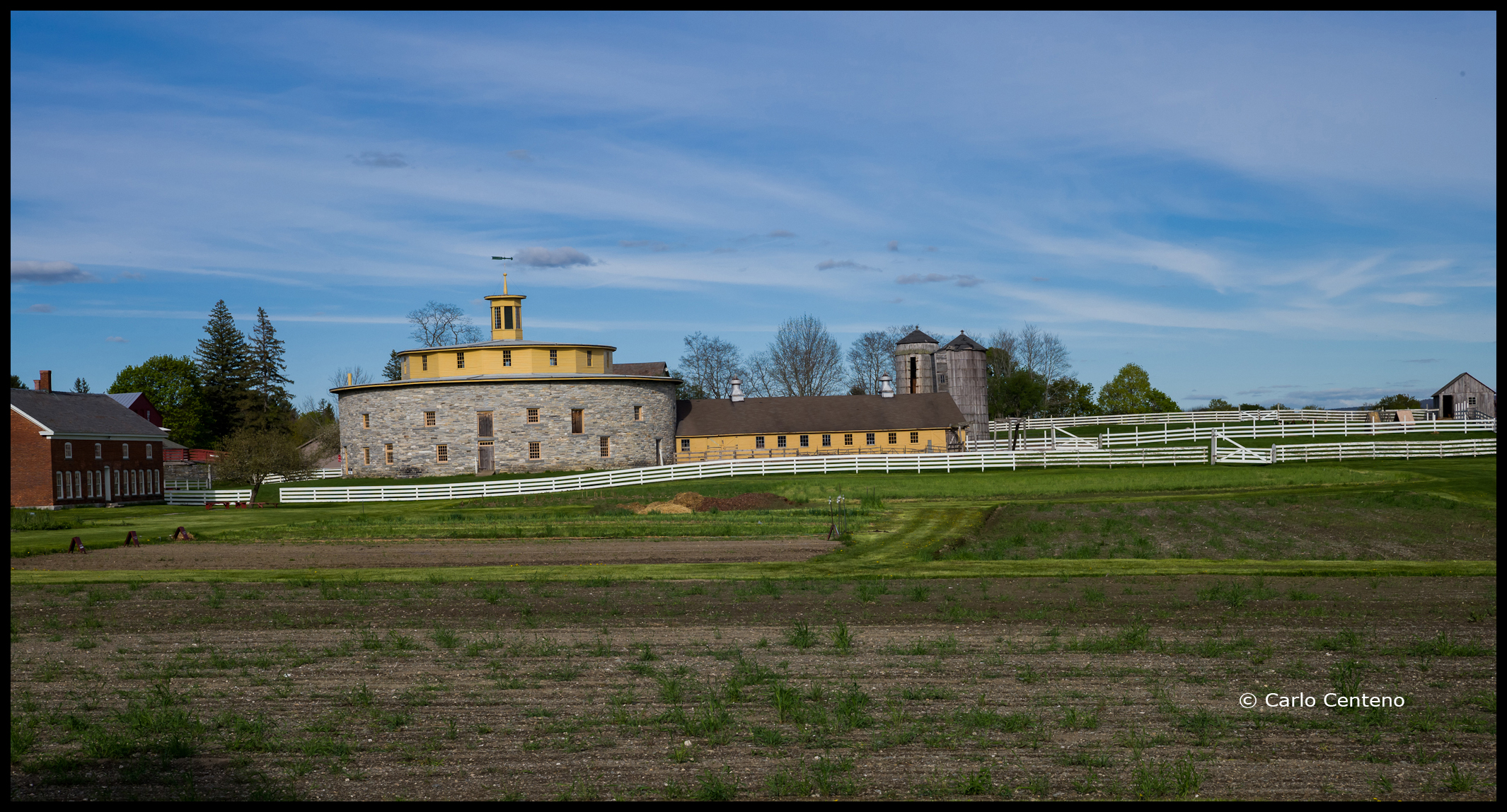
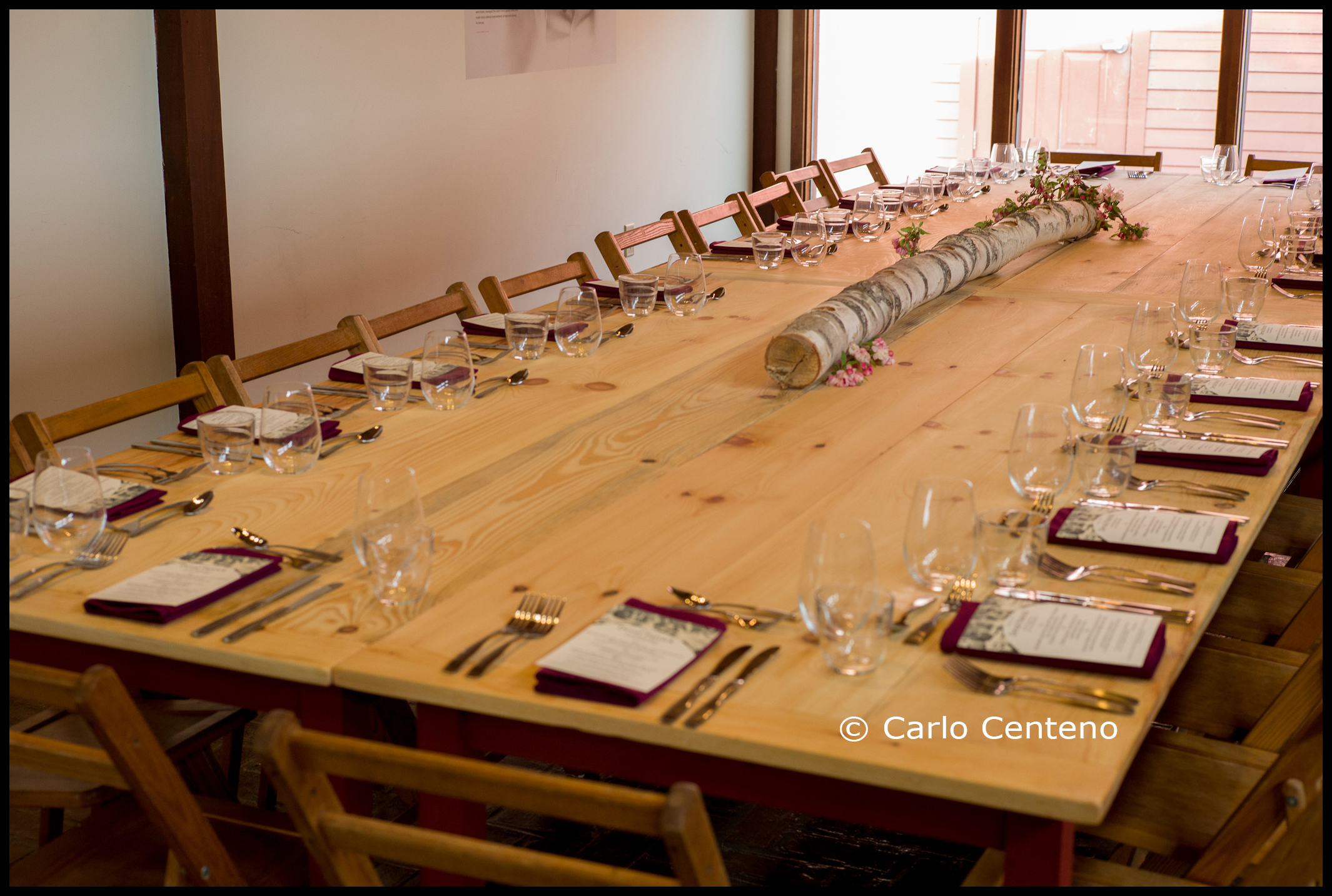
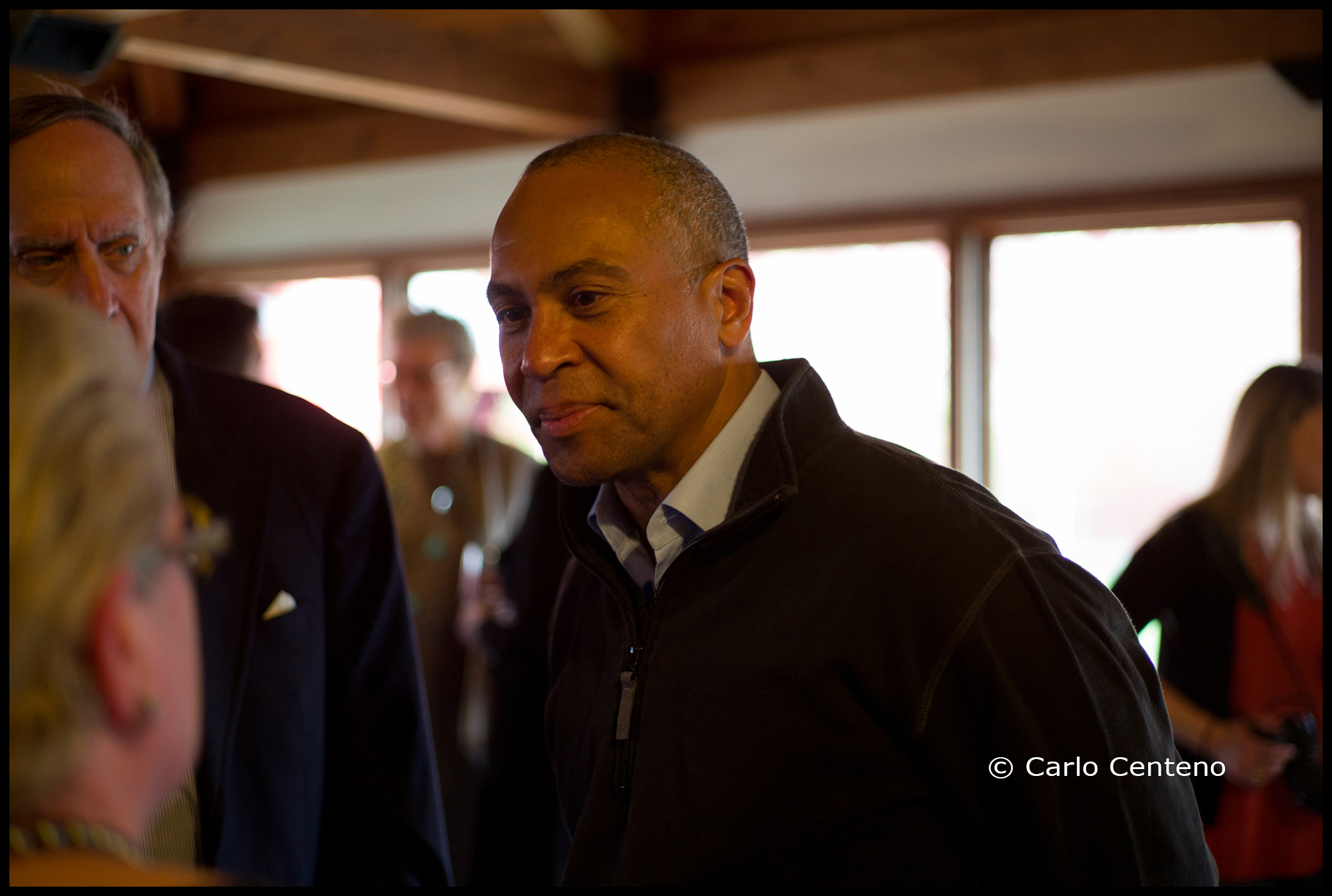
Hancock Shaker Village recently held the first of 4 dinners involving noted thinkers and authors. The Food for Thought program involves a monthly dinner May thru August, and invites folks to “feed your mind, body and soul…with an illuminating author.” The first dinner quickly sold out as 76 signed on to chat and dine with former Massachusetts governor, Deval Patrick. Within an ambiance shaped by the Shakers [who established this Village in the 1700s] the evening proved intimate, friendly, and grounded. In light of our current political climate, I suppose anything could’ve happened regarding a discussion of Mr. Patrick’s life politique; politics has been a lightning rod of recent times, as we all know, attracting more negativity to the point of consternation and frustration.
That wasn’t the case here. Instead, I was reminded of the importance, indeed the significance, of seeing things in person and to hear experiences in the first person. We are so immersed, so much more involved with our digital devices that I think we’ve lost touch on how to converse with verve, clarity, honesty, expression, sensitivity, empathy, integrity, patience, consideration, reciprocity and more. It’s a sad state of affairs and while this is a gross generalization, therein lies a truism in my previous sentence: many of us spend too much precious time eyeball-to-eyeball, hand-to-hand with a keyboard, a touch screen and/or ear buds.
In this setting, we conversed with Mr. Patrick and listened to what he had to say. He was genuine and unpretentious in his greetings with old friends and in acknowledging the company of new faces. In a space that consisted of movers and shakers and critical thinkers from the Berkshires and beyond, it would’ve been all too easy to spot someone posturing. No, we all possessed a quality common to each in that room regardless of social or professional standing. We were–and still are–sentient beings, vessels filled with doubts about freedom of speech, decorum, political bipartisanship, populism, nationalism, etcetera ad nauseum.
Yes, having access to commentary and perspective through YouTube, Vimeo, Aeon, TED Talks and others is timely, convenient and important, but I, personally, feel that being there, of being part of the gathering, is a different experience from those encountered online. When you’re surrounded by the event, you are indeed, part of the event. Many things become visceral and palpable, vulnerable and accessible, sensuous and profound. And while many communications can be paused or saved or added-to-my-view list, I’m reminded that with such gatherings, Life has no pause or rewind buttons. You are in the moment, beguiling a terrific gathering albeit brief.
I learned early on in my career that market segmentation is but one level of segmentation. I think of the process as one of differentiation. Demographic segmentation requires specificity in a cultural subset. In other words, you don’t place spanish-speaking people as solely spaniards any more than those speaking french as frenchmen.
The subset is of material importance. Spanish-speaking people come from many places other than Spain, ergo the same for french-speaking people living elsewhere than France. Think Puerto Rico, Mexico, Columbia, Dominican Republic for the former and Quebec, Monaco, Ivory Coast and Belgium for the latter.
There has been a tremendous amount of buzz regarding LGBT civil rights. Ireland is the first country that recognizes same-sex marriage after its citizens voted it so just this past May. Caitlyn Jenner is a household name and we’re likely to hear a lot more about the former Bruce Jenner’s transgender journey.
So, what does this have to do with marketing? For me, plenty.
First and foremost, we’re dealing with a community of people. Many countries treat LGBT people like criminals. In no uncertain terms, being lesbian, gay, bisexual or transgender puts you on death row in several countries. So, tell me where’s the real crime taking place?
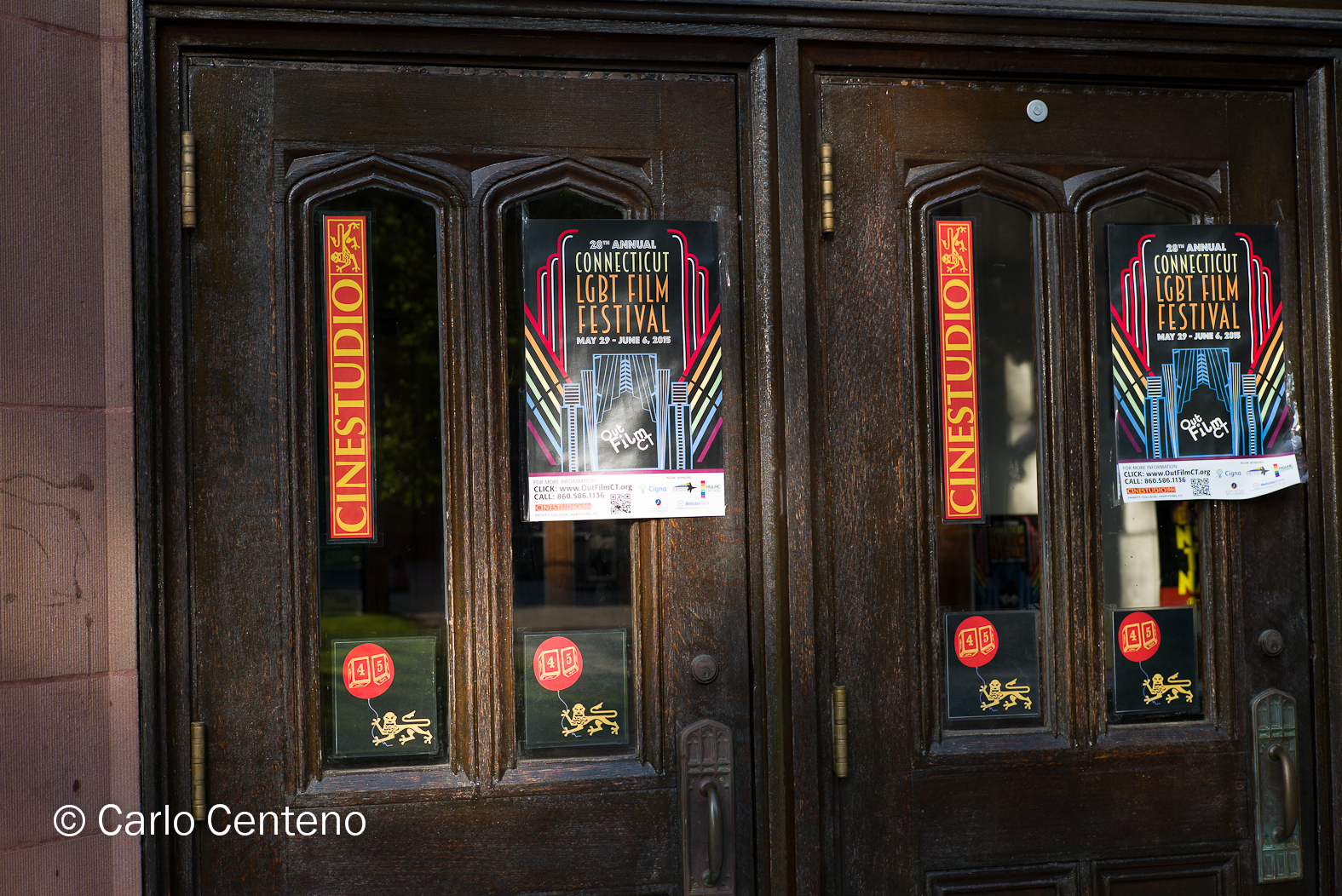
I recently attended a screening at the 28th Annual Outfilm CT Film Festival held on the beautiful campus of Trinity College in Hartford, Connecticut. From May 9th to June 6th, controversy, art, education, tolerance, intolerance, inclusion, love, forgiveness, the banal and the beautiful were expressed across a variety of films, short and of feature length. The films I watched provided a temporal take on LGBT concerns as well as the eternal qualities of love, acceptance and foregiveness.
There’s also the economic take that cannot be ignored. LGBT folks are contributors and consumers. Some hold high-level positions in business [Tim Cook, CEO of Apple, e.g.] Yes, the human costs are invaluable, however the economic costs can be calculated. If you need more information, this recent article from The Atlantic can shed more light on the value of the LGBT economy.
How important is the LGBT community? Here’s the short list of corporate sponsors of the Outfilm CT Film Festival: Pratty & Whitney; CIGNA; The Hartford; AARP; Aetna; Baccardi; Barefoot Wines, among others…like the firm I work with.
In addition to other key designations and credentials, Michael Matty, the President of St. Germain Investment Management, holds the following: Accredited Domestic Partner Advisor [ADPA]. While segmentation is important in marketing analysis, inclusion holds its own relevance as well.












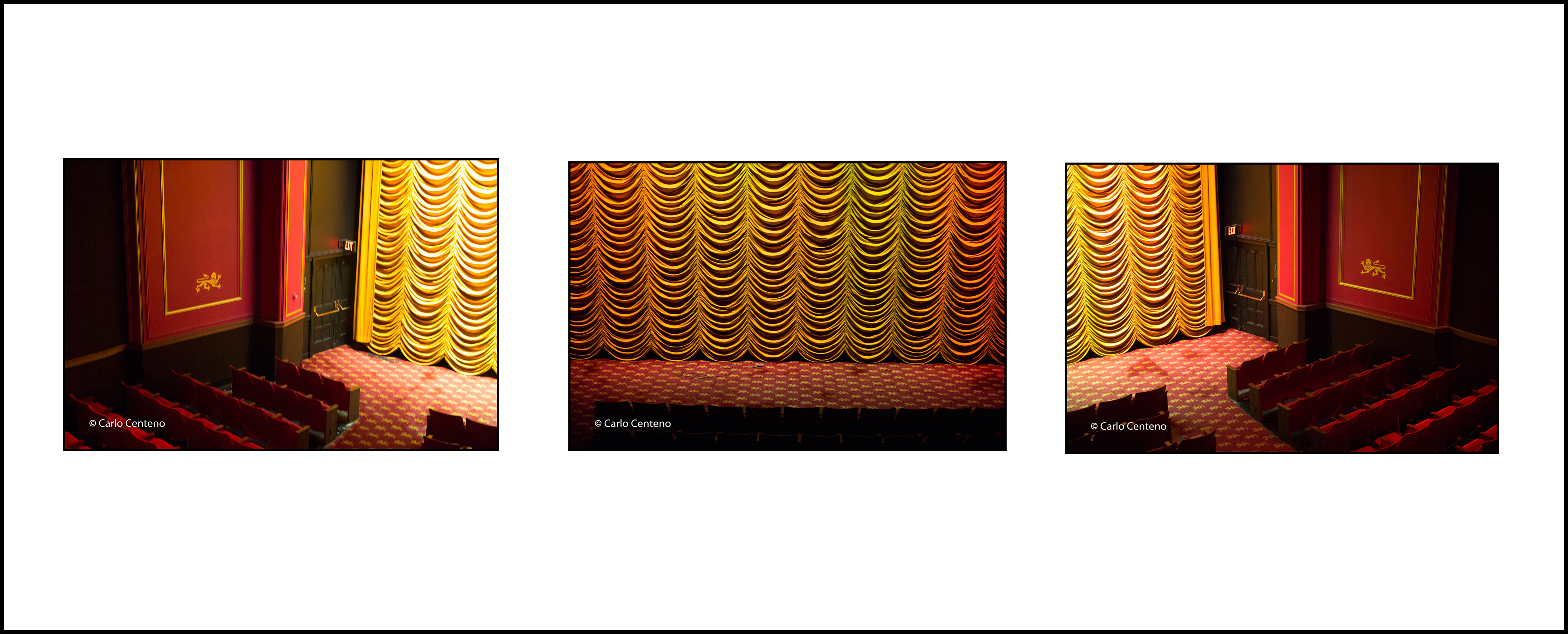 Contrary to the expression, “it is what it is,” I’m reminded that many things in our day-to-day lives aren’t what they appear to be. What it is, is often isn’t.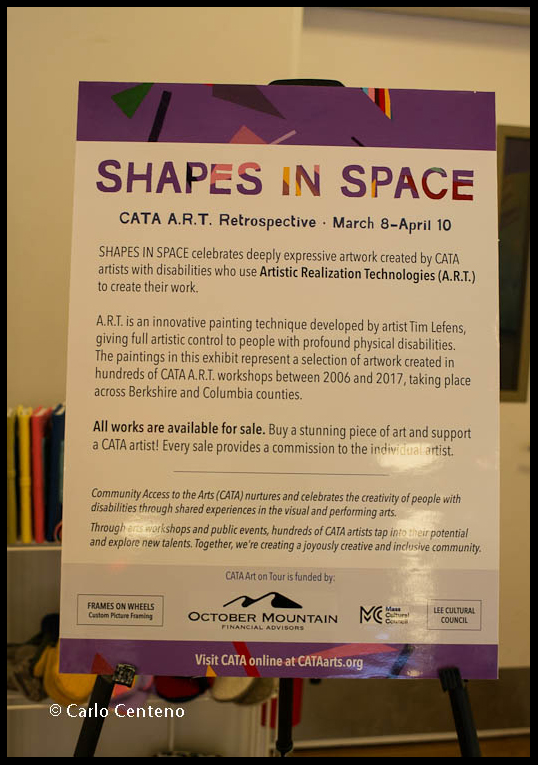











 Carlo Centeno