You can think of this post as part 2 of my previous one from about a week ago, Get Closer…but then again, what follows could be superfluous. Maybe. Each day our routines bring us across many familiar and common objects. Most of what we see barely catches our attention. A lot falls under the category of habitual repetition. However, if you put that aside, the what you see notion can change things.
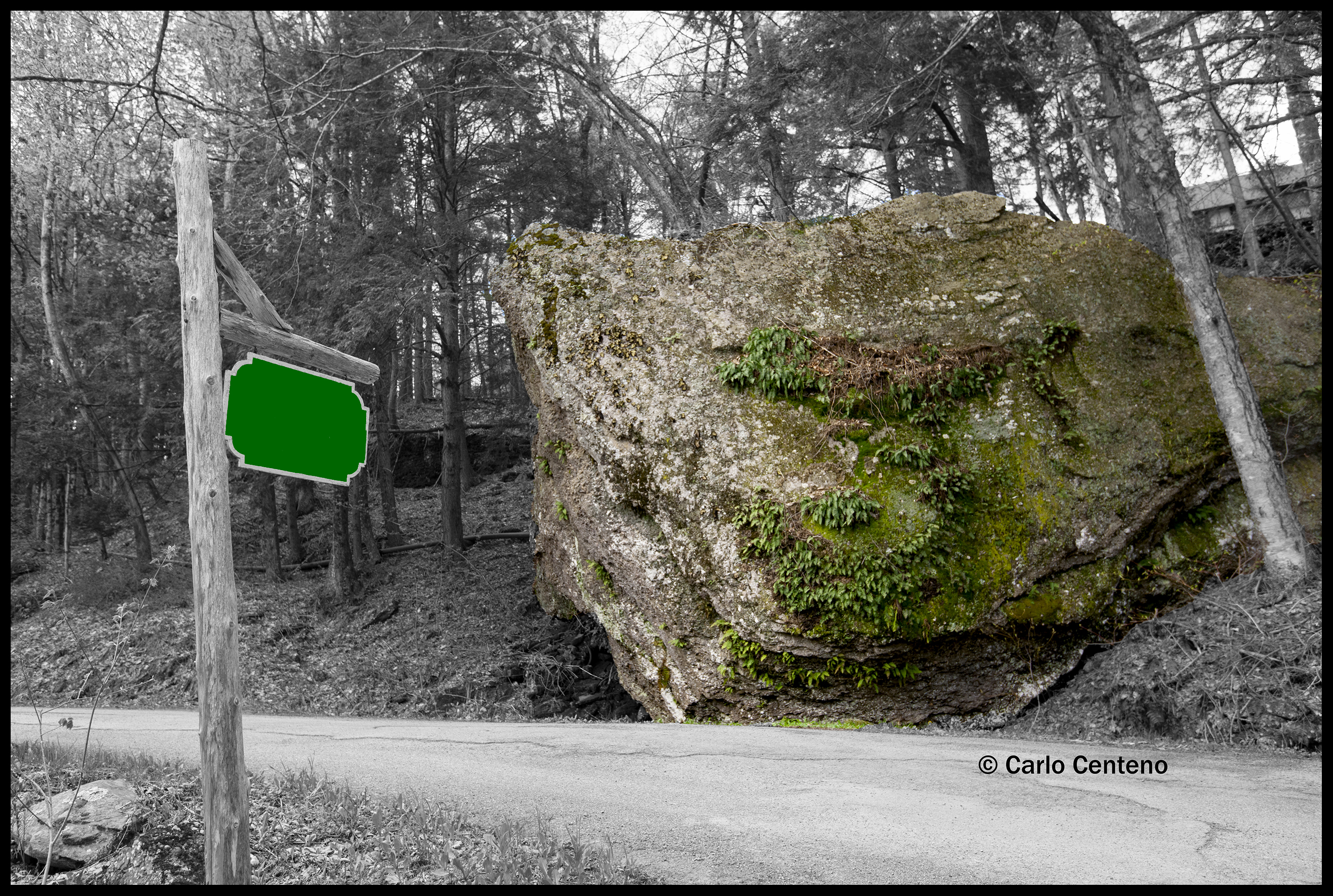
Anyway, regardless of which direction you’d be walking, you can’t miss the humongous rock, pictured above, resting next to a dirt road.
On a 1:1 scale, the size of this layered wonder from the Ice Age is massive. Around it and along the road, various homes stand proud against the various inclines, each perhaps possessing an immunity to gravity. Most of these homes have been around for generations.

“Follow the road up to the top. The vista is spectacular and you’re likely to get some good photos. Look for Pebble Rock Hill Road and keep an eye out for an unusual pebble.” Pebble’s eponymous road invites travelers to head to the top. Of course while on route, I had to stop to examine that “pebble” leaning into the hill.
I’m reminded of Jonathan Swift’s timeless novel, Gulliver’s Travels. In his travels, our protagonist arrives at Lilliput where all its inhabitants–are quite small–whereas Gulliver is a giant. This timeless tome may not be a summer beach read, but the arc of the novel deals with the vagaries of politics, the human condition, scatological humor and so forth. BTW, the first and only time I heard the word “scatological” was during my high-school sophomore class in English Literature. Go figure, and go Google it. The novel was first published in 1726.


Close to 300 years later, I’m certain Mr. Swift would have asked the same question of us: tell me, what do you really see…? There are times when I’m so immersed with what’s in front of me that when the camera comes up, I’m [figuratively] within the frame, scanning everything in the viewfinder.
Where’s the photo? Why am I taking a photo? What do I feel? What do I see if anything other than the obvious? Is it worth it?

Back in the days of film, most of us were pretty frugal with the number of frames we took of any subject let alone everything else. There were no preview screens to check on what you and the camera were looking at. Polaroid cameras were the analog version of confirming a shot. Today, however, it seems that others have already introduced their own Polaroid type-instant films.
When I developed my B&W films, the process felt rote at times, but when the timer was close to the end, my feelings changed to ones of anticipation, expectation and doubt.
It’s different today, obviously, but waiting and expecting to see B&W negatives had an aura all its own. Time gained additional significance because each frame was but one slice of a moment.
Digital capture can take the same slice of time, but it also offers instantaneous validation and the opportunity to take a good a number of retakes, each being instantly accessible to view. Picture taking has certainly evolved; I know many who have a boatload of jpegs on their mobile phones and tablets. A lot.
There’s some truth about the way film cameras slow down the picture-taking process; and for a group of film devotees, you could say it does something similar to some of our behaviors.



Sunsets and sunrises have been with us time immemorial. With or without a camera, they fascinate us. It’s all about the light and the way it changes–and rather quickly–to the familiar sunny or cloudy sky. The sky then becomes its usual self, an unevern canvas of grey or light grey with that hint of white. All of those visual details make it beautiful: a clear sky, dramatic skies, a storm or front already heading our way, along with whatever feelings that may surface to shape our visceral self.
Here’s to all our moments in our 24-hour lives, and to the details we discover that adds something to the way we see things.
























 Carlo Centeno