When you’re bogged down with writer’s block, creative fog, even brain freeze, what do you do to break free from its hold? Here’s one way to purge the hive of such impediments. Go to an opening, an art exhibit, perhaps one which deals in a medium that you know little of. In my case, think fabrics, paper and ceramics and other materials—either in combination—or crafted exclusively with fabric. An oversimplification, but a few photos can better illustrate the creations displayed at the exhibit, Beauty is Resistance, our Fall Art in the Barn Exhibtion. I was impressed with the inventiveness, originality, concept development, creativity, and overall execution of the various pieces.
At browngrotta arts, co-curators Tom Grotta and Rhonda Brown have managed original art, crafted by internationally recognized artists for more than 3 decades. My “introduction” to the pieces of art at this exhibit was an A-1 engagement of diminishing my brain fog, creative block and so on. Neither words nor photos can describe the pieces. This is a case of what I actually see and feel is amazing, because of what is physically in front of me. A demonstrative be-in-the-moment activity, to say the least. So, please take a moment to peruse a small sampling of what was on display.
A special thank you to Tom Grotta and Rhonda Brown for their hospitality and sharing their knowledge about the artists, the scope of this exhibit and their anecdotes of life in international Art. Photography: courtesy of Tom Grotta. All rights for the images and the Art are those of the artists.
Home artist Lija Rage; mixed media, wooden sticks, linen and copper [2-panels; detail shown in second image].
From Chaos to Reality artist Aleksandra Stoyanov; sisal, cotton
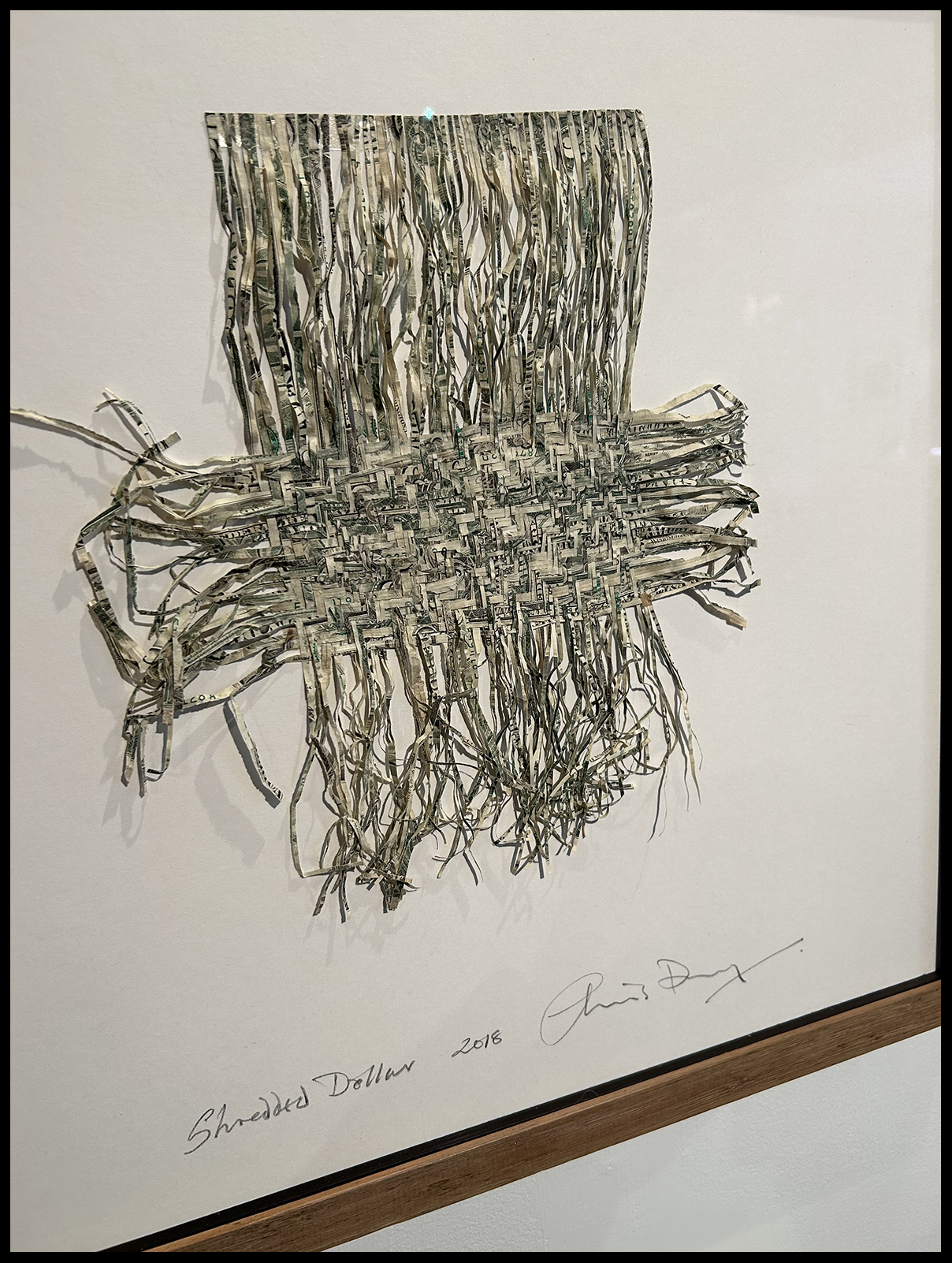
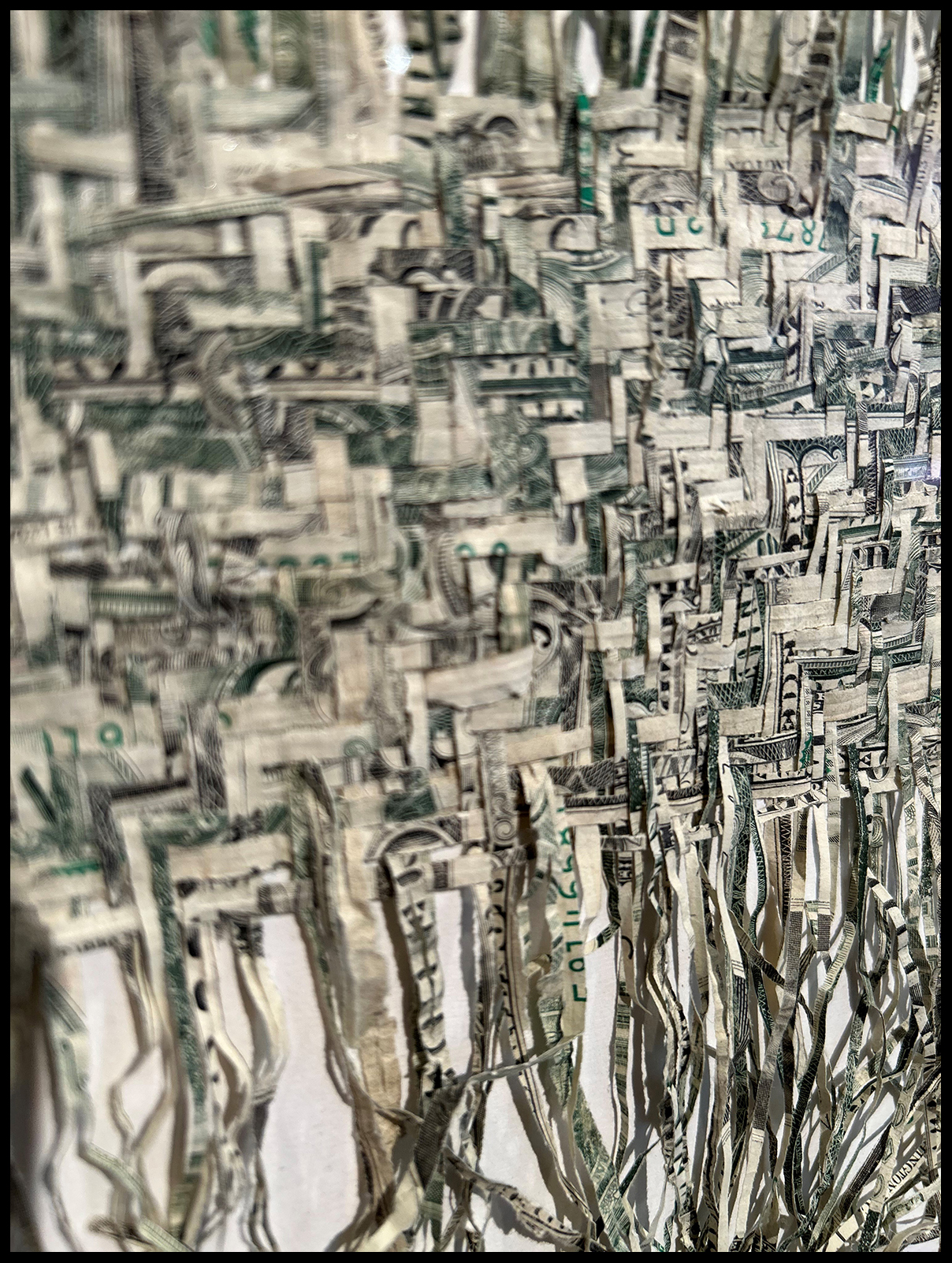
Shred dollar artist Chris Drury; US currency [detail shown below]
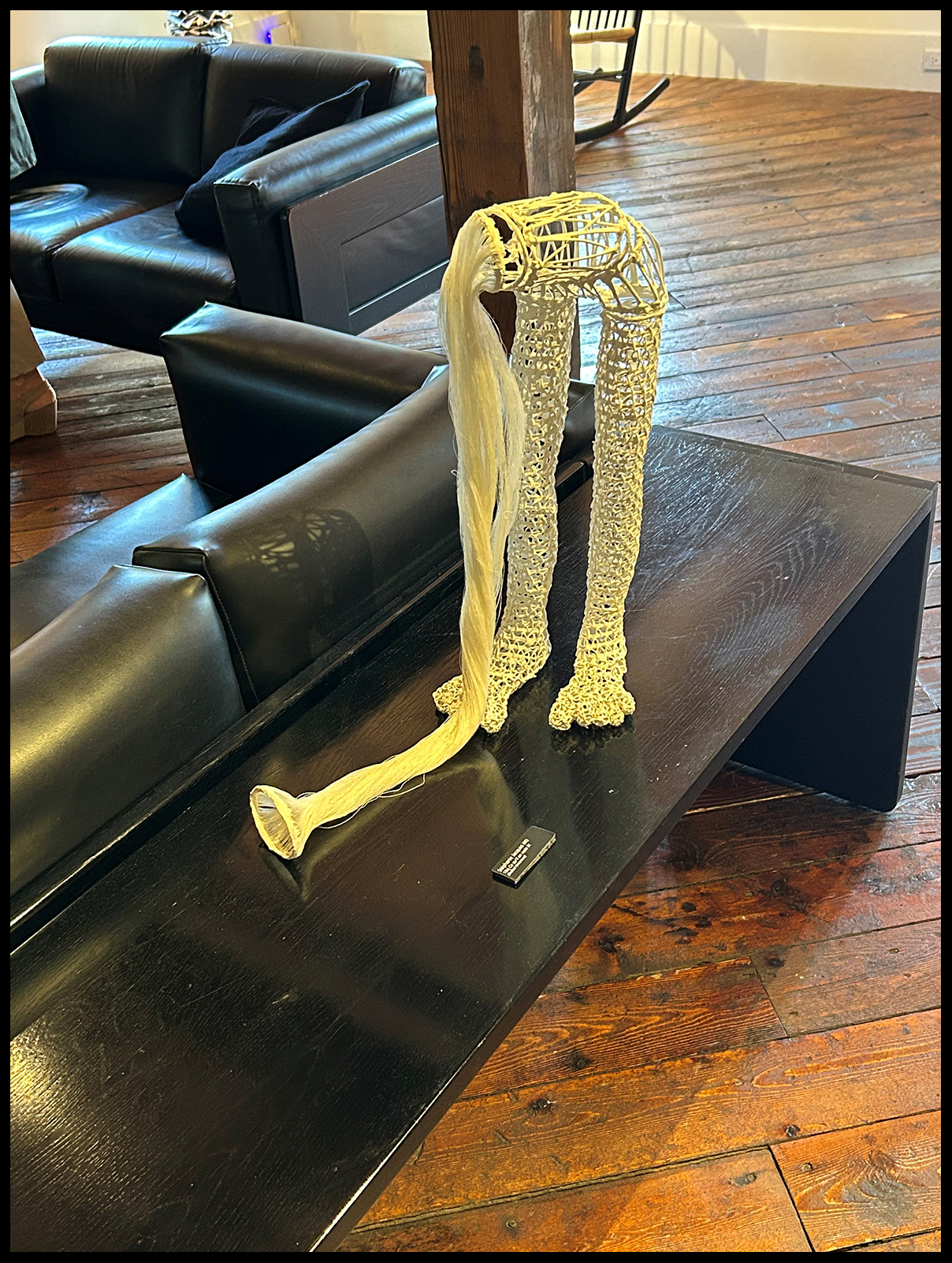
Female Husk II artist Anda Klancic; torso [from Momento Mori composition] with cone; palm tree bark, synthetic filament, acrylic, and metal wire
Ce qu’il en reste IX artist Stephanie Jacques; willow, gesso, linen thread
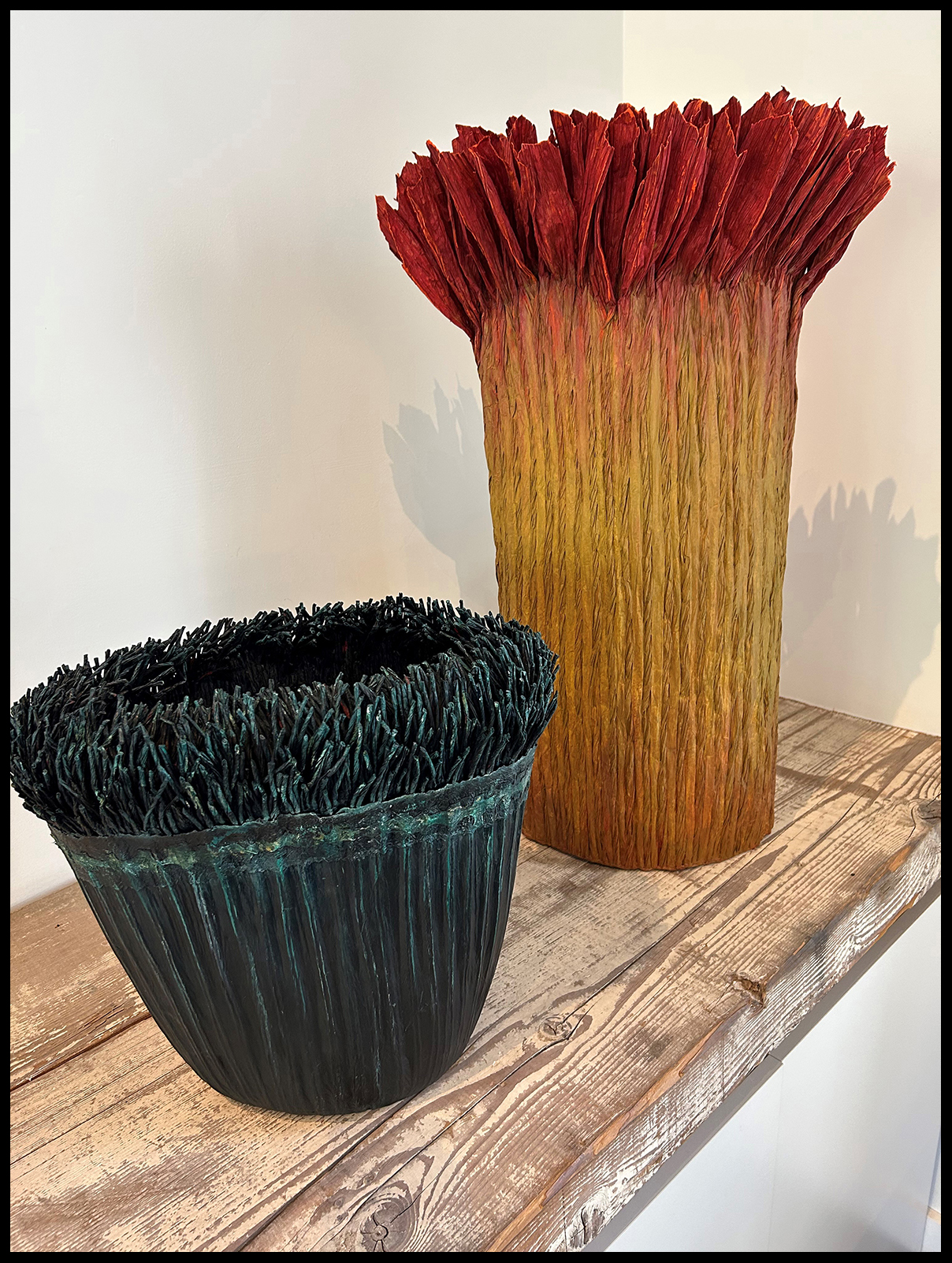
Flower Colors artist Mary Merkel-Hess; paper, cord, paper
Rhonda Brown co-curator
Tom Grotta co-curator
Photography a professional photographer, Tom Grotta created a display showcasing some of the literature and gear he has used through his ongoing career.
Back in the day, “soliloquy” was a word associated with theatre. There have been some powerful, mindful soliloquys, many found in English Literature. William Shakespeare and Robert Browning come to mind; the former for his plays, Browning for his poetry.
I find myself tuning into my inner self with soliloquys. These are not conversations to me, but a way to be honest with myself. In the process, I voice [in my head…..not out loud]. the deepest feelings which need to be brought out from the inner sanctum of my soul. These sentiments, perceptions and more, represent a personal unspoken anthology of emotions which remain exclusive to myself. Everyone should try their own form of soliloquy. You become the subject as well as the audience. The orator speaks to the most relevant, but private person in his/her life.
A recent trip to the Massachusetts Museum of Contemporary Art [MassMOCA] located in North Adams, MA is one location that gave an opportunity for reflection and acknowledgement. Come to think of it, most any museum makes a strong location for a soliloquy. Other alternatives abound: a beach, a park, a forest, a solitary space, even a space filled with people. The options are varied, but I do believe, like the soliloquys expressed in plays, poems and so forth, a place relatively quiet proves hospitable to many. A calm atmosphere is a priori given the breadth of one’s soliloquy.
Where ever you stand, and what ever you see, there lies a confluence of provocations that may come to the forefront of your thinking or introspection. The time stamp—from which these thoughts come from—depends on its significance: an early relationship gone awry; a current relationship that seems too good to be true; the unknown realm in choosing one option over another; the challenge of working through options in light of a chronic condition that will not stop let alone disappear. There’s a universe of profound feeling and thinking we can only imagine.
The above photos are from the MassMoCa’s permanent exhibit, The Boiler House. When you walk into the building, you’re visually overwhelmed with the scale and the number of boilers, pipes, connectors and vents that course over the entire space. If there ever was a place that made me feel Lilliputian, this is at the top of my list. The Boiler House is the facility that provided heat to all the space before it became MassMoCa. There are several floors, though I believe only the first 2 are open for visitors.
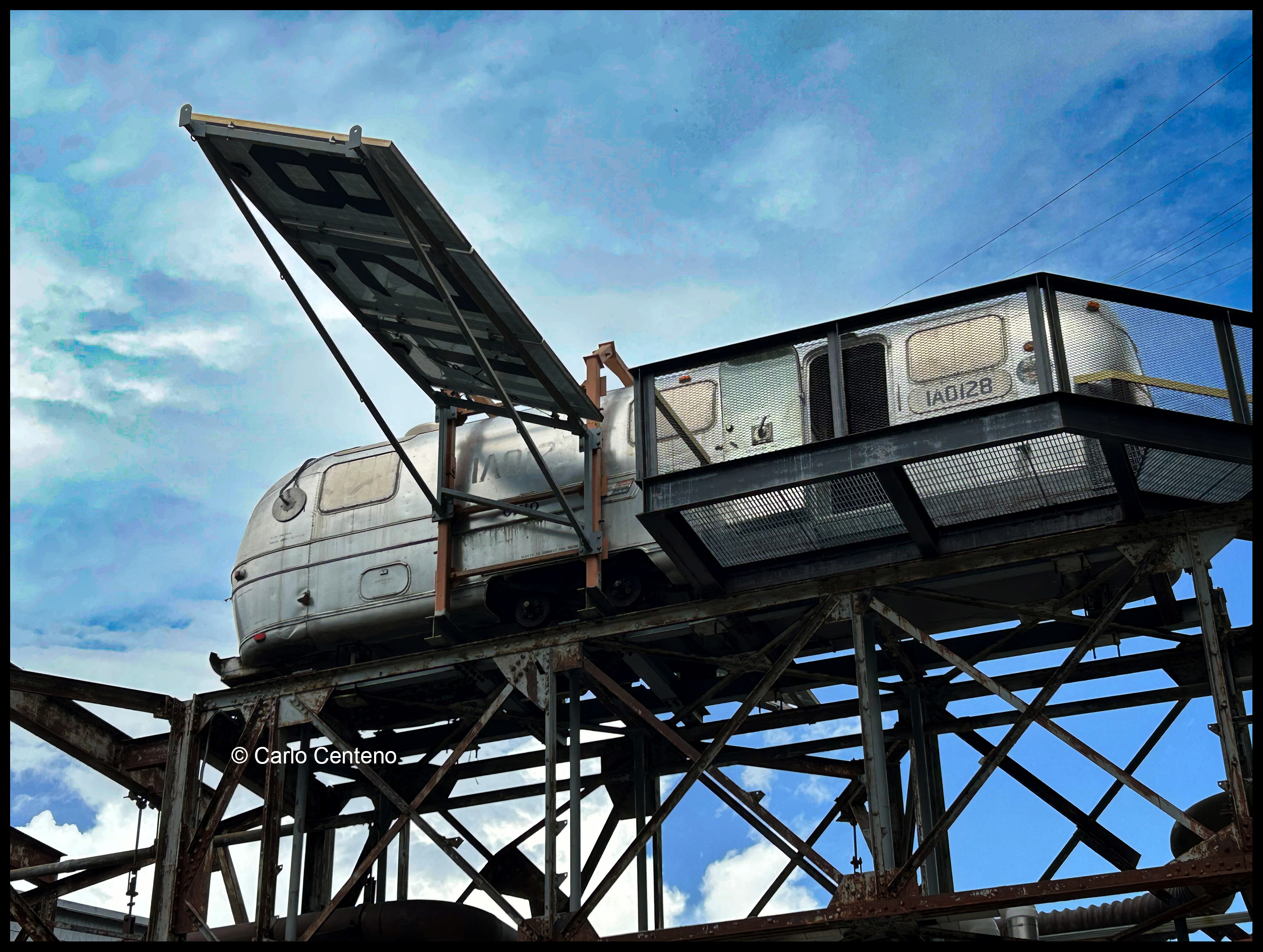
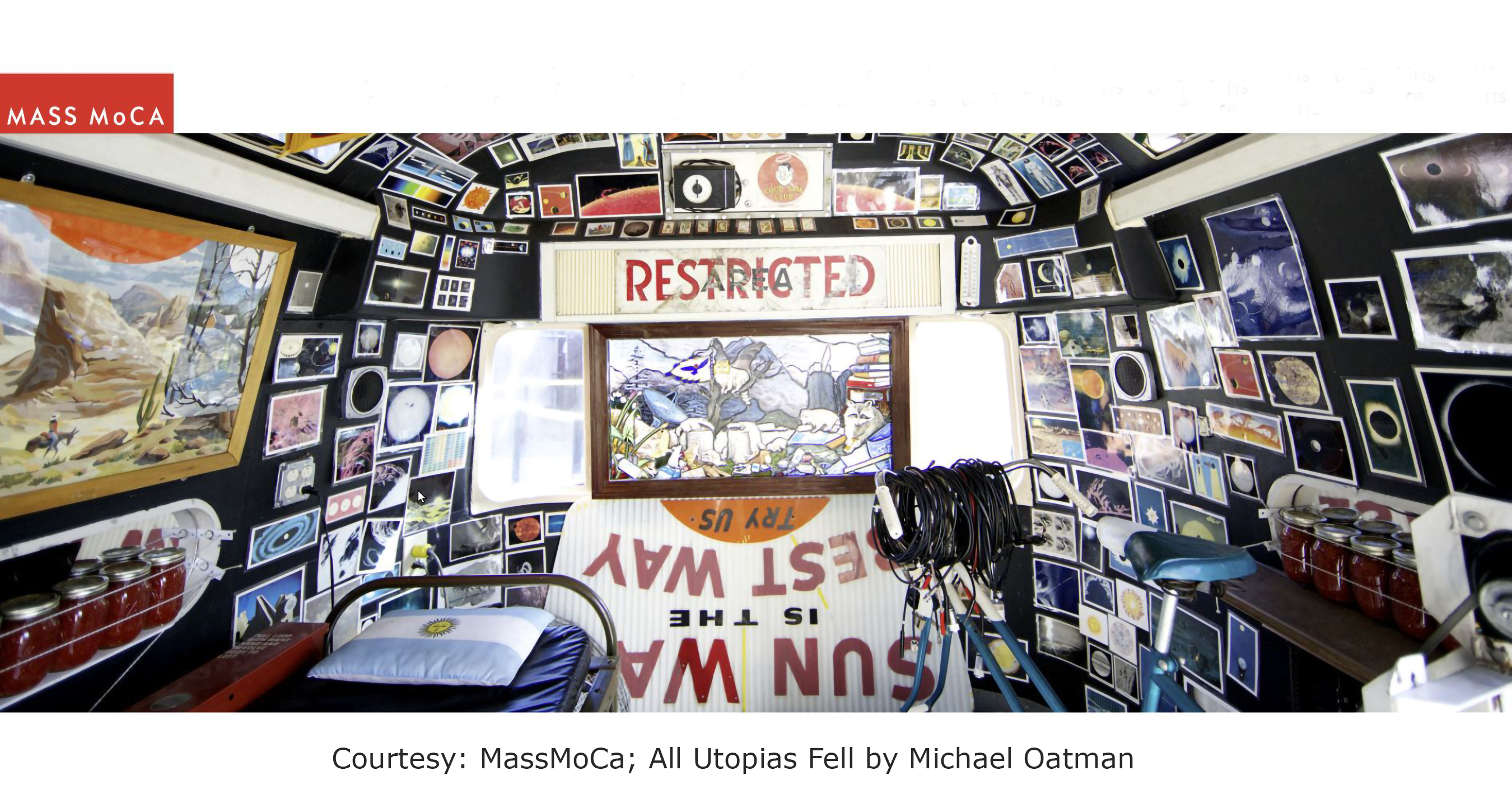
Suspended on tracks next to the Boiler House is an Airstream trailer. A walkway takes you to and from the Airstream to the Boiler House. This is the work of Michael Oatman, entitled “All Utopias Fell.”
A common theme in my soliloquy is this search for order and purpose, or a clarification of both. This is a challenge as I tend to overthink, excessively evaluate one over the other. Upon entering the Airstream, a myriad of visual elements reach out to you. It’s as if each photo, drawing, sign, piece of paper, object and so much more want to make mental impressions on you, as in right now. This is sensory overload and perhaps a metaphor for the soliloquy stirring in your thinking. It’s as if each piece could be a catalyst for a specific thought process. And once that piece or pieces enters your thinking, you start that introspection or make it progress to another level.
There are several “Why this?” and “What ifs?” within the profound, introspective construct of choices and decisions that are created. The certainty of being your own person, unique and unduplicated by any other, is that choices and decisions you make create the questions that begin with “why” or “what.” And while you and others are individuals in that singular sense, the framework of questioning is common for everyone, but ancillary circumstances are bound to differ between people.
Dr. Faustus, the play written by English dramatist Christopher Marlowe, revolves around the angst of Dr. Faustus agreeing to surrender his soul to the devil in exchange for magical powers. His soliloquy in the last hour before that exchange, is one which poses questions and conditions had the choices Dr. Faustus made were different. Once made, the commitment is binding, non-negotiable. There are no pause, stop or rewind buttons in life.
Shakespeare’s Hamlet is the quintessential soliloquy in my opinion. With new realities [and previous uncertainties] playing out today, themes of life & death, the meaning of our purpose and existence, mortality and vengeance are wonderfully distilled into words that examines all that can detract or enhance our existence.
I came across the last photo as I finished my visit to the Boiler House. It dawned on me that this effigy is a personification of someone covered with details that make up her/his soliloquy.
Time I spend at a museum of fine arts is about as cathartic an experience I can think of. Indeed, cathartic art is an emotional salve that can ease the burden of feelings that keep you down. For someone with dysthymia–like myself and others–engaging in positive activities helps mitigate the weight of dysthymia [Persistent Depressive Disorder]. PDD is not as well known as MDD [Major Depressive Disorder], but the former has less severe yet more persistent symptoms of depression.
With all that’s been bombarding us [unfortunately many instances are not positive] in our day-to-day, we can manage that which irks us and steer thought and action toward positive choices, which in turn can help generate positive thoughts and feelings. Some choices I lean to include blogging, letter writing, playing the piano, tennis, family time and more.
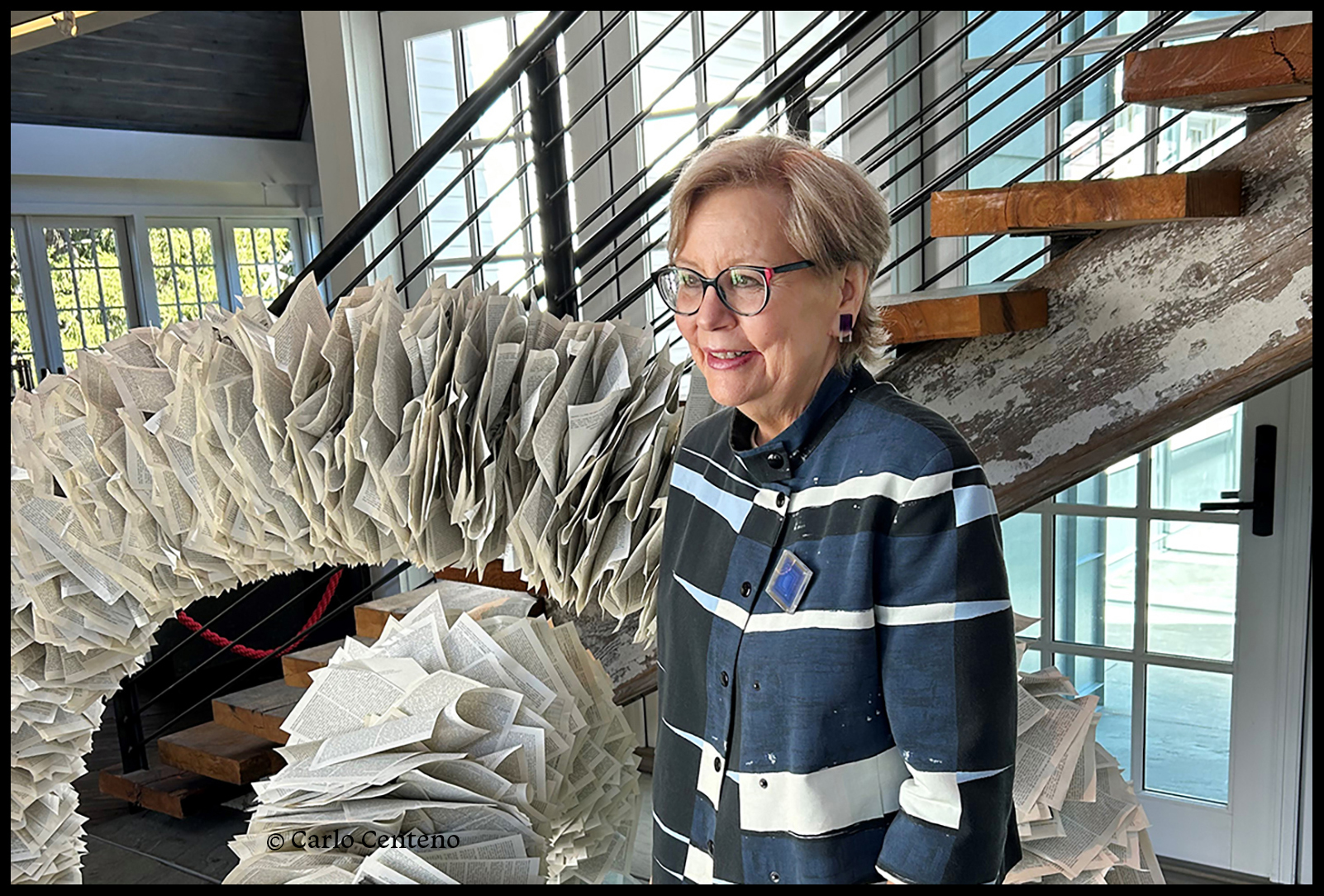
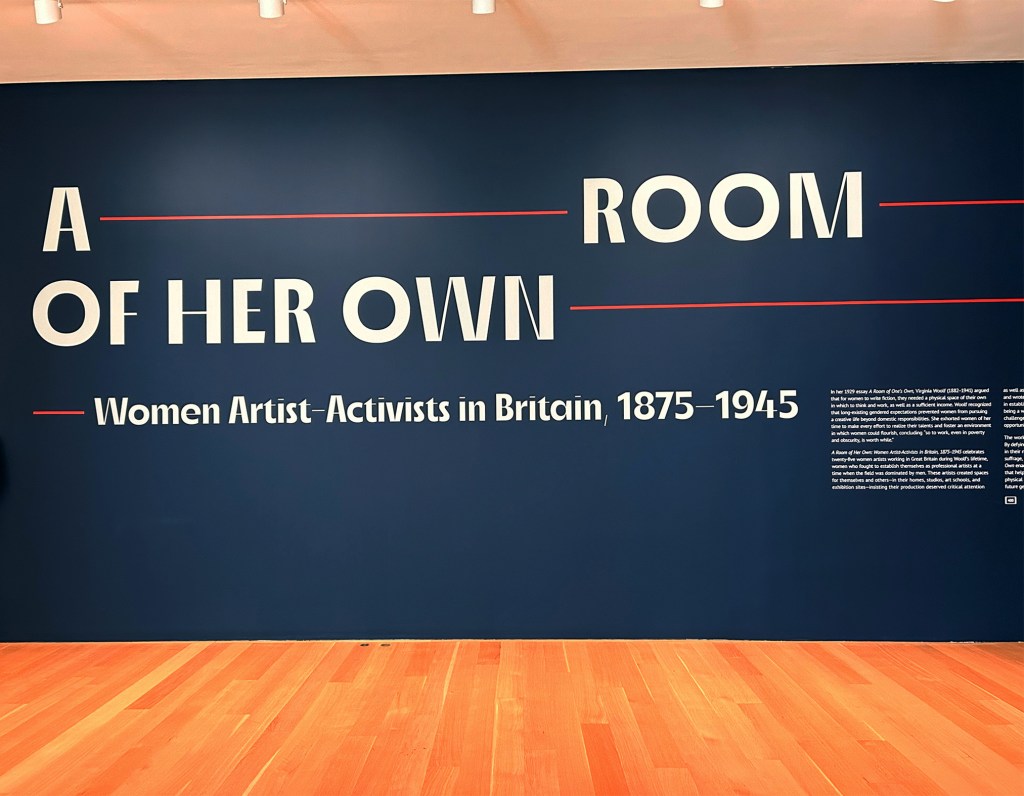
Recent family time with my 2 grown daughters, their husbands, children and their dogs percolated this thought: Both women and their spouses have full schedules with work, raising a family [includes a dog per family], volunteering etc. so then, how do these 2 women have a Room of One’s Own? I credit the exhibit now at the Clark Institute of Art, A Room of Her Own: Women Activists-Artists in Britain, 1875-1945, for germinating that thought surrounding my daughters. I encourage you to experience this exhibit; it runs until September 14, 2025.
The 1929 essay, A Room of One’s Own, was written by Virginia Woolf. You can see the tie between the title of the essay and the name of the exhibit. And if you read Ms. Woolf’s essay, all the better.
Photos taken, courtesy of Clark Institute of Art
Consider this post a “trailer” for the exhibit. It’s worth the trip, and not just for the love of art, but that of expanding our perspectives as well our own sensitivities toward women.
EPILOGUE For additional perspective with respect to women in the workforce please refer to the Women in the Workplace 10th anniversary report [published September 17, 2024 by McKinsey & Company]
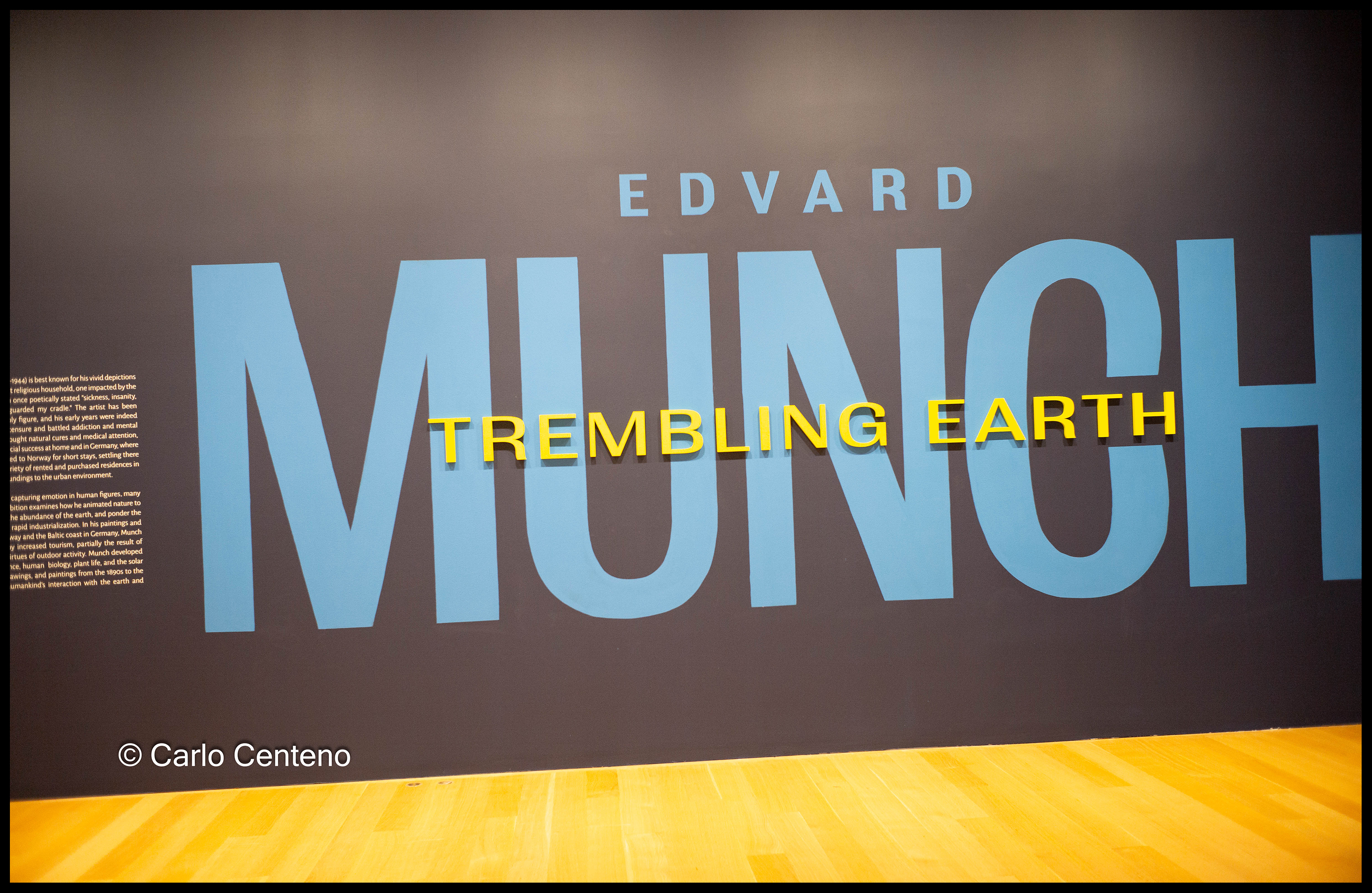
At the Clark Institute of Art, running through October 15, 2023, is a special exhibition, Edvard Munch: Trembling Earth. Munch’s [“Edward Moonk” Norwegian pronunciation] most recognizable, iconic painting is The Scream, and yet not many know of his other work which includes a number of self-portraits, prints, figure portraits and landscapes. The latter showed what he felt was a confluence of the natural world and humankind where nature provided a kind of salve that the urban environment could not deliver. The artist’s life contained the antagonists that shaped many of his creations: life and death; love and loss; loneliness and despair. And yet Munch as a protagonist, allowed us to see and feel the very antagonists that took hold of his deepest emotions.
I found the entire exhibit revealing if not eerily prescient. The power of art in all its forms allows us not to just see the obvious, but to measure if not ascertain a) what behooved the artist to produce his/her creation and b) what, if anything, draws your attention to the work?
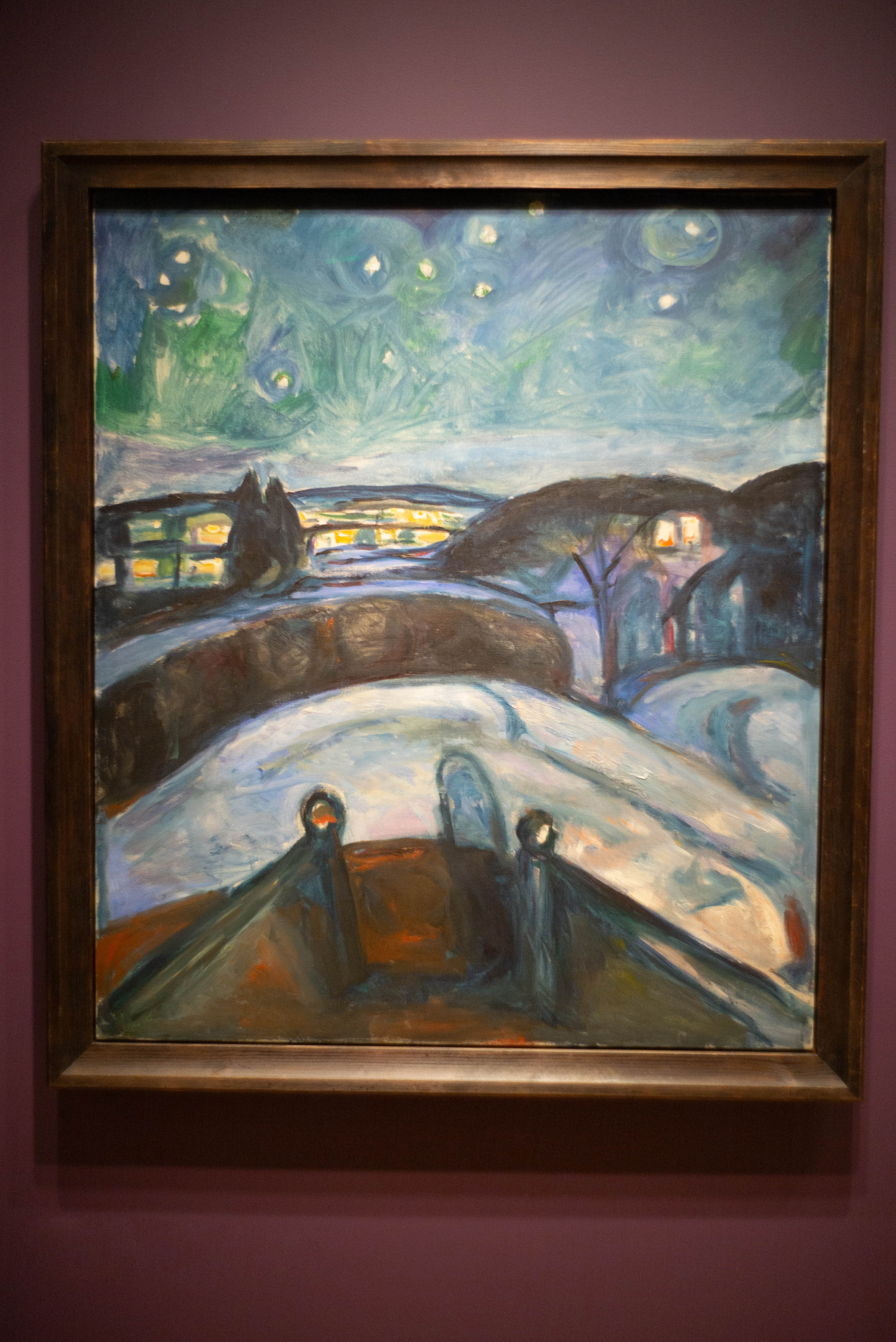
Starry Night, 1922-24
While some of his paintings hint at Vincent van Gogh [1853-1890], there is a quality that makes Edvard Munch’s work stand apart: his apotheosis of anxiety, loneliness, longing and loss are indicated by the despair of his faceless human subjects. The hue of uncertainty and angst lay claim to troubled souls.
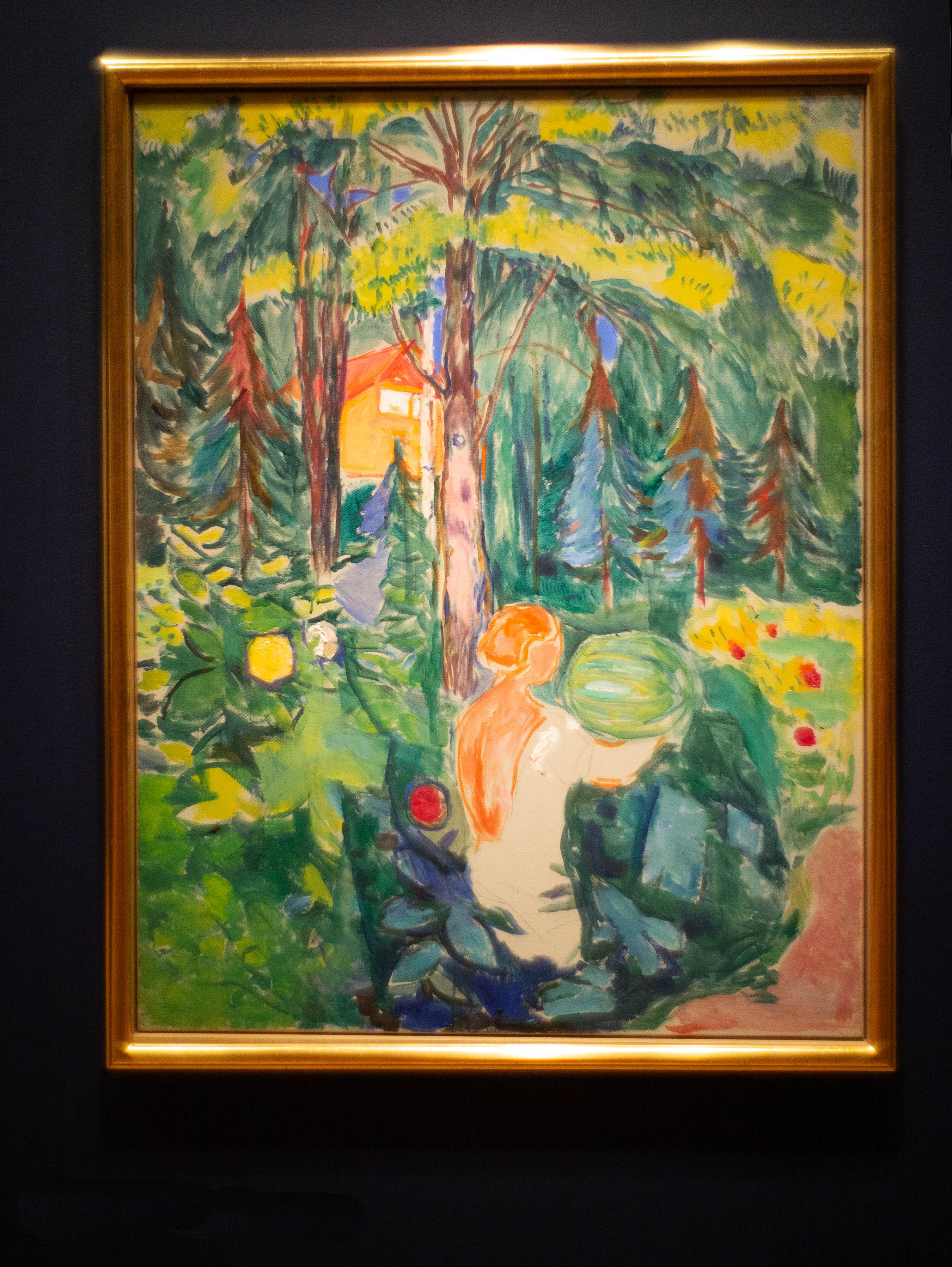
Woman with pumpkin, 1942
This is one of my favorite paintings, Woman with pumpkin. Its creation captures a sense of lost, and longing. The symbolism could be anything and everything. The pumpkin and the dark green color appear as if a person is holding the woman. Note the 3 “fingers” on the hip of the woman. In fact, the greenery next to the woman appears to be kneeling on its right knee, its “left leg” bent with a “foot” planted directly on the ground close to her back. Hence, the figure is resting its head on the woman’s right shoulder, the right arm suggesting a pillow.
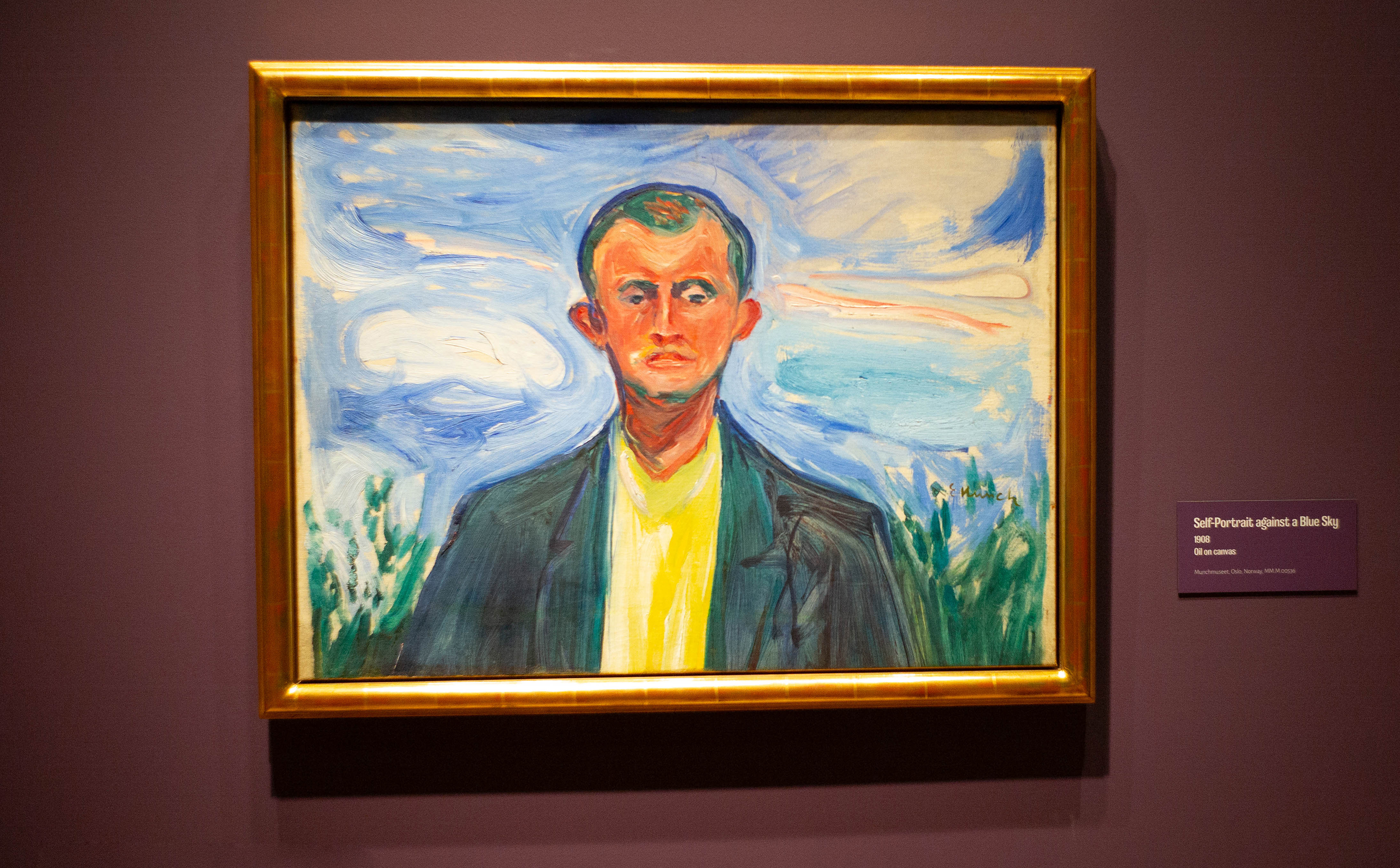
Self-portrait, 1908
Whatever you see and however you see it, Munch is a captivating study of conflict. You can feel it in most all of his works. The landscapes provide contrasts regarding our ability–and inability–to co-exist not only with the natural world, but with each other. Put another way, Munch is caught within an insatiable push-pull between the Id [our instincts], the Ego [reality] and the Superego [moral strength].
Self portrait with palette, 1926
No artist lives a life of order and predictability. It’s contrarian to that world of creativity and expression. Munch’s self-portraits demonstrate a fortitude within his reality that dices with the likes of the Id and the Superego. Each of us deal with the instability created by our instincts and morality, our actions and reactions, our angst and distress. In a way Munch’s paintings brings form to what is often abstract yet palpable, even vicarious and visceral.
Many artists come to mind when the genre of surrealism becomes a topic for discussion–or bone of contention–but Salvador Felipe Jacinto Dali y Domenech is one that occupies a notable position in the annals of imaginative imagery and surrealistic interpretation.
The Slave Market & Disappearing Voltaire
If your preferences lean toward realism, then Dali can and will, leave you wondering why such creations are in a museum, indeed, an eponymous one at that. Art is Art and its value depends on so many areas of technical and aesthetic measures. For the rest of us mortals, subjective interpretation is all we can muster. I overheard someone trying to understand one of his paintings and his somber remark was, “Salvador Deviant.”
Portrait of deceased brother if he lived to be an adult.
Art is what you make of it. It means you can be apathetic, sympathetic, curious, appreciative, angry, happy, bewildered, uncertain, confident, disappointed, insulted, overwhelmed, inspired or even validated.
You have to appreciate his creative genius when you’re pulled into one of his canvases only to be taken aback when the image changes. In one moment you see 2 nuns, then a blink later, you suddenly see a face made in part by the same 2 nuns [cf first image above for Voltaire].
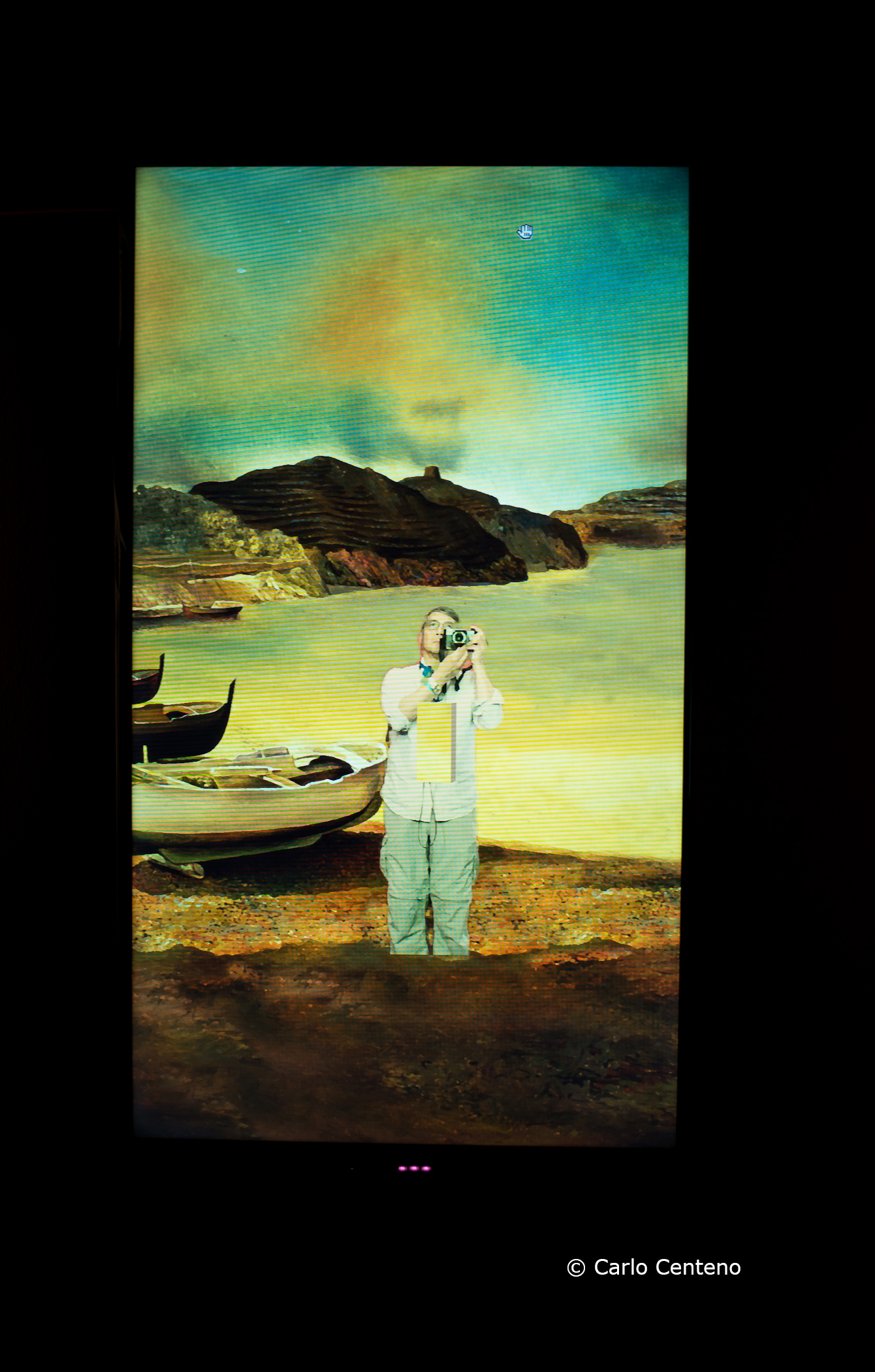
Interactive self-portrait.
My self-portrait is an interesting take on a photo booth, but one more entertaining if not interesting. In a way I’m borrowing a slice of time from Dali’s world. A simple souvenir for me, though I suspect Dali would’ve seen a leitmotif kindred to the impertinence and sarcasm of his painting, Persistence of Memory.













 Carlo Centeno